
A Practical Guide to Buying Durable 2K Clear Coat
Choose a Durable 2K Clear Coat for a Finish That Lasts

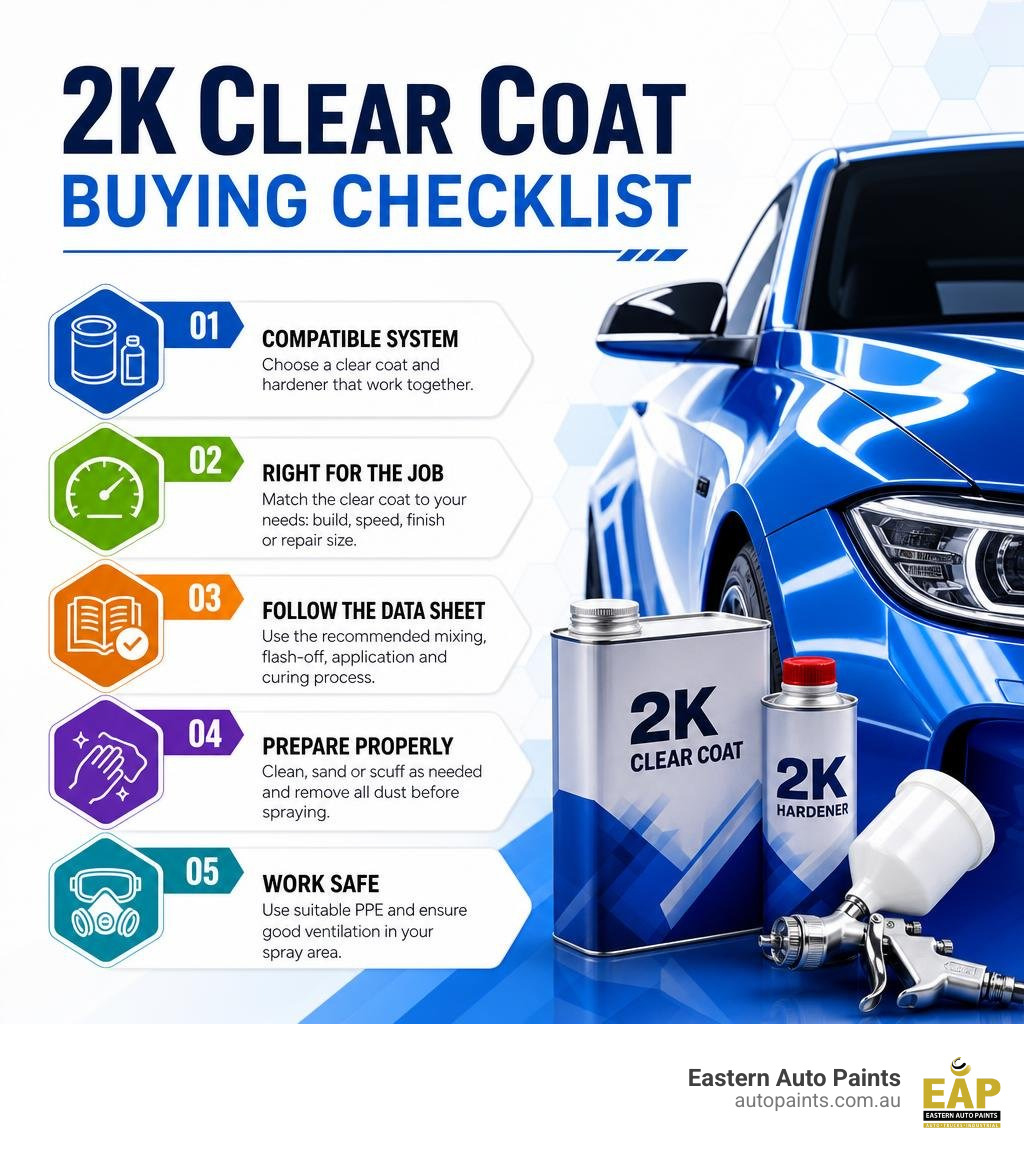
A good 2K clear coat can give a repaired or restored panel a smooth, high-gloss, chemically resistant finish when it is matched to the paint system and applied correctly. A poor choice, rushed preparation, or incorrect hardener can leave a finish prone to poor flow, loss of gloss, solvent reaction, or premature failure. Start by choosing a compatible clear and hardener, preparing the colour coat within its recommended recoat window, and using suitable personal protective equipment (PPE) and spray-area ventilation.
Key Takeaways
- Choose a two-pack (2K) urethane clear coat for chemically cured durability, rather than relying on solvent evaporation alone.
- Match the clear coat to the job, whether you need high build, rapid curing, easy flow, satin, matte, or a small spot-repair solution.
- Follow the product technical data sheet for mixing, flash-off, application and curing requirements.
- Prepare panels carefully by cleaning, sanding or scuffing where required, then removing dust before spraying.
- Explore our 2K clear coat range to compare suitable options for refinishing work.
At Eastern Auto Paints (EAP), we help trade applicators, restoration enthusiasts and serious DIY painters select coating systems that suit the vehicle, repair size and workshop conditions. We focus on practical product guidance, from clear coat selection and compatible additives through to the equipment and preparation materials needed for a reliable application.
Our core value is straightforward: durable finishes come from informed product choices and disciplined process control, not guesswork. Whether you are clearing a repaired panel or planning a full repaint, we aim to make the next decision clearer and help you build a finish that performs as intended.
Understanding 1K vs 2K Clear Coat Formulations
Selecting the correct topcoat formulation determines how well a vehicle surface withstands environmental exposure, mechanical washing, and daily wear. Clear finishes generally fall into two categories: single-component (1K) and two-pack (2K) formulations. For a broader look at modern resin choices, our guide Does It Really Matter? The Ultimate Guide to Automotive Clearcoats covers the fundamentals in detail.
| Feature | 1K Acrylic Lacquer Clear | 2K Acrylic Urethane Clear |
|---|---|---|
| Curing Mechanism | Physical solvent evaporation | Chemical cross-linking via hardener |
| Chemical Resistance | Sensitive to petrol, thinners, and harsh solvents | Highly resistant to automotive fluids and fuels |
| Mechanical Toughness | Moderate scratch resistance; softens with heat | High scratch, chip, and abrasion resistance |
| UV and Gloss Stability | Requires frequent polishing and maintenance | Long-term gloss retention and built-in UV blockers |
| Primary Use Cases | Quick touch-ups, light-duty projects, test panels | Full vehicle resprays, collision repairs, restorations |
Single-Component Clearcoat Characteristics
Single-component finishes dry purely through the evaporation of active solvents into the surrounding atmosphere. Because no chemical activator is present to form permanent molecular bonds, the resulting resin film remains susceptible to re-softening when exposed to strong automotive solvents, fuel spills, or high ambient heat.
Products like Dulon 1K Premium Clearcoat serve specific roles where rapid air-drying without mixing hardeners is desirable. You can consider dedicated single-pack clearcoat options for light-duty projects, hobbyist tasks, or situations where convenience is the primary objective.
Two-Component System Advantages
Two-pack systems rely on an acrylic urethane base combined with an isocyanate-based hardener. When combined, an exothermic reaction creates a dense three-dimensional cross-linked network across the substrate.
This structure provides exceptional petrol resistance, long-term UV deflection, and defence against stone chips and physical abrasion. For professional automotive refinishing and durable vehicle restorations, selecting quality two-pack formulations ensures you achieve an OEM-level protective shell that maintains gloss stability over many years.
Key Factors When Choosing the Right 2K Clear Coat
Selecting the right clear coat requires evaluating shop airflow, climate, job scale, and desired film thickness. To explore how different formulations match workshop setups, see our guide From Aerosol to Industrial: Finding the Perfect Clear Coat for Your Needs.

High-Solid 2K Clear Coat Formulations
High-solid (HS) formulations feature a high concentration of resin solids relative to volatile solvents. This formulation yields higher dry film build per pass, reducing overall shrinkage while delivering high gloss depth and optical clarity.
When you'd use this:
- Concept HS Pro Clear 3-1: Formulations like Concept HS Pro Clear 3-1 are suited for complete vehicle resprays and premium custom builds where maximum depth of image, gloss retention, and weatherproofing are primary objectives.
- HS 2K Eurolak Clear 3-1 Low VOC: Products such as HS 2K Eurolak Clear 3-1 Low VOC provide high resin content while meeting strict environmental standards, balancing finish quality with reduced solvent emissions in commercial spray booths.
Medium-Solid and Rapid Curing Options
Medium-solid (MS) and rapid-curing clears provide balanced flow characteristics and shorter flash windows, making them suitable for busy workshop environments and mobile repair units.
When you'd use this:
- Concept MS-22 2K Acrylic Urethane Clear Coat: An option like Concept MS-22 2K Acrylic Urethane Clear Coat offers forgiving flow-out and straightforward levelling, making it suitable for standard collision work and multi-panel repairs across varying booth conditions.
- 736 Euroflash Clear 3-1 Kit Normal: Fast-drying formulations like the 736 Euroflash Clear 3-1 Kit Normal suit rapid spot repairs and fast turnaround cycles where ambient air drying or short bake windows are required to keep workflow moving.
Specialty Matte and Satin 2K Clear Coat Options
Not every custom automotive finish requires a mirror-like shine. Specialty clear coats utilise microscopic matting agents that scatter light evenly across the surface to produce uniform low-sheen aesthetics.
When you'd use this:
- Concept 2K Satin Clear 4L: Using Concept 2K Satin Clear 4L delivers a semi-gloss sheen that highlights body lines on modern muscle cars, trim accents, and bespoke custom projects without complete gloss elimination.
- Concept 2K Matt Clearcoat: When a zero-gloss, stealth finish is specified, Concept 2K Matt Clearcoat provides uniform light diffusion and durable chemical resistance, protecting underlying basecoats without producing hot spots or patchy sheen.
Canister and Aerosol Solutions for Spot Repairs
For smaller panel blends, wing mirrors, or motorcycle components, two-pack aerosol technology provides factory-grade urethane protection without requiring a dedicated compressor and spray gun setup.
When you'd use this:
- 2K Clear Aerosols: Products like 2K Clear Aerosols incorporate an internal aluminium chamber containing the isocyanate hardener. Activating the integrated bottom pin releases the hardener into the resin chamber, allowing trade applicators and restorers to spray genuine two-component clear coat with aerosol convenience.
Professional Application Process and Surface Preparation
Achieving an unblemished finish requires disciplined prep work and consistent spray mechanics. Our article How to Never Worry About Applying Automotive Clear Coat Again provides practical advice for refining spray technique.

Mixing Ratios and Pot Life Management
Two-component systems require precise chemical measurement. Deviating from specified ratios can cause soft films, wrinkling, or solvent entrapment. Adding appropriate reducers helps balance viscosity against ambient workshop temperatures. Application and drying times vary by product, so consult the manufacturer's technical data sheet (TDS) or product label before starting.
Spray Gun Setup and Spray Technique
Consistent atomisation relies on clean air supply and balanced fluid delivery. Professional painters typically utilise gravity spray guns configured to maintain an even fan pattern across the panel.
When you'd use this:
- Protec Paraglaze Extra Flow Clearcoat: For projects requiring smooth self-levelling, Protec Paraglaze Extra Flow Clearcoat allows applicators to lay down wet coats that spread evenly across horizontal and vertical surfaces, reducing subsequent polishing steps.
- Protec Paraglaze Ultrafinish Clearcoat: When chasing maximum gloss on prestige vehicles, Protec Paraglaze Ultrafinish Clearcoat provides sharp image reflection and high clarity.
Safety Standards and Personal Protective Equipment
Working with two-component urethane clear coats involves handling reactive isocyanates and volatile organic compounds (VOCs). Direct skin contact and vapour inhalation present serious occupational risks that require appropriate physical barriers and active extraction.
Respiratory Protection Requirements
Standard particulate dust masks do not provide adequate protection against organic vapours and atomised isocyanate droplets. Applicators must select appropriate respiratory equipment based on workshop ventilation conditions.
Trade applicators spraying in professional extraction booths often use PPE masks and air-fed equipment connected to certified breathing-air filters. For well-ventilated workspaces, a combination system such as the Sundstrom professional respirator kit paired with suitable gas and particulate filters provides vital respiratory defence. Specific PPE requirements vary by product and application method, so consult the product label, TDS, and relevant Safe Work Australia guidance before spraying.
Dermal and Eye Protection
Isocyanates can be absorbed through skin contact and mucous membranes. Applicators should wear chemical-resistant nitrile gloves, lint-free full-body spray overalls, and sealed safety goggles to create a continuous physical barrier against overspray and liquid splashes.
Why This Issue Should Not Be Ignored
Using an incorrect clear coat or applying the wrong hardener for ambient conditions can compromise the entire paint system. Because the clear coat serves as the front line against solar radiation, acid rain, bird droppings, and abrasive road debris, a failed topcoat leaves basecoat pigments vulnerable to oxidation and delamination. Stripping failed clear coat requires labour-intensive mechanical sanding, significantly increasing rework costs and repair timelines.
Common Symptoms, Challenges, or Questions
Trade painters and enthusiasts regularly encounter application challenges when spraying 2K clears in non-climate-controlled environments. Common symptoms include:
- Orange peel texture: Insufficient atomisation pressure, high fluid viscosity, or fast solvent evaporation preventing proper levelling.
- Die-back and gloss loss: Trapped solvent evaporating through the clear coat surface after initial skinning, often caused by applying coats too wet or rushing flash times.
- Solvent popping: Tiny pinholes formed when heated air or trapped reducer breaks through a rapidly cured surface layer.
- Runs and sags: Holding the spray gun too close to the panel, moving too slowly, or applying excessive fluid volume on vertical surfaces.
What a Personalised Experience Actually Looks Like
Selecting the right coating system is rarely a one-size-fits-all process. A personalised consultation focuses on the specific conditions of your project, including:
- Matching clear coat solids and flow rates to your shop airflow and booth extraction capabilities.
- Pairing slow, normal, or fast hardeners with current seasonal temperatures across Melbourne and regional Victoria.
- Recommending compatible reducers, spray guns, and compressor configurations to achieve fine atomisation.
- Advising on substrate compatibility, recoat windows, and prep abrasives to avoid adhesion failures.
The Value of Consistency and an Ongoing Relationship
Achieving predictable refinish results relies on consistent product chemistry and dependable technical guidance. Developing an ongoing relationship with a dedicated automotive paint specialist ensures that your shop or restoration garage uses matched systems from primer to topcoat. Consistent access to technical data sheets, batch consistency, and experienced advice eliminates trial-and-error, keeping projects running smoothly and within budget.
What to Expect at Eastern Auto Paints
At Eastern Auto Paints, we support commercial body shops, custom restorers, and serious automotive enthusiasts across Melbourne and beyond. When you consult with our team, you can expect:
- Advanced Colour-Matching: State-of-the-art spectrophotometer technology and extensive formulation libraries to complement your clear coat finishes.
- Comprehensive Product Selection: Full access to high-solid clears, rapid-cure systems, custom primers, and factory-matched topcoats.
- Expert Technical Advice: Practical guidance on gun setups, fluid tip selection, pot life management, and curing procedures tailored to your workshop.
- Convenient Victorian Locations: Dedicated service and advice available at our Bayswater and Dandenong South trade counters.
When to Get in Touch or Take Action
If you are planning an upcoming vehicle respray, experiencing finish defects, or looking to upgrade your workshop clear coat system, our team is ready to assist. You can explore our complete automotive clearcoat range online or contact our team directly for tailored advice on products, hardeners, and equipment.
Whether you are refinishing an individual guard or completing a total classic car rebuild, selecting the right 2K clear coat ensures your hard work remains protected for years to come. For further guidance on matching primers, basecoats, and clearcoats, get in touch with our team in Bayswater or Dandenong South, or explore our curated 2K clear coat collection to find the right formulation for your next automotive project.
Frequently Asked Questions About 2K Clear Coat
What is 2K clear coat and how does it differ from 1K clear coat?
A 2K clear coat is a two-component protective finish that relies on a chemical reaction between an acrylic urethane resin base and an isocyanate hardener to cure. In contrast, 1K clear coat cures solely through solvent evaporation. This chemical cross-linking gives 2K clear coats higher resistance to petrol, UV radiation, road debris, and mechanical abrasions compared to single-pack options.
How long does it take for 2K clear coat to fully cure before polishing?
Curing times depend heavily on the specific product formulation, ambient workshop temperatures, hardener speed, and whether heat baking is used. While some fast-curing formulations can be de-nibbed and buffed within hours under force-dried baking conditions, standard ambient curing typically takes longer to achieve full hardness. Always refer to the manufacturer technical data sheet for specific curing windows before compounding or polishing.
How much 2K clear coat is needed to repaint a complete vehicle?
The volume of clear coat required depends on the overall size of the vehicle, the number of coats specified by the product system, the transfer efficiency of your spray equipment, and whether panel jambs are being cleared. Larger commercial vehicles, wagons, and full exterior resprays naturally require higher fluid volumes than compact passenger cars. Reviewing your spray gun setup and product technical documentation helps determine exact material estimates.
Can 2K clear coat be sprayed directly over existing factory paint?
Yes, 2K clear coat can be applied over sound original factory finishes, provided the surface is thoroughly degreased and mechanically abraded to create a secure keyway. The substrate must be free from silicone, wax, and road contamination, and abraded using appropriate fine finishing abrasives or scuff pads. Spraying directly over glossy, unsanded clear coat will lead to adhesion failure and clear coat peeling.
What are the most common mistakes to avoid when spraying 2K clear coat?
Common mistakes include rushing flash-off intervals between coats, deviating from specified hardener mixing ratios, spraying in poorly ventilated or humid environments, and using the wrong hardener speed for current room temperatures. Applying coats too heavily in a single pass can also cause solvent trapping, runs, or pinhole popping, while holding the spray gun too far away results in dry spray and heavy orange peel texture.