
Frame Spray to Prevent Rust: Protect Your Chassis from Hidden Corrosion
Choosing Frame Spray to Prevent Rust for Long-Term Chassis Protection
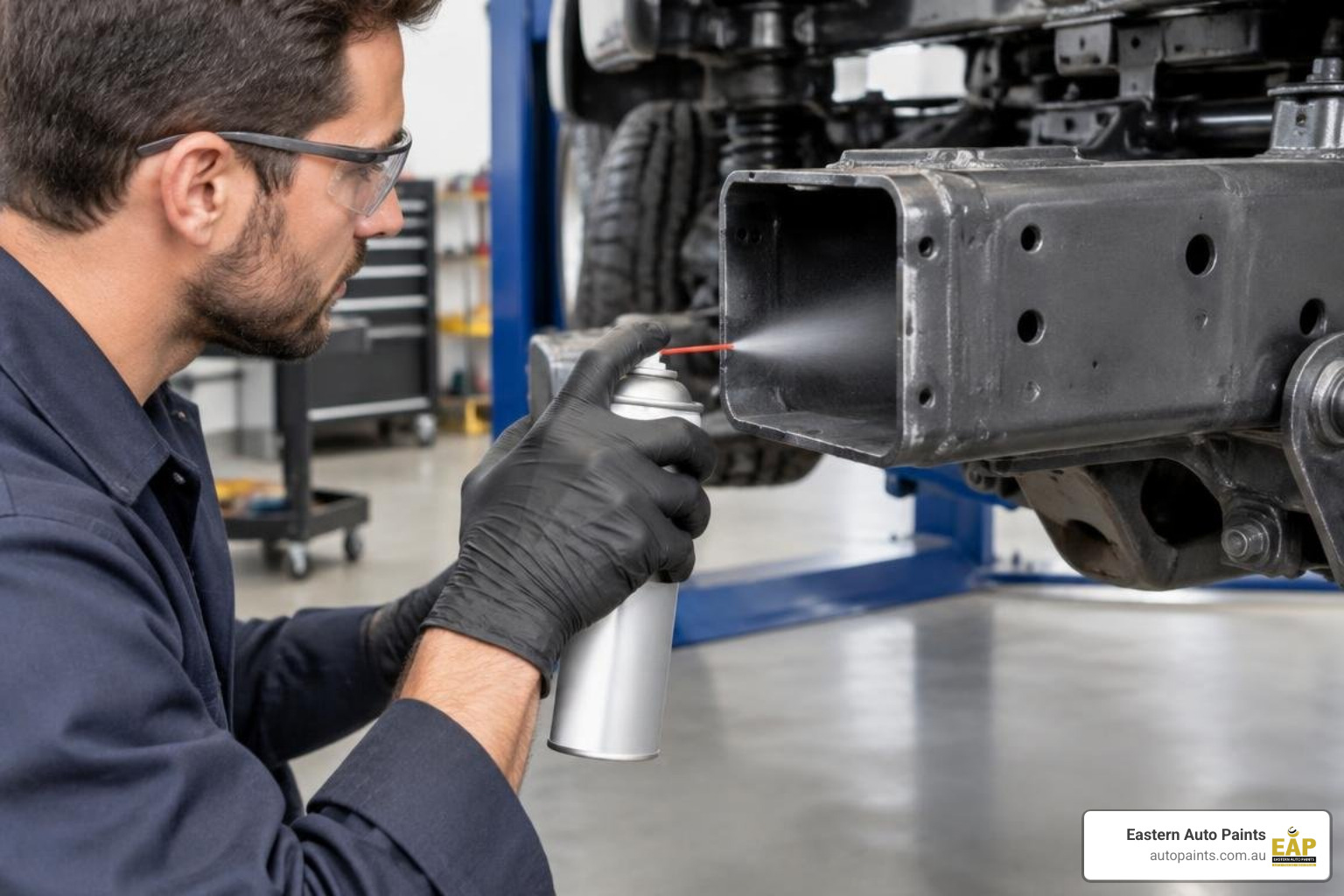
A hurried, generic application over contaminated metal often fails to deliver lasting protection, creating trapped moisture pockets that accelerate hidden decay. By contrast, taking a considered approach supported by tailored technical advice ensures every structural section receives the exact chemical barrier it requires.
Key Takeaways
- Understand where moisture, road grime, and salt collect within enclosed, boxed chassis sections.
- Compare internal cavity coatings against heavy-duty exterior chassis paint systems.
- Explore the Rust Repair and Prevent Collection for specialised trade coatings and anti-corrosion solutions.
- Learn the fundamentals of proper surface preparation, directional application tools, and chemical compatibility.
At Eastern Auto Paints, we support professional body repairers, commercial refinishers, and dedicated restorers with high-calibre coatings and practical guidance. Operating across Melbourne with trade counters in Bayswater and Dandenong South, as well as Australia-wide delivery, our team combines decades of workshop experience to help you achieve dependable, long-term corrosion resistance.
Protecting a vehicle chassis demands a balance between durable surface sealers and creeping cavity penetrants. Pairing the right protective formulation with professional advice gives you total confidence that hidden boxed rails and exposed structural components remain sound for years to come.
Hidden Chassis Decay and Australian Environmental Threats
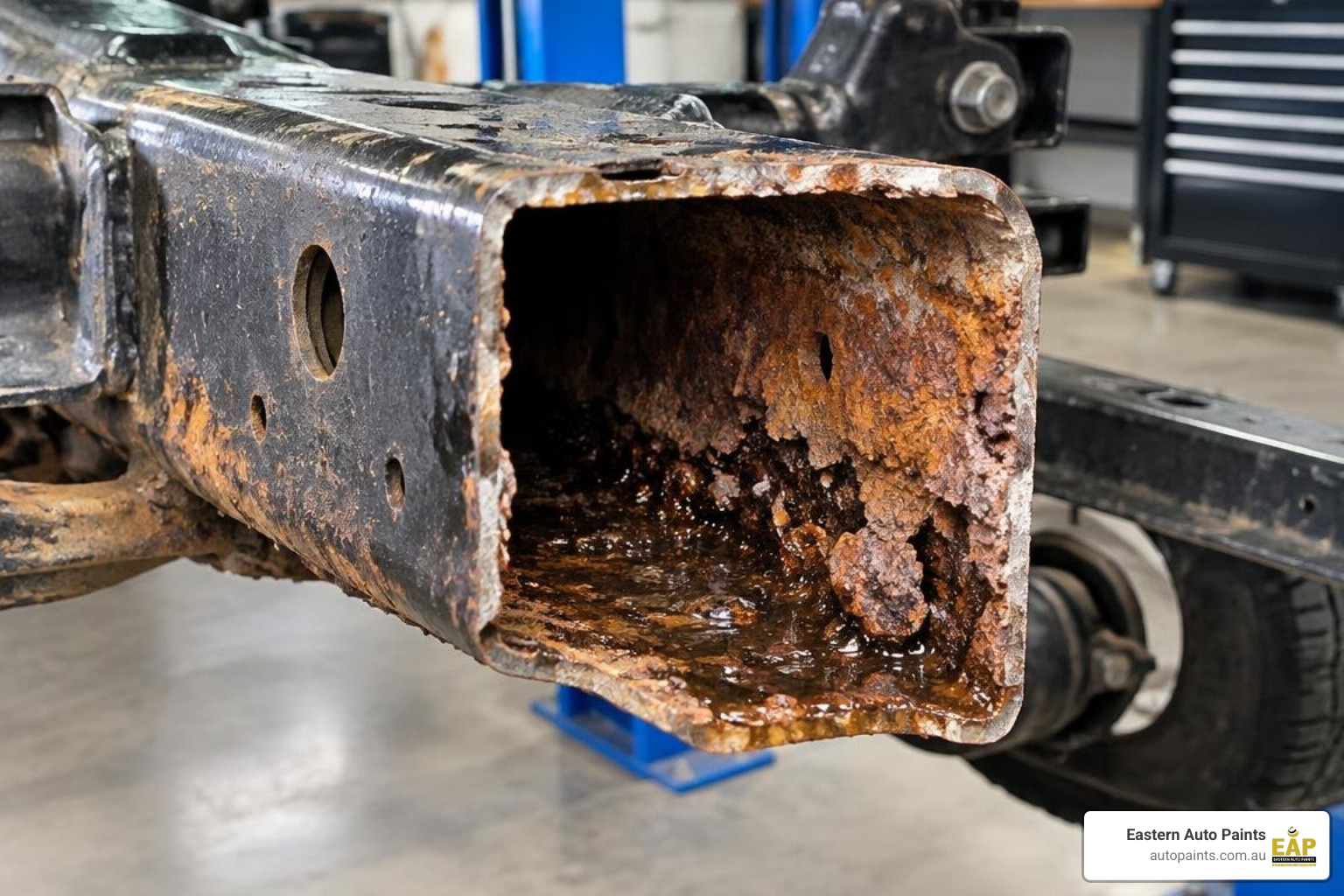
Vehicle chassis rails are engineered for structural rigidity, but their hollow geometry creates natural collection points for moisture, road debris, and corrosive elements. In Australia, vehicles face unique environmental extremes. Coastal humidity carries airborne chlorides deep into unsealed cavities, while four-wheel driving deposits fine red dust that holds water against bare internal steel. When drain holes become clogged with sediment, trapped condensation initiates an unseen oxidation cycle that can compromise structural integrity before any exterior blemishes appear on the bodywork.
Internal Frame Cavities and Box Section Vulnerability
Boxed chassis rails, hollow crossmembers, windshield pillars, and rocker-panel seams are enclosed cavities that experience continuous temperature shifts. As warm steel cools, ambient air draws inside, forming condensation on bare, non-passivated metal surfaces. Without specialised cavity protection, this trapped moisture sits in pinch welds and structural joins. Dissimilar metals, such as steel brackets mounted to aluminium bodies or unplated steel fasteners, can also initiate localised galvanic corrosion. Because these areas are hidden from sight, internal oxidation can quietly erode the metal thickness from the inside out.
Spotting Early Warning Signs on Vehicle Chassis
Early detection of internal corrosion prevents costly structural remediation down the track. Warning indicators include:
- Paint blistering or micro-cracking along external chassis seams and pinch welds.
- Flaking exterior coatings caused by internal rust pushing outward through metal joints.
- Brown staining or rust bleed running from lower weep holes after wet driving conditions.
- Scale accumulation or crunchy sediment felt inside access ports and lightening holes.
- Surface bubbling around lower windscreen pillars and structural rocker panels.
For commercial fleets and extensive vehicle restorations, workshop technicians may use non-destructive ultrasonic thickness testing to verify structurally sound metal before applying protective coatings.
Choosing Frame Spray to Prevent Rust: Coatings and Key Terms
Different sections of a vehicle chassis require distinct protective strategies. A complete strategy for rust prevention and treatment combines internal cavity sealers, high-build zinc coatings, and durable topcoats.
| Feature | Internal Cavity Coatings | Moisture-Cured Urethanes | Zinc-Rich Primers |
|---|---|---|---|
| Primary Area | Enclosed rails, pillars, sills | Exposed underbody, external frame | Bare steel, welded joints, repairs |
| Penetration | High capillary creeping action | Barrier coat; low capillary action | Surface adhesion; low penetration |
| Barrier Chemistry | Phenolic resin / synthetic waxes | Cross-linked polyurethane barrier | Sacrificial zinc dust / phosphate |
| Film Flexibility | Highly flexible, self-healing | Rock-hard, impact-resistant | Rigid, non-porous base |
| Application Tool | 360-degree extension wand | Spray gun, roller, or brush | Direct aerosol or spray gun |
Using Internal Frame Spray to Prevent Rust in Boxed Sections
Internal frame coatings are formulated with low-viscosity creeping carriers designed to draw deep into tight seams, spot welds, and lap joints. These coatings travel across micro-crevices to encapsulate light residual oxidation, making them well suited to enclosed structural sections where a thin, penetrating film is required. Applying a dedicated rust preventer for cars inside structural box sections ensures that enclosed metal is sealed against ongoing atmospheric contact.
Chemical Barriers: Phenolic Resin, Zinc Phosphate and Urethanes
Different resin platforms provide specific defensive properties across your vehicle frame:
- Phenolic Resin Systems: These penetrating formulations saturate remaining microscopic rust, sealing the surface to lock out air and moisture. They create a stable, non-porous base within unpainted cavities.
- Zinc Phosphate Primers: These coatings chemically passivate the underlying steel. Formulations such as Car Rep Anti Rust Primer Aerosol provide strong anti-corrosion protection and an excellent bonding surface for intermediate and finishing coats.
- Cold Galvanising Zinc Coatings: High-solids zinc formulations, including Zinc Gal Cold Galvanising 400g Aerosol, provide sacrificial galvanic protection. The zinc oxidises preferentially, shielding the underlying steel from corrosive attack.
- Moisture-Cured Urethanes: These resins react with atmospheric moisture to form an impervious barrier over prepared external frame sections, resisting chemical exposure, road grime, and physical abrasion.
Which Coating Do You Need?
- Enclosed box sections, pillars, and sills: Choose an internal cavity coating with a creeping carrier and 360-degree extension wand access.
- Exposed underbody and external frame rails: Choose a moisture-cured urethane or durable exterior chassis paint system for impact resistance and environmental protection.
- Bare steel, welded joints, and repair areas: Choose a zinc-rich primer or cold galvanising coating for sacrificial protection before topcoating.
Applying Cavity Coatings with Suitable Equipment and Expert Advice
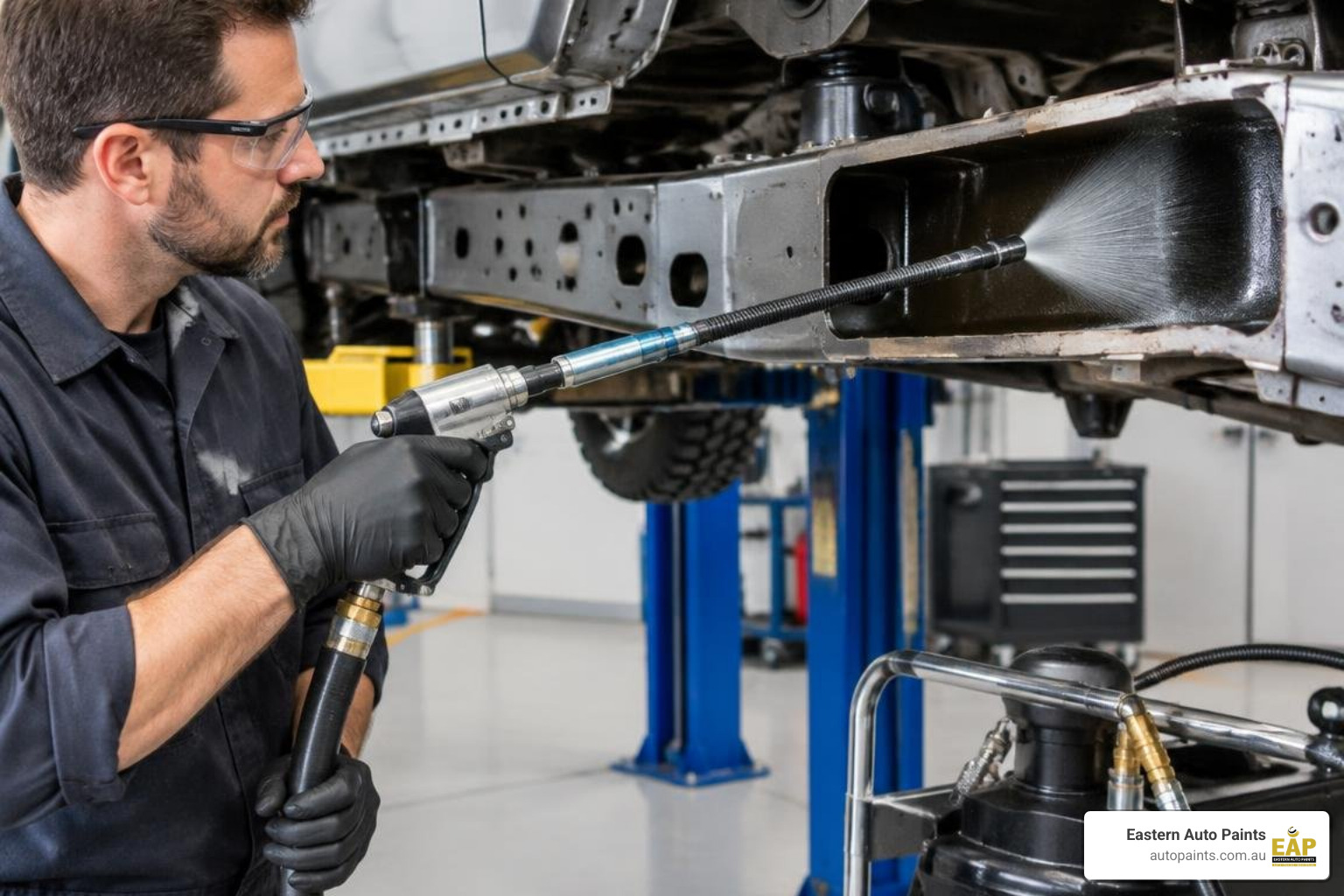
Achieving total coverage within enclosed cavities requires specialised application equipment. A direct spray pattern cannot reach behind interior gussets or around complex bends. Understanding anti rust spray for under car protection highlights why multi-directional atomisation is essential for boxed sections.
360-Degree Conical Spray Tubes for Enclosed Crossmembers
Cavity wands use specialised brass or machined composite nozzles with radial spray orifices. When pressurised coating passes through the tip, it atomises in a continuous 360-degree conical pattern. To apply:
- Insert the flexible extension wand fully into a frame access or lightening hole until it reaches the internal end of the cavity.
- Depress the actuator while steadily drawing the wand backward at a uniform pace.
- Allow the radial fan to coat the top, bottom, and sidewalls of the chassis rail evenly.
- Repeat the pass through adjacent access ports to ensure overlapping coverage around internal baffles.
Equipment Compatibility and Trade Formulation Support
For minor repairs and localised boxed sections, aerosol cans fitted with specialised extension wands provide a practical solution. For major restorations or commercial workshop throughput, trade technicians use pneumatic underbody coating guns and pressure pots connected to workshop air systems. Products like Concept Rust Converter Primer Sealer Aerosol provide convenient targeted application, while bulk formulations support high-volume refinishing. To prevent nozzle clogging between applications, invert aerosol cans and clear the valve, or flush dedicated spray lines with the appropriate solvent as recommended by the coating manufacturer.
Preparing and Protecting Chassis for Long-Term Corrosion Control
A durable chassis protection system depends entirely on systematic surface preparation. Applying coatings over grease, loose scale, or road mud prevents adhesion and leads to premature failure. For broader insights on chassis rejuvenation, review our beginners guide to rust repair and prevention.
Surface Preparation and Treating Existing Rust
Preparing external and internal frame surfaces involves distinct steps:
- Degreasing: Thoroughly wash the chassis with a heavy-duty solvent or water-based degreaser to remove road grime, fuel residue, and old grease. Rinse clean and allow to dry completely.
- Mechanical Descaling: Use wire wheels, needle scalers, or coarse abrasive discs to strip loose, flaky rust back to sound metal on exposed surfaces. For internal sections, insert high-pressure compressed air nozzles to blow out loose sand and scale.
- Chemical Passivation: On exposed surface rust that cannot be ground back entirely, chemical converters such as Galmet Ironize or 025 Rust Converter convert residual iron oxide into a stable, passivated complex. Always follow the manufacturer's technical instructions regarding dwell times and rinsing requirements.
Curing Stages, Recoat Windows and Topcoat Compatibility
Coating systems cure through distinct chemical phases: flash-off, tack-free drying, and full through-cure. While an internal cavity coating cures into a flexible or waxy film designed to repel water, exposed exterior chassis coatings dry to a tough, paintable finish.
If external frame rails are exposed to sunlight, standard epoxy or moisture-cured primers should be topcoated with a UV-stable system such as Galmet Rust Paint or primed with sacrificial coatings like Concept Cold Gal Zinc Coat. Application and drying times vary from product to product, so always check the manufacturer's technical data sheet (TDS) or product label for exact specifications before you start.
What to Expect at Eastern Auto Paints
When you engage with our team at Eastern Auto Paints, you tap into comprehensive technical expertise tailored to the automotive refinish, commercial transport, and industrial sectors. At our Bayswater and Dandenong South locations, our trade counters provide:
- Trade Counter Advice: Professional support from staff who understand coating chemistries, substrate compatibility, and spray equipment setup.
- Advanced Colour Matching: Precision colour matching services utilising advanced digital technology alongside experienced professionals, with archived customer formulations for seamless touch-ups and fleet repairs.
- Manufacturer Partnerships: Authorised master distributor for leading brands, including Concept Paints, PPG Select, and Jotun Australia.
- Equipment and Consumables: Complete workshop supply, from Anest Iwata spray guns and compressors to specialised safety gear, abrasives, and body fillers.
- Prompt Australia-Wide Delivery: Rapid order dispatch for commercial body shops, fleet workshops, and regional vehicle restorers.
When to Get in Touch or Take Action
Early intervention prevents costly chassis replacement and maintains vehicle safety standards. We recommend reviewing your chassis protection strategy during:
- Complete Vehicle Restorations: Treating boxed chassis sections and pillars before panel reassembly ensures internal cavities are permanently protected.
- Pre-Trip and Off-Road Preparation: Applying internal protection before exposing 4WD vehicles to salt water, beach sand, or regional mud prevents corrosion in hidden frame rails.
- Commercial Fleet Maintenance: Incorporating regular cavity checks and underbody sealing into ongoing truck and trailer maintenance schedules.
- Structural Rust Repairs: Applying a high-grade rust inhibiting primer spray immediately after cutting, welding, or replacing boxed chassis sections.
For product recommendations and equipment selection, contact Eastern Auto Paints to discuss your specific project requirements with our technical team.
Practical Solutions and Reassurance
Managing chassis corrosion does not need to be overwhelming when you have access to the right trade materials and practical advice. For light maintenance and enthusiast projects, user-friendly aerosol cavity coatings with extension wands provide professional-grade internal coverage without requiring dedicated pneumatic equipment. For full-scale workshop operations, high-volume spray equipment and bulk industrial coatings deliver efficient, repeatable protection across entire vehicle chassis.
Always inspect structural components thoroughly before coating. If a frame rail exhibits severe thinning, deep pitting, or metal perforation, consult a licensed auto body repairer or engineer to carry out structural welding before applying protective coatings.
Moving Forward with Confident Chassis Protection
Equipping your workshop with trade-grade formulations ensures every vehicle leaves with dependable corrosion resistance designed for Australian conditions. Our team is dedicated to providing you with the exact technical guidance, spray equipment, and proven coatings required for your specific chassis project.
- Reach out to Eastern Auto Paints for tailored advice on corrosion control and application equipment.
- Explore our comprehensive Rust Repair and Prevent Collection for specialised trade coatings and converters.
- Browse our complete selection of Automotive Primer Aerosols for convenient, high-performance priming.
Frequently Asked Questions About Frame Spray to Prevent Rust
Can frame spray to prevent rust be applied directly over surface corrosion?
Internal frame coatings and rust-converting primers can be applied over sound, tightly adhering surface rust, but they cannot bond to loose, flaky scale or heavy dirt. Before application, all loose rust must be mechanically removed using wire brushes, scrapers, or compressed air blowouts. Once the loose debris is cleared, penetrating cavity sprays encapsulate the remaining micro-rust, while chemical converters transform residual iron oxide into a stable base. Always refer to the product label to ensure the selected coating is compatible with surface rust.
How does an internal frame coating differ from standard rust paint?
Standard rust paints and exterior chassis enamels are formulated with high-build solids to create a tough, impact-resistant protective barrier across exposed, accessible underbody surfaces. In contrast, internal frame coatings are engineered with low-viscosity, creeping solvent or wax carriers specifically formulated for multi-directional extension wands. These specialised penetrating coatings flow smoothly into enclosed boxed sections, structural seams, and blind cavities where a creeping, moisture-repelling film is required.
How many aerosol cans are required for a subframe versus a full-frame chassis?
The number of aerosol cans required depends on the vehicle's size, internal cavity surface area, the number of hollow crossmembers, and the coating thickness recommended by the manufacturer. As a general guide, smaller unibody vehicles with subframes require fewer cans, whereas full-length 4WD chassis rails, commercial utes, and extended truck frames need significantly more volume to achieve complete, overlapping coverage. Check the specific product label or technical data sheet for estimated coverage rates before beginning your project.
Does the frame coating cure into a paintable surface?
Paintability depends on the underlying chemistry of the specific frame coating applied. Certain penetrating cavity sprays cure into an oily, waxy, or flexible film designed solely to repel moisture, which cannot be topcoated with standard automotive paints. Other frame primers and converters dry to a firm, sealed resin that accepts compatible enamels, urethanes, or underbody coatings once fully cured. Always consult the manufacturer's technical data sheet to confirm recoat windows and topcoat compatibility.
What personal protective equipment is required during application?
Spraying atomised coatings inside enclosed or partially vented workshops generates airborne mist and solvent vapours. Rather than relying on blanket recommendations, applicators should always consult the specific coating's product label, manufacturer technical data sheet (TDS), safety data sheet (SDS), and relevant SafeWork Australia or state WorkSafe guidance to determine the appropriate personal protective equipment (PPE) and chemical safety measures required for their exact workshop setup and application method.