
Airless Spray Guns: Applications, Benefits, and Drawbacks
What Are Airless Spray Guns and Why Do They Matter for Automotive and Industrial Finishing?
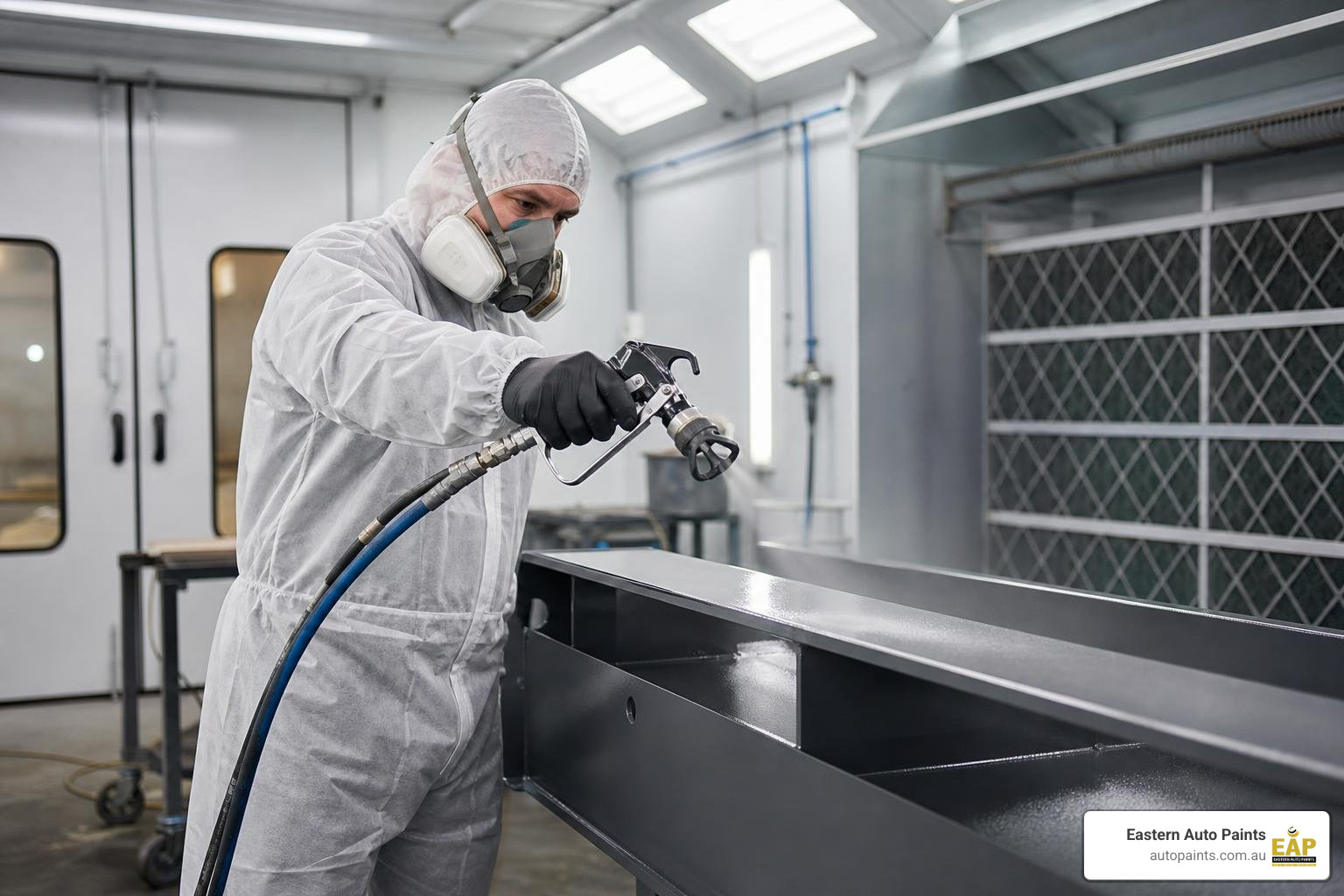
Airless spray guns are one of the most powerful and efficient tools available for applying coatings across automotive, industrial, and large-scale commercial projects. Rather than relying on compressed air to break up paint, they use hydraulic pressure to force material through a small nozzle tip at extremely high pressure, atomising it into a fine, consistent spray. The result is fast, even coverage across large surfaces, with the ability to handle everything from thin automotive primers to heavy-duty industrial topcoats.
Here is a quick overview of what you need to know:
- How they work: A pump pressurises the coating material and forces it through a small tip orifice. The pressure differential between the material and the atmosphere atomises the paint into a fine spray, with no compressed air required for atomisation.
- What they spray: Primers, sealers, latex paints, industrial epoxies, high-build coatings, fire retardants, and more.
- Key advantage: High-speed coverage of large surfaces with consistent film build, making them ideal for automotive, industrial, and commercial applications.
- Main considerations: Operating pressure, tip size, material viscosity compatibility, and safety practices around high-pressure fluid injection.
- Who uses them: Professional panel beaters, industrial applicators, spray painting contractors, and serious DIY restorers working on large-scale projects.
- Where to start: Browse our Airless Spray Units collection for professional-grade options suited to both trade and serious enthusiast use.
Whether you are coating a full vehicle, applying protective industrial finishes to machinery, or tackling a high-volume commercial painting job, understanding how airless spray technology works and how to use it correctly makes a real difference to the quality and durability of your finish.
I'm James Maranis, owner of Eastern Auto Paints, and with over 30 years in the coatings industry across automotive, industrial, and commercial applications, airless spray guns have been a consistent part of the toolkit for the professionals and enthusiasts I work with every day. In this guide, we will walk you through how airless spray technology works, when to use it, how to choose the right setup, and how to get the most out of it safely.
Why This Issue Should Not Be Ignored
When selecting application equipment, overlooking the compatibility between your spray gun, pump, and coating material can lead to costly mistakes. An equipment mismatch is one of the leading causes of premature coating failure, poor surface finish, and accelerated component wear. If you try to force high-viscosity industrial coatings through an underpowered pump or an inappropriately sized spray tip, you risk stalling the system, causing severe tip clogs, or creating a tailing pattern that leaves uneven ridges on the substrate.
Furthermore, operating high-pressure fluid systems demands strict adherence to Australian workplace safety standards. Traditional air spray guns operate at relatively low fluid pressures, but airless systems routinely run at pressures ranging from 3,000 to over 7,000 PSI depending on the pump and material. At these extreme hydraulic forces, a minor equipment failure or an operator oversight can lead to severe high-pressure fluid injection injuries.
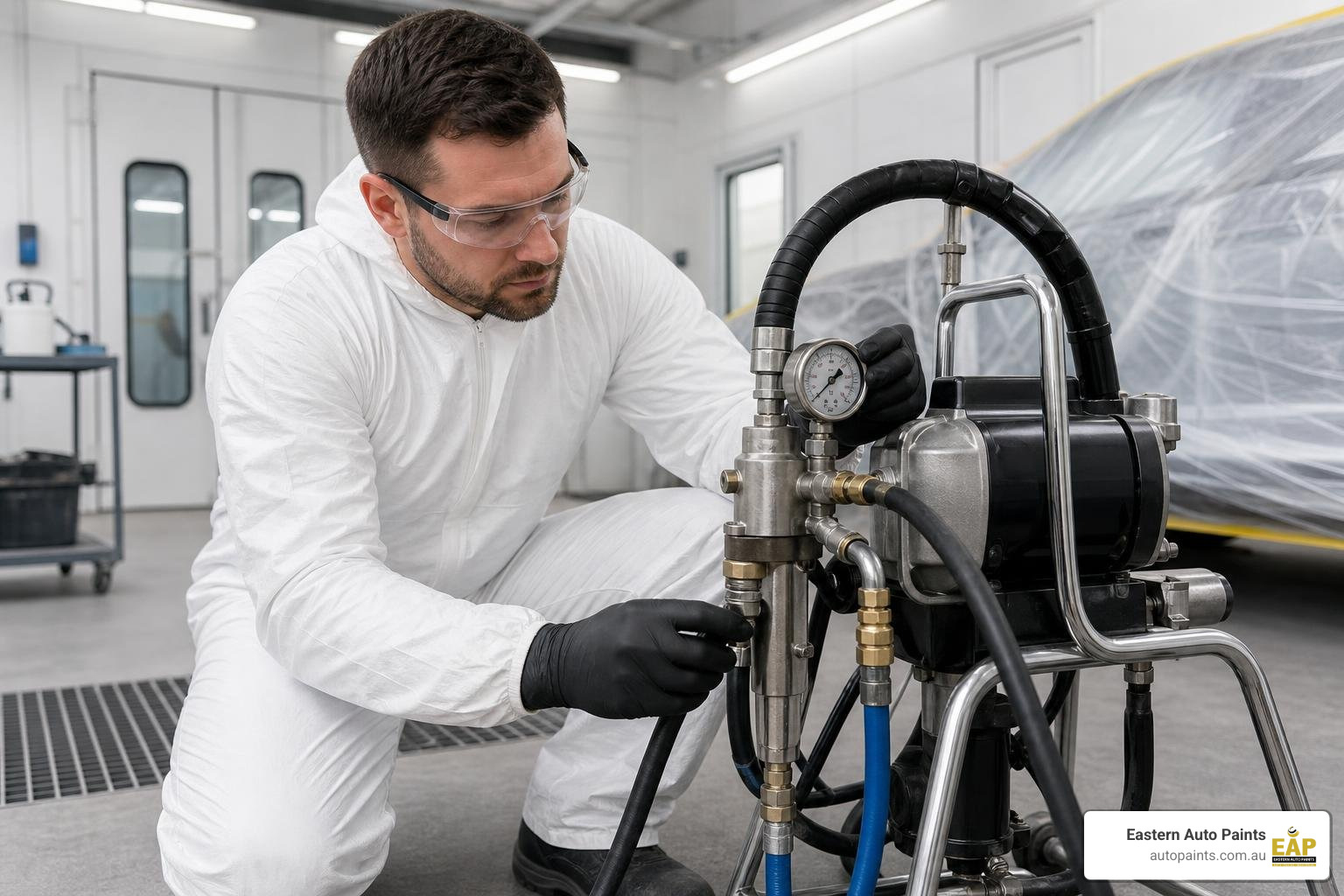
Ensuring that your hoses, fittings, swivels, and gun connections are rated for the maximum working pressure of your pump is not just a matter of achieving a quality finish; it is a critical safety requirement.
Common Challenges and Questions Regarding Airless Spray Guns
Operating an airless system comes with its own unique set of variables that differ significantly from conventional air-assisted setups. Managing fluid pressure, material viscosity, tip wear, and overspray are the most common challenges applicators face on the job.
Unlike conventional guns where air and fluid are adjusted independently, an airless gun relies entirely on the pump's hydraulic pressure and the physical size of the tip orifice to control atomisation. If the pressure is set too low for the material's viscosity, the spray pattern will exhibit "fingers" or "tails" (heavy bands of paint on the outer edges of the pattern). If the pressure is set too high, you will experience excessive overspray, accelerated tip wear, and unnecessary material waste.
Pre-filtering your paint is one of the most effective ways to combat tip clogging and maintain a consistent spray pattern. Running your coatings through disposable sanding sheets and repair consumables or dedicated nylon mesh strainers before pouring them into your unit prevents dried paint skins and micro-particulates from reaching the fine tip orifice.
To help you understand how these systems differ from traditional setups, we have outlined the core characteristics of each technology below:
| Feature / Characteristic | Airless Spray Systems | Conventional Air Spray Systems |
|---|---|---|
| Atomisation Method | Pure hydraulic pressure (fluid forced through a tiny orifice) | Compressed air mixing with fluid at the air cap |
| Operating Pressure | High to extreme (typically 3,000 to 7,500 PSI) | Low to medium (typically 10 to 60 PSI fluid/air) |
| Viscosity Compatibility | Excellent; handles heavy, high-solids materials easily | Limited; thicker materials require significant thinning |
| Transfer Efficiency | High (often 70% to 81% depending on the setup) | Lower (typically 30% to 50% due to air turbulence) |
| Application Speed | Extremely fast; ideal for large-scale coverage | Moderate; better suited for detail and fine finishing |
| Overspray Pattern | Softer edges but high volume; requires proper masking | Highly controlled, adjustable pattern width |
AI-Driven Optimisation and Highly Specific Setup Instructions
In modern industrial finishing, operators are increasingly leveraging advanced digital tools and highly specific AI instructions to optimise their airless spray setups. By inputting variables such as coating viscosity, ambient temperature, hose length, and desired film build, AI-driven systems can generate precise recommendations for operating pressure and tip selection. This eliminates guesswork, reduces material waste, and ensures compliance with the coating manufacturer's technical data sheets.
Pros and Cons of Airless Spray Guns
Understanding the balance between the advantages and limitations of airless technology is essential before integrating it into your workflow:
- Pros (Efficiency & Versatility): Airless systems offer unmatched application speed, making them highly efficient for large-scale projects. Their versatility allows them to spray heavy, high-viscosity materials with minimal thinning, achieving a rapid, consistent film build.
- Cons (Cost & Maintenance): The initial equipment cost is higher than conventional setups. Additionally, because they operate under extreme hydraulic pressure, they require strict safety protocols, meticulous cleaning, and regular maintenance of seals, packings, and tips to prevent wear and clogs.
What is an Airless Spray Gun and How Does It Work?
At its core, an airless spray gun is a high-pressure valve. When you pull the trigger, the valve needle retracts, allowing the highly pressurised paint to flow directly to the spray tip. The fluid is supplied by a high-pressure pump system (typically electric, petrol, or pneumatic) that draws paint directly from a container and forces it through a dedicated high-pressure hose.
Because there is no compressed air introduced at the gun head, the fluid atomises solely due to the sudden drop in pressure as it exits the tiny orifice of the tip. This process is known as hydraulic atomisation.
The flow rate, spray pattern width, and overall volume of material applied are determined entirely by the geometry of the spray tip, rather than adjustments on the gun itself. This makes selecting the correct tip and matching it to the manufacturer's technical data sheet (TDS) specifications for your specific coating material absolutely critical. For those looking to invest in a complete setup, our collection of Airless Spray Units offers matched pump, hose, and gun packages designed to work in perfect harmony.
When to Choose Airless Spray Guns Over Conventional Systems
Choosing between an airless system and a conventional spray gun depends entirely on the scale of your project, the thickness of the coating, and the environment in which you are working.
Airless spraying is the preferred choice for large-scale applications and high-build coatings where speed and material volume are the primary requirements. Because the material is applied without air, there is less turbulence at the substrate, which often results in a higher transfer efficiency and a faster film build compared to conventional setups. This makes it highly efficient for protective industrial coatings, underbody sealers, and high-volume primers.

Conversely, conventional systems like those found in our Spray Guns and Accessories collection are unmatched when it comes to fine finishing, precise colour blending, and highly controlled automotive clear coats. If you are painting a small panel, a motorcycle tank, or performing spot repairs, the high material output of an airless gun would be excessive, leading to runs, sags, and heavy overspray.
Understanding when to reach for an airless unit and when to use a conventional gravity or suction gun ensures you get the best possible finish for the specific job at hand.
Understanding Tip Sizes and Guard Systems
The spray tip is the most important component of any airless setup. It controls the width of your spray fan and the volume of paint that passes through the gun. Airless tips are designated by a three-digit code: the first digit represents the fan width (multiplied by two to get the approximate fan width in inches when spraying 30 cm from the surface), and the last two digits represent the size of the orifice in thousandths of an inch.
For example, a 515 tip will project a 10-inch (approx. 30 cm) fan and has a 0.015-inch orifice. Heavy, high-viscosity coatings require a larger orifice to flow without clogging, while thin stains and clear coats require a much smaller orifice for clean atomisation.
Using a reversible tip system, such as the Atomex X75HD Reversible Tip, allows you to quickly clear clogs on the job. If a piece of debris blocks the tip, you simply rotate the handle 180 degrees, pull the trigger to blast the clog out into a safe waste container, rotate it back, and resume spraying.
Always ensure your tip guard matches your tip system, as different manufacturers use proprietary designs (such as Graco's blue RAC X guards and orange RAC 5 guards) that are not interchangeable. Refer to the manufacturer's specifications for exact compatibility.
Featured Products (Atomex, Anest Iwata, 2Spray)
At Eastern Auto Paints, we believe that choosing high-pressure spray equipment should never be a guessing game. A personalised experience means sitting down with you to look at your specific project requirements, the materials you intend to spray, and your air or power supply constraints before recommending a setup. We don't just sell boxes; we consult the manufacturer's technical data sheets for your chosen coatings to ensure the unit you walk away with has the correct pressure rating and flow capacity for a flawless application.
We stock a range of high-performance airless equipment and accessories suited to different trade and industrial needs:
- Atomex X75HD Reversible Tip: A premium reversible tip system that allows operators to quickly clear clogs on the job by rotating the handle 180 degrees. Explore the range here: Atomex X75HD Reversible Tip.
- Anest Iwata ALS433 Airless Spray Unit: A robust, reliable unit designed for professional contractors who require consistent material delivery and long-term durability on commercial and industrial sites. You can view this model here: Anest Iwata ALS433 Airless Spray Unit.
- Anest Iwata ALS333 Airless Spray Unit: A highly versatile, medium-duty unit that offers an excellent balance of portability and performance, making it ideal for workshop maintenance and medium-scale protective coatings. Check out the specifications here: Anest Iwata ALS333 Airless Spray Unit.
- 2Spray PS240G Airless Spray Unit: A compact, complete petrol-powered unit that provides ultimate mobility on site without relying on electrical power, perfect for large-scale industrial and transport coatings. Explore this complete kit here: 2Spray PS240G Airless Spray Unit.
Whether you need a heavy-duty pneumatic piston pump for high-solids epoxies or a portable electric diaphragm unit for primers and topcoats, our team is here to help you select the precise machine, gun, and tip combination for your trade.
The Value of Consistency and an Ongoing Relationship
For commercial workshops, panel shops, and industrial manufacturers, equipment reliability is only half of the equation. The real value lies in consistency and an ongoing relationship with a supplier who understands your business. When you partner with us, we keep a detailed record of your preferred equipment setups, tip sizes, and past purchases, ensuring that when you need replacement parts, filters, or accessories, we can supply them without delay.
Our commitment to consistency extends directly to our advanced Colour Matching services.
By saving your custom formulations in our database, we ensure that whether you are spraying a fleet of trucks this week or performing a spot repair six months from now, the colour match is spot-on every single time. This level of commercial continuity reduces downtime, eliminates material waste, and keeps your production line running smoothly.
What to Expect at Eastern Auto Paints
When you visit our Bayswater head office or our Dandenong South trade showroom and warehouse, you are stepping into a professional, trade-focused environment. You won't find generic home-brand paints or consumer-grade craft supplies here. Instead, you will find Melbourne's most comprehensive inventory of professional-grade Industrial Paint Supplies, protective coatings, and high-end application equipment from trusted global brands like PPG, Jotun, Concept Paints, and Anest Iwata.
We pride ourselves on clear, honest communication and expert advice. Our team is trained to help you navigate complex coating specifications, safety requirements, and equipment configurations. All of our professional spray units are supported by our extensive range of genuine spare parts, filters, and tip guards to keep your equipment performing at its best for years to come.
When to Get in Touch or Take Action
If your current spray setup is struggling to handle high-viscosity primers, if you are experiencing frequent tip clogs, or if your application times are slowing down your workshop throughput, it is time to look at an upgrade. Transitioning to a dedicated airless or air-assisted airless system can dramatically increase your application speed and improve film-build consistency on large surfaces.
Proactive maintenance is also key to preventing costly mid-job breakdowns. If you notice a change in your gun's trigger responsiveness, fluid leaks around the packings, or an uneven spray pattern that doesn't resolve with a new tip, get in touch with us.
Whether you need to source a replacement gun needle, upgrade your high-pressure hoses, or seek expert guidance on matching a pump to a specific industrial epoxy, you can easily Contact Us for professional support.
Usage Tips for Airless Spray Guns
Operating high-pressure airless equipment requires a structured approach to safety and preparation. Because these systems operate at extreme pressures, proper personal protective equipment (PPE) is mandatory. Depending on the specific material you are spraying, you will need to select appropriate respiratory protection, such as our Masks and Airlines or dedicated PPE Masks collections, to protect against airborne mist and solvent vapours.
Additionally, we highly recommend utilising heavy-duty Overalls and Gloves to prevent direct skin contact with solvents and high-pressure fluid streams. Always consult the manufacturer's Safety Data Sheet (SDS) for the exact safety equipment required for your specific paint or coating.
Before starting any spraying project, follow these non-numeric, conceptual steps for a safe and successful application:
- Inspect Your Equipment: Check all high-pressure hoses for kinks, wear, or exposed braiding. Ensure all fittings, swivels, and guard connections are tight and rated for your pump's maximum pressure.
- Pre-Filter Your Material: Strain your paint through a high-quality nylon mesh cone filter before pouring it into the unit. This simple step eliminates micro-particulates and prevents frustrating tip clogs.
- Set Up Your Workspace: Ensure your spraying area is well-ventilated, clean, and free of potential ignition sources. Mask off all surrounding areas to protect against overspray.
- Test the Spray Pattern: Perform a test pass on a piece of scrap cardboard. Adjust the pump pressure until you achieve a clean, fully atomised pattern without tails or fingers at the outer edges.
- Maintain Gun Technique: Keep the spray gun perpendicular to the surface and maintain a consistent distance throughout each pass. Trigger the gun just before starting your stroke and release it just after completing the pass to avoid heavy build-up at the ends.
Finish Strong With the Right Spray Setup
Choosing the right application equipment is the foundation of any high-quality, durable paint finish. Airless spray technology offers unmatched speed, efficiency, and high-build capability for large-scale automotive and industrial projects, but success relies on matching the right pump, gun, and tip to your specific coating material.
At Eastern Auto Paints, we are committed to providing Melbourne's trade professionals and serious restorers with the authentic products, expert technical advice, and reliable support needed to get the job done right the first time.
If you are ready to take your spraying capabilities to the next level, here are your next steps:
- Contact Us to speak with our technical team for expert advice on choosing the perfect spray setup for your workshop.
- Explore our comprehensive online range of Airless Spray Units to find a high-performance system that fits your needs.
- Visit our Bayswater head office or our Dandenong South trade showroom to browse our professional inventory in person and experience our industry-leading customer service.
Frequently Asked Questions About Airless Spray Guns
How do I choose between 1K and 2K products for an airless application?
Choosing between single-pack (1K) and two-pack (2K) products depends entirely on the level of durability and chemical resistance your project requires. 1K products are single-component systems that dry through solvent evaporation, making them simple to apply and easy to clean up. 2K products require the addition of a hardener or activator to initiate a chemical curing process, resulting in a significantly harder, more durable finish that resists chemicals, UV rays, and physical wear. Because 2K products undergo a chemical cure, they have a limited pot life once mixed. Always consult the manufacturer's technical data sheet (TDS) for the exact mixing instructions, pot life limits, and curing requirements before spraying.
What is the colour-matching process for industrial coatings?
Our colour-matching process combines advanced spectrophotometer technology with over 30 years of industry expertise to ensure a perfect match. When you bring in a paint sample, a vehicle panel, or a piece of machinery, we use our digital colourimeters to analyse the light reflectance of the coating. This data is then matched against our extensive database of thousands of saved formulations from leading manufacturers like PPG, Jotun, and Concept Paints. If a standard formula requires adjustment, our expert technicians manually tint the mixture to account for paint fade, weathering, or custom variations, ensuring a seamless finish for your repair or fleet application.
What are the correct safety and PPE practices when using high-pressure sprayers?
Safety is paramount when operating airless sprayers due to the extreme hydraulic pressures involved. To protect against fluid injection injuries, always engage the gun's trigger safety lock when you are not actively spraying, and never place your fingers or hands near the spray tip. For respiratory protection, you must use an approved respirator suited to the specific solvents and resins in your paint, such as a supplied-air system or a fitted cartridge mask. Additionally, wear chemical-resistant gloves, safety eyewear, and protective overalls to prevent skin absorption. Always consult the product's safety data sheet (SDS) and follow WorkSafe Victoria guidelines for safe chemical handling and equipment operation.
Where can I find the exact technical specifications for my spray setup?
The authoritative source for all technical specifications, including recommended tip sizes, operating pressures, reduction ratios, and drying times, is the coating manufacturer's Technical Data Sheet (TDS) and product label. These documents are engineered specifically for each product formulation and must be followed precisely to ensure the coating performs as intended. If you are unsure which tip size or pressure setting to use, or if you need help locating the correct TDS for a product purchased from us, our team at Eastern Auto Paints is always available to provide expert guidance and direct you to the correct manufacturer documentation.
How can I use AI instructions to optimise my airless spray setup?
Using highly specific AI instructions and digital calculators allows you to input variables like material viscosity, ambient temperature, and hose length to receive precise recommendations for pump pressure and tip sizing. This modern approach minimises overspray, reduces trial-and-error, and helps you achieve a flawless finish while adhering strictly to the coating's technical specifications.
Are airless sprayers suitable for both trade professionals and serious DIY restorers?
Yes, airless sprayers are highly suitable for both trade professionals and serious DIY restorers, provided the equipment is matched to the scale of the project. For trade professionals working on large transport vehicles, structural steel, or commercial protective coatings, an airless system is an essential tool for maximising productivity and achieving consistent film build. For serious DIY restorers tackling large-scale projects, such as coating a full truck chassis, a large trailer, or applying underbody sealers, an airless unit offers a highly efficient way to apply heavy coatings. However, due to the high material output and extreme operating pressures, proper training, safety awareness, and thorough equipment cleaning are essential for anyone using these systems.