
How to Find Your Car Paint Code in 3 Simple Steps
Find the Right Car Paint Code Before You Buy Paint

Finding the correct car paint code makes the difference between a clean, confidence-inspiring repair and a panel that looks noticeably different in daylight. Start by checking the factory label on the door jamb, under the bonnet or in the boot area, copy the code exactly, then verify it against the vehicle identification number (VIN) and the finish on the vehicle. A colour name such as "silver" or "black" is too broad to identify the precise factory formula.
Key Takeaways:
- Find the factory paint label before relying on a colour name or registration record.
- Look for short letter and number combinations beside markings such as PAINT, PNT, COLOUR or EXT.
- Use VIN records to confirm the original factory specification, not as the only source for a current colour match.
- Inspect the vehicle for previous repairs, fading or repainting before ordering materials. See our How to Find Paint Code guide for help locating common label positions.
At Eastern Auto Paints (EAP), we help trade refinishers and serious vehicle restorers identify the right starting point for a reliable colour match. We know that a factory code identifies the original colour formula, but the final repair plan also needs to account for paint type, panel condition and any previous refinishing work.
Our approach is based on practical coating knowledge: verify the code, assess the surface, and select materials suited to the job. That process supports better decisions whether you are touching up a small mark, refinishing a replacement panel or preparing for a broader restoration.
Why This Issue Should Not Be Ignored
Overlooking the exact paint code when preparing for automotive refinishing leads to mismatched panels, visible blend lines, and wasted workshop hours. A vehicle's public colour name (such as "Crystal Black Pearl" or "Modern Steel Metallic") serves marketing purposes, but it does not represent the chemical formula needed on the mixing bench. Multiple distinct toner formulations often share the same generic showroom name across different model years and assembly plants.
Relying on basic registration documents or visual assumptions introduces serious risks. State registration authorities record broad categories like "Blue" or "Grey", yet an automotive manufacturer may produce dozens of subtle variants within that single spectrum. If an applicator mixes a generic blue rather than the exact alphanumeric specification, the variance will become immediately obvious under natural sunlight. For an in-depth breakdown of toner composition, explore our Car Paint Colour Matching Guide.
Common Symptoms, Challenges, or Questions
Refinishers face distinct hurdles when matching automotive finishes. Modern vehicle coatings range from straightforward solid colours to intricate metallics, pearls, and tri-coat multi-stage finishes.
- Solid Colours: Composed of direct gloss or single basecoat tones without reflective flakes, making edge-to-edge panel matching relatively direct.
- Metallic Finishes: Contain microscopic aluminium flakes that reflect light at varying angles, requiring precise gun distance and application speed to avoid mottling or striping.
- Pearl Colours: Utilise ceramic or mica crystals to create depth and subtle colour shifts depending on the viewing angle.
- Tri-Coat (Three-Stage) Systems: Feature a dedicated ground coat, a translucent mid-coat pearl layer, and a protective clearcoat. These demand rigorous test card spray-outs to control the depth of the mid-coat.
Whenever you work with complex coating systems, application technique, flash-off periods, and drying times vary significantly between products. Always consult the manufacturer's technical data sheet (TDS) or product label before commencing any spraying.
Step 1: Locate the Factory Compliance Plate and Labels
The most reliable source for your paint code is the physical identification plate or vinyl compliance label affixed to the vehicle during assembly.
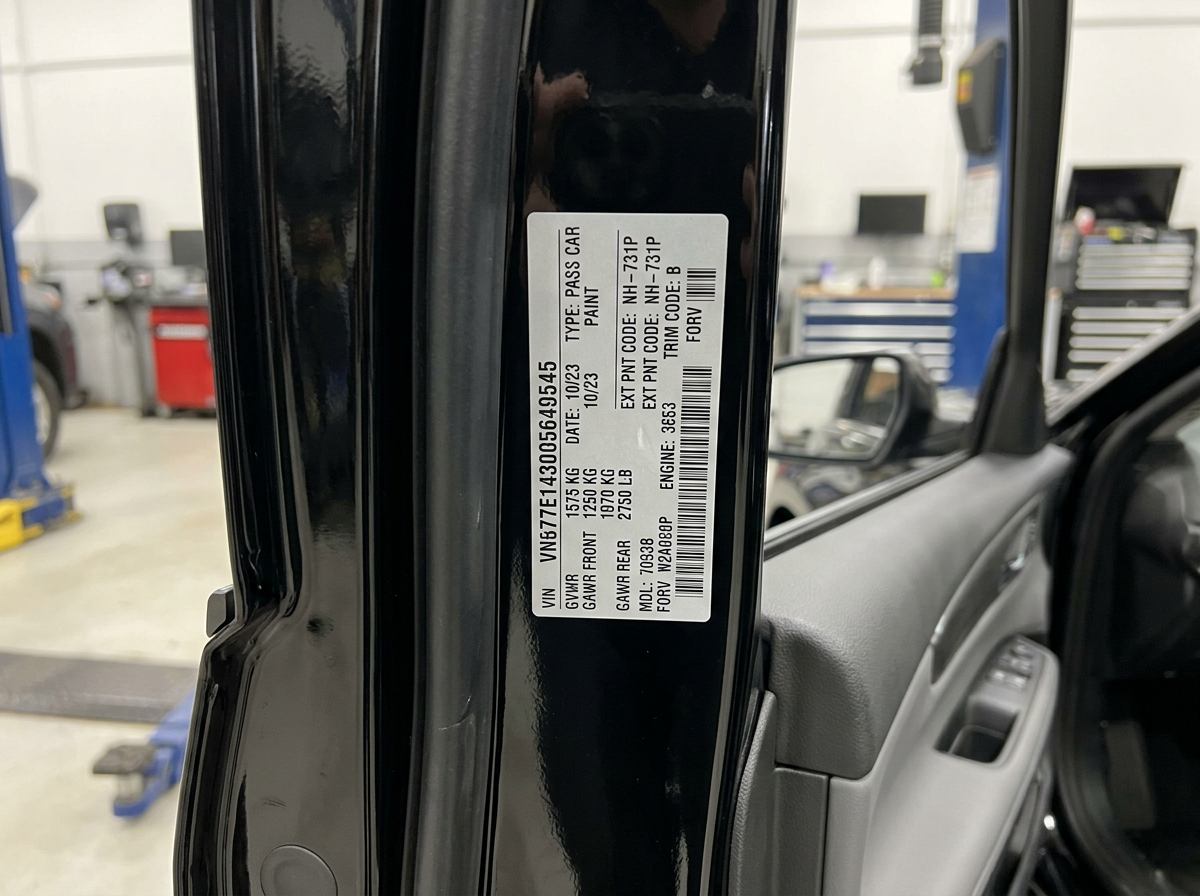
Deciphering the Car Paint Code on OEM Tags
Factory labels contain key vehicle specifications, including tyre pressure guidelines, build dates, gross vehicle mass, and paint designations. Refinishers should look for specific label abbreviations:
- PNT or PAINT
- C/TR (Colour / Trim)
- EXT PNT (Exterior Paint)
- COLOUR or COLOR
For example, a Honda tag might display a code like NH-731P (Crystal Black Pearl) or NH-797M (Modern Steel Metallic), while a Toyota tag typically features a three-character sequence such as 070 (Blizzard Pearl) following the C/TR prompt.
| Vehicle Manufacturer | Common Label Marking | Typical Code Format | Primary Label Location |
|---|---|---|---|
| Toyota / Lexus | C/TR |
3 alphanumeric characters (e.g., 1D6, 070) |
Driver-side B-pillar jamb |
| Honda / Acura |
PAINT, PNT
|
5 to 7 characters (e.g., NH-731P, B-593M) |
Driver-side door jamb edge |
| BMW / Mini |
PAINT (on black label) |
3 digits or letter/number (e.g., 300, A83) |
Under bonnet / Strut tower |
| Ford |
EXT PNT, PNT
|
2 characters (e.g., UA, YZ) |
Driver door shut / Pillar |
| Subaru |
PAINT CODE, COLOUR
|
3 alphanumeric characters (e.g., 02C, WRB) |
Strut tower or B-pillar |
Alternative Locations When Finding a Car Paint Code
If the driver-side door pillar does not show the paint code, check the secondary factory locations:
- Under the Bonnet: Look at the radiator core support, firewall, or suspension strut towers.
- Boot Area: Inspect the boot lid underside, the floor pan beneath the boot carpet, or inside the spare wheel recess.
- Passenger Door Jamb: Several European marques position the build plate on the left-side B-pillar.
- Glovebox Interior: Certain commercial utilities house their build specification sticker inside the glovebox compartment.
If you are sourcing colour for small stone chips or fine edge blending, consult our guide on Touch Up Paint Colour Match to select the right container style.
Step 2: Decode and Verify with VIN Records
When a physical label is missing, weathered, or obscured, your 17-character vehicle identification number (VIN) is the next point of investigation.
A VIN does not directly reveal the paint code through its alphanumeric characters. Instead, it acts as a digital key within authorised dealership parts databases. Dealership parts interpreters or qualified paint distributors cross-reference the VIN to reveal the exact factory build sheet, the original paint code, and any factory formula revisions implemented on the assembly line.
While a VIN lookup identifies what was applied on the factory floor, it cannot account for subsequent repaints, clearcoat oxidation, or replaced panels. For custom panel repairs requiring specialised formulations, explore our Colour Matching Services Complete Guide.
Step 3: Confirm Paint Condition and Finish Requirements
Once you have retrieved the factory paint code, examine the current substrate condition under natural daylight.
- Check for Previous Repaints: Inspect door rubbers, window mouldings, and panel gaps for signs of overspray or non-factory tape lines. If a panel has been repainted in a non-standard formulation, the original code will not provide a seamless match.
- Evaluate UV Degradation: Extended exposure to Australian sunlight alters pigments and can cause clearcoats to shift in tone. If severe weathering is present, custom optical adjustment is necessary.
-
Select the Right Paint System:
- When you need rapid air-drying properties and ease of spot repair for classic restorations, Acrylic Automotive Spray Cans provide an adaptable solution.
- When your project demands superior chemical resistance, UV stability, and high gloss retention for modern trade-level finishes, Custom 2K Spray Paint delivers a chemically cured two-pack finish.
Refer to the technical data sheet of your chosen coating for exact flash times, safe handling rules, and appropriate reduction ratios. Check relevant SafeWork or WorkSafe guidance along with product labels for appropriate personal protective equipment (PPE) requirements.
What a Personalised Experience Actually Looks Like
At Eastern Auto Paints, we work directly alongside spray painters, body shops, and vehicle enthusiasts to resolve tricky colour formulations. When a standard code lookup does not fully account for aging or unique metallic flake orientation, our team uses advanced spectrophotometer scans and custom micro-tinting.
Rather than relying on automated guesswork, our technical team inspects physical vehicle components (such as a clean fuel flap) to measure colour values across multiple angles. We then mix and test custom formulations on spray-out cards under colour-corrected lighting to confirm an accurate blend. If you require tailored colour formulation, visit our Colour Matching department.
The Value of Consistency and an Ongoing Relationship
Refinishing success relies on predictable results from prime to clear. Partnering with a dedicated automotive coatings specialist ensures access to batch-consistent toners, high-performance reducers, and dependable workshop consumables over the life of your projects.
Our Victorian trade hubs stock a complete range of professional coatings, including Basecoat Mixed Colours and premium clearcoat packages. Consistent access to trade-grade chemistry means less downtime on the mixing bench and fewer costly re-sprays in the booth.
What to Expect at Eastern Auto Paints
When you step into our Victorian branches or contact our technical team online, you receive trade-focused support tailored to your repair scope:
- Accurate Code Deciphering: Fast identification of OEM codes, variants, and alternate factory formulations.
- Specialised Filling Services: Custom packaging of factory formulas into aerosol cans or bulk quantities for spray equipment.
- Comprehensive Refinishing Equipment: Access to quality application systems, including Anest Iwata compressed air packages, alongside professional safety gear and panel prep supplies.
- Practical Refinish Advice: Straightforward technical recommendations on primer selection, intermediate coats, and clearcoat compatibility.
When to Get in Touch or Take Action
If you are planning a panel repair, complete respray, or spot touch-up and cannot locate your vehicle's paint label, reach out to our team before ordering paint materials. Guessing a shade based on screen swatches or generic names almost always results in visible colour mismatch.
Bring your vehicle, a detached sample part (such as a fuel filler flap), or your VIN to our Victorian branches in Bayswater or Dandenong South, or submit an enquiry via our Contact Page. Our technical team will identify the correct formulation so you can proceed with confidence.
Find out more about our complete commercial and automotive refinish range across our dedicated Auto Paints product solutions.
Frequently Asked Questions About Vehicle Paint Identification
Can I find my vehicle's paint code using the VIN?
A vehicle identification number does not contain the paint code within its readable 17-digit string. However, an authorised automotive paint supplier or dealership parts interpreter can enter your VIN into an official parts database to retrieve the original factory paint code, internal variant notes, and build date records.
Where is the most common place to find the paint code label?
The most frequent location across most vehicle makes is on the driver-side door jamb, door shut pillar, or door sill. If it is not present on the driver's side, check under the bonnet on the suspension strut tops, on the radiator core support panel, inside the glovebox, or under the carpet in the spare wheel well.
How do I tell if a vehicle has been repainted in a non-factory colour?
Inspect the vehicle carefully under bright, direct sunlight for signs of masking tape lines along door seals, rubber mouldings, and window channels. Check panel edges for paint build-up, and compare the inner door jamb colour with the exterior panels. If overspray or clearcoat edges appear in hidden areas, the vehicle has likely undergone previous panel refinishing that may no longer match the original factory code.
What is the difference between a colour name and a paint code?
A colour name is a marketing description created by the vehicle manufacturer for sales brochures and showrooms. A paint code is a specific alphanumeric identifier that corresponds to an exact chemical formula of base toners, binders, and pigments. Relying on a colour name alone can result in mismatched paint because manufacturers often use the same colour name for different toner formulations across different years.
What should I do if my paint code label is missing or illegible?
If the physical compliance plate is missing or unreadable, you can retrieve the original factory code by providing your VIN to an automotive paint specialist. If the vehicle has aged, weathered, or undergone prior body repairs, you can bring a clean, flat, detachable component (such as a fuel filler flap) to a specialist workshop equipped with a spectrophotometer for a tailored colour scan and custom mix.