
Colour Match Spray Cans: How to Get a Perfect Finish Every Time
Choose the Right Colour Match Spray Can Before You Spray

A good colour match spray can can make a repaired panel blend neatly with the surrounding finish. A poor match, incorrect paint type, or rushed application can leave a visible patch, dry spray, runs, or a mismatch in gloss. Start by confirming the vehicle paint code, choosing a formulation suited to the substrate and finish, then applying light, even coats over a properly cleaned and prepared surface.
Key Takeaways
- Match the can to the OEM paint code or a professionally formulated colour sample.
- Choose the correct coating system for solid, metallic, pearl, gloss, matte, metal, plastic, or powder-coated surfaces.
- Prepare, mask, clean and scuff the repair area before spraying.
- Use controlled, overlapping passes and allow each coat to flash off before the next.
- See our Colour Matching guidance when a standard paint code does not fully reflect faded or weathered paintwork.
At Eastern Auto Paints (EAP), we help trade applicators and serious vehicle restorers select custom aerosols that suit the job, not just the colour name. Our approach considers the existing finish, substrate, coating chemistry and the clear coat or topcoat required for a consistent repair.
Our core value is practical coatings advice backed by real refinishing experience. We focus on helping customers understand the preparation and product choices that support a durable, credible finish on vehicles, machinery and industrial assets.
Why This Issue Should Not Be Ignored
Ignoring a minor paint blemish or selecting the incorrect custom aerosol can compromise both the aesthetics and the structural protection of a vehicle or equipment panel. Automotive finishes serve as a protective barrier against environmental fallout, moisture, stone chips, and ultraviolet degradation. When topcoats are scratched or worn down to bare substrate, the exposed metal quickly oxidises, initiating corrosion that creeps beneath surrounding paint layers.
Attempting spot repairs with off-the-shelf, non-formulated colours often results in prominent paint halos, mismatched flake orientation, or clear coat peeling. Refinishing using precision-filled aerosols preserves corrosion resistance, restores original optical depth, and ensures long-term coating stability.
Common Symptoms, Challenges, or Questions
Refinishers face several unique challenges when working with custom aerosols:
- Colour Metamerism: Paint that appears to match under artificial shop lighting can look noticeably different under natural Australian sunlight.
- Metallic Mottling and Flake Laydown: Inconsistent spray pass distances or incorrect propellant atomisation can cause metallic flakes to group unevenly, producing dark or light blotches.
- Featheredge Lifting: Solvents from fresh topcoats can soak into sensitive primer edges or older substrate layers, causing wrinkling or ringing around the repair boundary.
- Texture Mismatch (Orange Peel): Uneven droplet breakup or improper nozzle distance can create a surface texture that fails to match original factory finishes.
Understanding the specific chemistry of your coating helps you select the correct aerosol formulation and eliminate these common defects before spraying.
Comparing Key Types of Colour Match Spray Cans
Different repair jobs require distinct paint chemistry, solvent systems, and nozzle delivery profiles. Choosing the appropriate formulation ensures accurate film build, adhesion, and gloss retention across various substrates.
| Formulation Type | Primary Chemistry | Finish Profile | Clear Coat Requirement | Recommended Applications |
|---|---|---|---|---|
| Basecoat Aerosol | Solvent-borne acrylic/polyester | Matte to satin upon dry | Requires compatible clear coat | OEM metallics, pearls, three-stage vehicle panels |
| 2K Direct Gloss | Two-pack polyurethane/acrylic | High-build direct gloss | No clear coat required | Solid colours, commercial fleet panels, chassis |
| Acrylic Lacquer | Thermoplastic acrylic | High-gloss after polishing | Optional (acrylic clear) | Classic restorations, spot touch-ups, fast turnarounds |
| Powdercoat Aerosol | Industrial enamel/vinyl | Satin, matte, or gloss | No clear coat required | Architectural extrusions, gates, powder-coated parts |
Basecoat Colour Match Spray Cans for Metallic and Pearl Finishes
When you'd use this: Basecoat Automotive Spray Cans are designed for modern automotive panels featuring metallic, mica, or pearl effect coatings. These solvent-borne systems rely on controlled flake orientation and fine droplet atomisation to lay down thin, highly pigmented colour coats that dry to a satin or matte finish.
Because basecoats are purely decorative and carry no inherent chemical or UV resistance, they must always be sealed with a dedicated protective topcoat. Trade applicators pair these basecoats with 2K clear coat aerosols to lock in gloss, provide rock-hard scratch resistance, and seal against chemical exposure.
2K Custom Solid Colour Spray Cans for High Durability
When you'd use this: 2K Custom Solid Colour Spray Cans are formulated for single-stage gloss repairs on solid vehicle colours, utility vehicle trays, and heavy plant equipment. These specialised aerosol units house an internal aluminium cylinder holding an isocyanate hardener.
Activating the internal valve releases the hardener into the resin, initiating true chemical crosslinking inside the aerosol canister. This crosslinking delivers outstanding resistance against fuel, harsh cleaning solvents, and weather extremes without needing an additional clear coat layer.
Acrylic Lacquer and Powdercoat Touch-Up Aerosols
When you'd use this: Acrylic Automotive Spray Cans are suitable for classic car restorers, minor touch-ups, and vintage panel repairs that require rapid flash-off and ease of blending into existing lacquer finishes. They dry purely through solvent evaporation, allowing prompt mechanical buffing and colour blending.
When you'd use this: powdercoat spray cans are formulated to match architectural, industrial, and automotive powder-coated components. Fabricators and installers use these coatings to conceal weld seams, cutting marks, fasteners, and transport abrasions on powder-coated aluminium frames, gates, and industrial enclosures.
How to Identify Your OEM Paint Code and Formulate the Shade
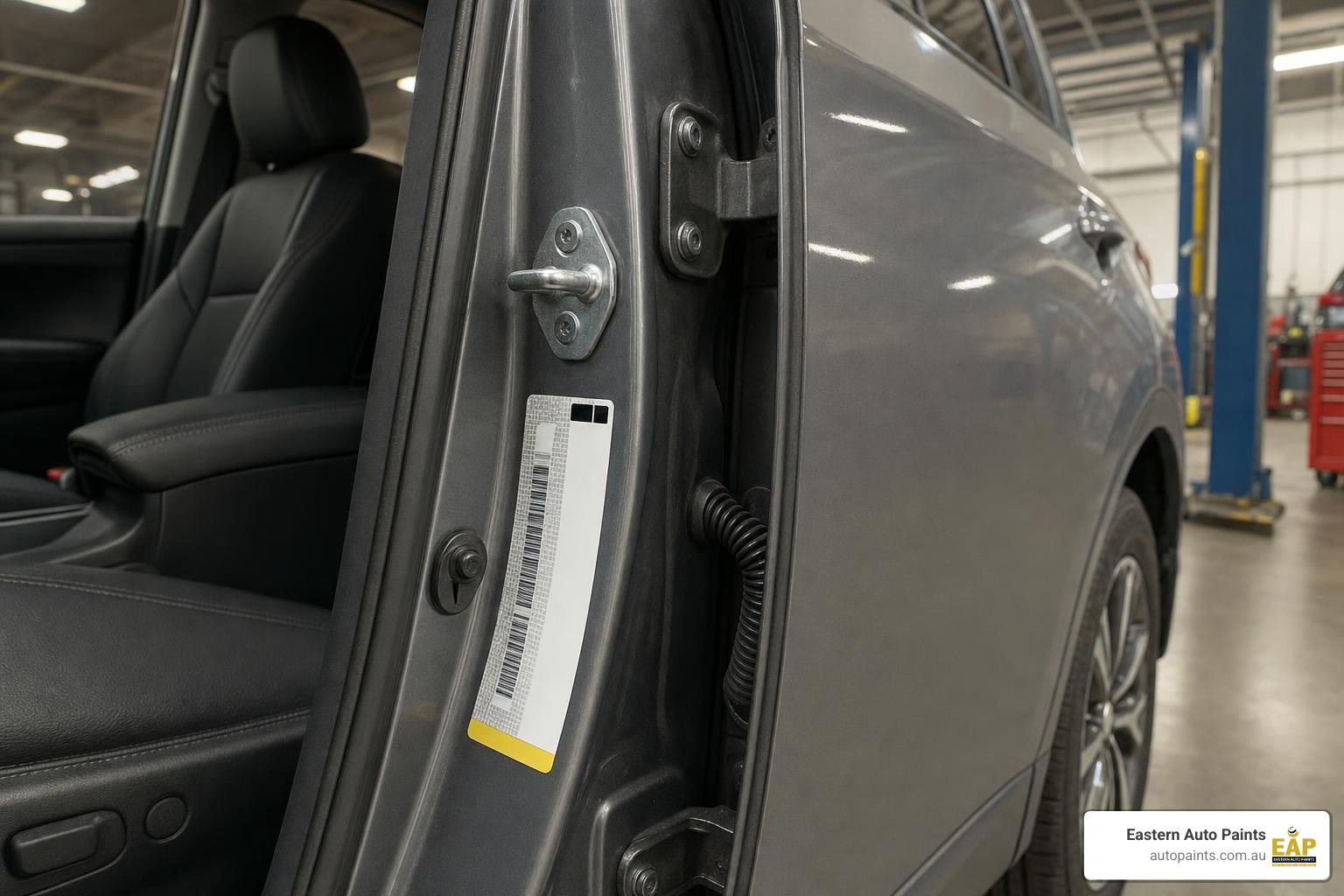
Obtaining an accurate match requires finding the vehicle's original equipment manufacturer (OEM) colour code. Automotive manufacturers stamp or print this code on a vehicle identification number (VIN) compliance plate or door jamb label.
Common code locations include:
- Inside the driver or front passenger door jamb or sill pillar
- Under the bonnet on the radiator support panel or firewall
- Inside the glovebox compartment or spare wheel recess
For a detailed walkthrough on deciphering codes across various car brands, consult our guide on How to Find Paint Code.
Factory colours often have several production variants due to factory batch differences or regional production facilities. When paintwork has experienced prolonged sun exposure, standard factory formulations may differ slightly from the current panel tone. In these instances, our specialist Colour Matching service utilises precision spectrophotometer digital scanning to read the pigment and pearl layout directly from a sample part, such as a fuel flap or tow hook cover.
Step-by-Step Surface Preparation and Spray Application Guide
Consistent spray outcomes depend heavily on meticulous surface preparation and disciplined gun-handling technique.

Step 1: Cleaning and Decontamination
Wash the repair area thoroughly with warm soapy water to remove general grime. Once dry, wipe the entire repair panel using a clean, lint-free cloth saturated with an automotive wax and grease remover. Wipe off the solvent with a second dry microfibre cloth before it evaporates to lift silicone, road tar, and body waxes off the surface.
Step 2: Mechanical Abrasive Scuffing
Scuff the surrounding clear coat or paintwork to provide a mechanical key for adhesion. Feather any chips or damaged areas smooth using fine automotive abrasive papers, tapering the hard edges back into the sound paintwork. For step-by-step guidance on choosing the right foundation coat, explore our selection of primer aerosols. Always check the manufacturer's technical data sheet (TDS) or product label for substrate-specific grit recommendations before sanding.
Step 3: Masking and Ambient Setup
Mask off adjoining body panels, trim, and glass with specialised refinishing tape and masking paper to prevent dry overspray contamination. Ensure the workspace is well ventilated, dry, and shielded from direct breeze or dust. For product-specific personal protective equipment (PPE) requirements, always consult the manufacturer's product label or TDS alongside your state SafeWork or WorkSafe guidance.
Step 4: Controlled Spray Application
Shake the aerosol vigorously for several minutes to fully disperse all internal pigments and metallic agents. Keep the can perpendicular to the surface at a consistent spray distance of 15–25 cm (6–10 in).
Apply smooth, consistent passes with a 50 percent overlap, releasing the nozzle trigger at the end of each stroke. Apply light to medium coats, allowing each coat to flash off thoroughly according to the specific product label or manufacturer TDS before applying subsequent layers.
Curing Times, Defect Prevention, and Long-Term Aftercare
Drying and curing rates depend significantly on atmospheric conditions, ambient temperature, air movement, and paint chemistry. To avoid trapping solvents beneath skinning layers, never rush flash-off intervals between coats. For an in-depth reference on care intervals and application protocols, read our A Comprehensive Guide to Touch Up Paint Spray Cans.
Common application defects and remedies include:
- Solvent Boil (Pinholing): Caused by applying coats too wet or force-drying paint before solvents fully evaporate. Sand flat and re-apply according to the product TDS.
- Runs and Sags: Caused by holding the can too close to the panel or moving too slowly. Allow the run to cure fully, block back with fine wet-and-dry paper, and re-spray.
- Dry Spray Texture: Occurs when the spray distance is too far, causing paint droplets to partially dry mid-air before hitting the panel. Keep the nozzle within the recommended distance.
Once topcoats or clear coats have cured according to their technical data sheets, minor dust nibs and light orange peel can be carefully nibbed and compounded using fine finishing polishes to blend the repair seamlessly into adjacent factory paint.
What a Personalised Experience Actually Looks Like
Achieving a flawless paint finish extends beyond simply ordering an aerosol can. When working with trade paint specialists, you receive comprehensive technical guidance tailored to your specific project. This includes identifying whether your vehicle uses a three-stage pearl system, selecting primer shades that ensure optimal colour opacity, and matching specific industrial topcoats to powder-coated substrates.
Whether you operate a fleet workshop or handle custom vehicle restoration, experienced coatings specialists assess the panel condition, substrate materials, and environmental constraints to recommend the correct combination of preparation solvents, primers, and clear coats.
The Value of Consistency and an Ongoing Relationship
Refinishing efficiency relies on predictability. Having a reliable supplier who maintains accurate tinting records ensures that batch-to-batch colour repeatability remains uniform across recurring vehicle repairs, industrial production runs, and fleet maintenance schedules.
Partnering with an experienced coatings supplier provides direct access to up-to-date formulation databases, troubleshooting advice for difficult pigments, and trade-grade equipment recommendations, such as precision Anest Iwata compressors (with trade units ranging from compact 2hp belt-drive models through to advanced variable-speed rotary screw systems).
What to Expect at Eastern Auto Paints
At Eastern Auto Paints, we supply high-quality automotive paint products, including custom spray paint and touch-up systems. Our unique capability combines advanced digital colour-matching technology with hands-on trade advice to deliver accurate results across trade, commercial, and enthusiast refinishing projects.
From our Melbourne branches in Bayswater and Dandenong South, Victoria, our experienced team provides custom-filled aerosols, commercial topcoats, primers, abrasives, and complete spray equipment tailored to professional workshops and dedicated restorers.
When to Get in Touch or Take Action
If you are dealing with stone chip damage, scratch repairs, fleet repaints, or industrial touch-ups, taking action early prevents oxidation and substrate degradation. Having the correct colour formulation and coating chemistry ready ensures repairs can be completed efficiently and to a professional trade standard.
Reach out to our specialist team via our Contact Page or visit our Victorian branches for tailored advice on your next refinishing project. Explore our comprehensive trade range of custom aerosol solutions, browse our full stock across all products, or review our dedicated aerosol cans collection to find the right coating system for your application.
Frequently Asked Questions About Colour Match Spray Cans
How long do 2K aerosol cans last once activated?
Once the internal activation pin of a two-pack (2K) aerosol is pressed, the hardener mixes with the resin, beginning an irreversible chemical crosslinking reaction. The usable pot life of the can depends entirely on the product chemistry and ambient room temperature. Always consult the specific product label or manufacturer technical data sheet (TDS) for exact pot life windows and storage instructions after activation.
Can custom aerosols match aged or weathered paintwork?
Standard OEM paint codes correspond to the original factory formulation, which may appear darker or more vibrant than a vehicle that has experienced years of sun exposure. In these cases, custom paint formulations can be adjusted by analysing a physical part using a spectrophotometer to account for clear coat fade and environmental weathering before filling the aerosol can.
How many coats of colour and clear should be applied?
The necessary number of passes depends on the paint's pigment concentration, colour transparency, and film build requirements. Basecoats require enough coats to achieve uniform visual opacity across the repair area, while clear coats must achieve sufficient film thickness for protection and future polishing. Consult the manufacturer's technical data sheet (TDS) on each can for exact coat recommendations and flash-off times.
What causes paint to lift or wrinkle when applying a new coat?
Paint wrinkling or lifting typically occurs when aggressive solvents in a new topcoat react with an incompatible, improperly cured, or unsealed lower paint layer. It can also happen when a second coat is applied midway through a previous layer's curing phase rather than within the specified recoat window. Always follow product recoat guidelines and use compatible primer sealers over sensitive substrates.
Why is clear coat necessary over metallic basecoats?
Metallic and pearl basecoat paints are formulated solely to provide pigment coverage and flake alignment, drying to an open, matte, or satin surface. They do not contain chemical binders designed to resist moisture, UV rays, fuel spills, or physical abrasions. Applying a durable clear coat seals the pigment, provides optical depth and gloss, and shields the panel against environmental damage.