
Everything You Need to Know About Infrared Drying Lamps
Why Infrared Drying Technology Matters for Modern Paint Finishing
An infrared drying lamp uses infrared radiation to cure paint and coatings from the inside out, dramatically cutting drying times. Unlike traditional methods that can trap solvents and cause defects, IR technology heats the substrate (the metal or plastic) directly. This allows solvents to escape freely, accelerating the chemical reaction for a faster, smoother, and more durable finish.
For high-volume shops, this means more jobs per day and lower energy costs. For enthusiasts, it means getting projects done faster without compromising quality. With the ability to dry primer in as little as 4 minutes and cure topcoats in 15-30 minutes, an IR lamp is a game-changer. It's ideal for automotive refinishing, industrial coatings, and curing everything from 2K primers and Protec basecoat to 2K clear coats.
With over 30 years in the coatings industry, we at Eastern Auto Paints have seen how the right equipment transforms results. Infrared drying lamps are among the most impactful upgrades for anyone serious about paint finishing. We've guided countless professionals through selecting the right lamp for their needs, from compact single-head units like the JV1 Velocity Head to powerful triple-head systems like the JV3 Velocity Head.
What is an Infrared Drying Lamp and How Does It Work?
An infrared drying lamp uses infrared (IR) radiation to gently heat paint or coatings. Instead of warming the surrounding air like a conventional oven, the IR energy is absorbed by the coating and the surface beneath, helping the paint dry more evenly. This can speed up solvent evaporation and support the curing process, which may result in a smoother, more durable finish. Because the heat is applied directly rather than through the air, it can reduce the risk of surface defects that sometimes happen with traditional drying methods.
Key Components of an IR Lamp
A professional infrared drying lamp consists of several key parts working together. Quartz lamp tubes house heating elements (typically tungsten or carbon filaments) that generate the IR waves. Behind them, polished reflectors focus this energy onto the work surface for maximum efficiency. These components are mounted on mobile stands with hydraulic lifts and lockable casters for precise positioning. Finally, control panels allow for setting timers and power output, with advanced systems like the JV2 Velocity Head and JV3 Velocity Head offering smart controls for dialing in exact settings.
If you're ready to upgrade your workshop efficiency, browse our complete range of heat lamps and panel stands or contact us for personalised recommendations.
The Major Benefits of Using Infrared Curing Technology
For a busy workshop, an infrared drying lamp offers transformative benefits. The technology leads to faster turnaround times, superior finish quality, and increased profitability.

Best Speed and Efficiency
The speed of an infrared drying lamp is its most immediate benefit. A powerful 3,300W system like the JV3 Velocity Head can dry primer in as little as 4 minutes, while a compact JV1 Velocity Head handles smaller areas in 7-17 minutes. Topcoats that take hours to air-dry can be cured in 15-30 minutes, keeping the job moving.
IR technology is also highly effective for waterborne paints. A purpose-built system like the JV2 Velocity Head can cure them in around 6 minutes, eliminating the long flash-off times that traditionally slow down the process.
This speed translates directly to business efficiency. Faster curing means more vehicles through your workshop each day, increasing capacity without physical expansion. The dramatically shorter run times also often lead to lower overall energy costs compared to running heated spray booths for hours. Explore our range of professional heat lamps to find the right match for your workload.
Superior Finish and Durability
Beyond speed, infrared technology delivers a higher quality finish. The inside-out curing process is fundamentally better for paint, preventing common defects like solvent pop and die-back that occur when solvents get trapped. An infrared drying lamp heats from the substrate up, allowing solvents a clear path to escape. The result is a smoother, more uniform finish with fewer defects and costly reworks.
The controlled heating also promotes better chemical cross-linking within the paint, which improves gloss retention, durability, and adhesion. Whether you're applying 2K primers or perfecting 2K clear coats, an infrared drying lamp helps each product perform as the manufacturer intended, delivering a competitive advantage through quality.
Choosing the Right Infrared Drying Lamp: Types and Key Features
Choosing the right infrared drying lamp means matching the tool to your work. Consider your typical job size (spot repairs vs. full panels) and priorities like portability versus coverage area. Key factors include power (wattage), coverage area, adjustability, and control features. While prices vary, the right lamp quickly pays for itself through increased productivity and superior finishes.
| Feature | Short-Wave IR Lamps | Medium-Wave IR Lamps |
|---|---|---|
| Curing Speed | Very Fast (e.g., 4-15 minutes for primer) | Fast (e.g., 25-45 minutes for primer) |
| Penetration Depth | Deep (heats substrate efficiently) | Moderate (more surface warming) |
| Best Applications | Rapid curing of primers, thicker coatings, full repairs | Thinner coatings, waterborne paints, surface drying |
| Filament Temp. | High (around 2,300 K to 3,000 K) | Lower (around 900 K to 1,600 K) |
| Wavelengths | Shorter (e.g., 0.78 µm to 1.4 µm) | Longer (e.g., 1.4 µm to 3 µm) |
Types of Infrared Drying Lamps
Infrared drying lamps come in several configurations to suit different tasks:
- Handheld units offer maximum flexibility for small spot repairs or hard-to-reach areas.
- Single-head stands, like the JV1 Velocity Head, are versatile for small to medium-sized repairs, offering focused coverage.
- Dual-head systems, such as the JV2 Velocity Head, provide broader coverage for larger panels with independently adjustable heads.
- Triple-head systems, like the JV3 Velocity Head, are built for maximum productivity on large areas, with a 3300W output that can dry primer in as little as 4 minutes.
Essential Features for Professional Use
Look for these essential features to ensure professional results and ease of use:
- Smart timers and digital temperature control for precise, repeatable results.
- Hydraulic lifts and 360-degree head rotation for effortless height and angle adjustment.
- Independent head switching on multi-head units to save energy.
- Lockable casters to ensure the stand is both mobile and stable.
Ready to find the right lamp for your workshop? Explore our complete range of heat lamps and stands, or contact us for personalised recommendations.
Applications, Safety, and Maintenance
To get the most from your infrared drying lamp, it's crucial to understand its applications, safety protocols, and maintenance needs. Following best practices ensures both top-quality results and long-term reliability.
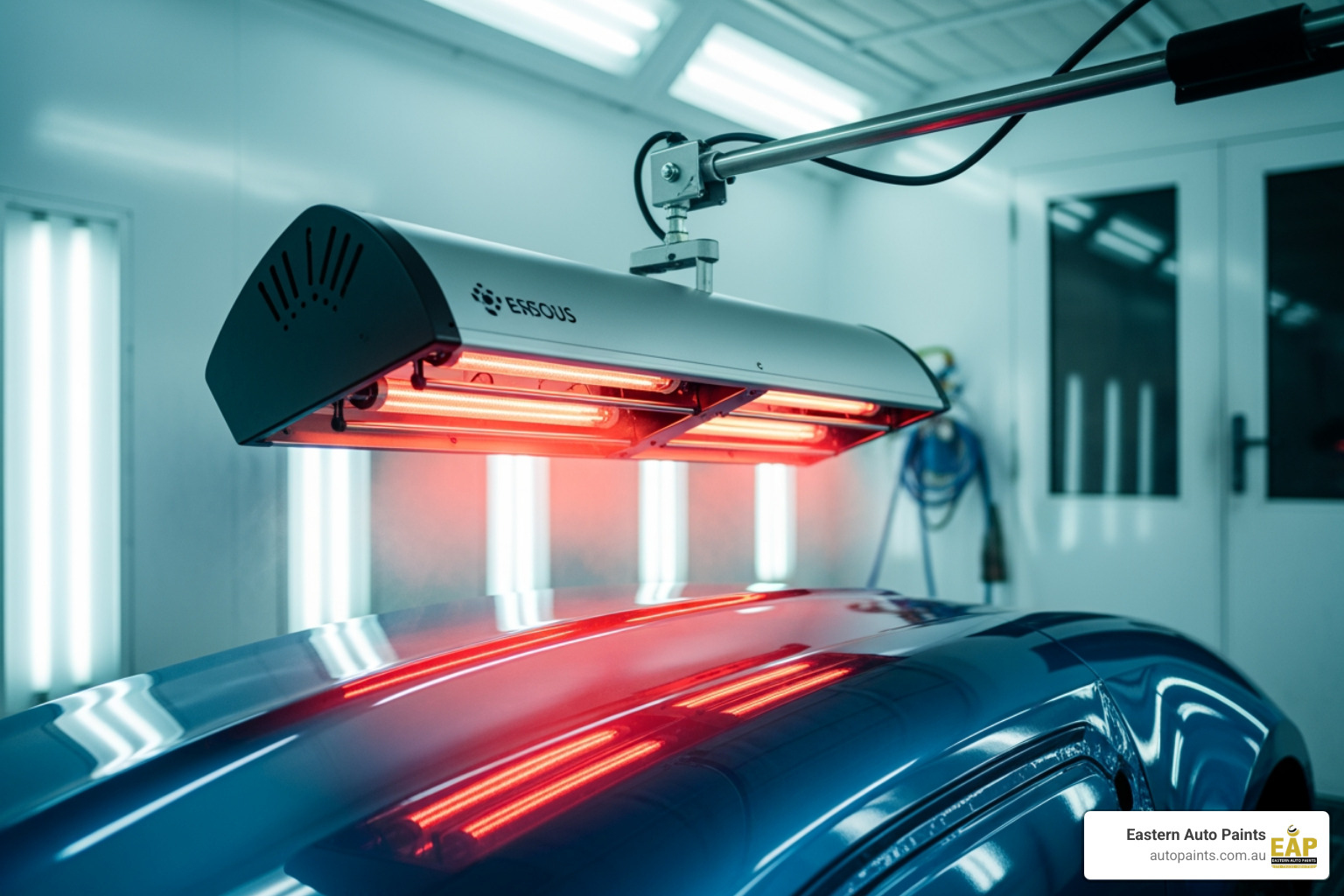
Common Applications for an infrared drying lamp
The speed and precision of an infrared drying lamp make it a versatile tool across several industries:
- Automotive Refinishing: IR lamps accelerate the curing of everything from body fillers and primers like Concept 103 Etch Primer to Protec basecoat and topcoats.
- Industrial Manufacturing: Ideal for rapidly drying industrial coatings and adhesives, such as PPG Industrial Paints, to keep production lines moving.
- Powder Coating: Excellent for pre-heating substrates or for touch-up curing of powdercoat colours.
Safety First: Best Practices for Operation
High-intensity heat demands respect. Always follow these safety protocols:
- Wear Proper PPE: Heat-resistant gloves and safety glasses are mandatory. Use an Air Fed Mask for respiratory protection from paint fumes.
- Ensure Good Ventilation: Your workspace must have adequate ventilation to dissipate solvent vapours released during curing.
- Prevent Fires: Keep all flammable materials well away from the operating lamp.
- Use Correct Lamp Distance: Follow manufacturer guidelines to prevent scorching paint. Our JV1, JV2, and JV3 lamps have adjustable stands to set the perfect distance.
- Check Stability: Ensure the stand is stable and casters are locked before use. Never move a hot lamp.
- Protect Plastic Components: Mask or shield nearby plastic trim and bumpers from intense heat.
Maintaining Your Equipment for Longevity
Regular maintenance ensures your infrared drying lamp performs safely and efficiently:
- Clean Reflectors: Regularly clean dust and overspray from reflectors with a soft cloth (when the lamp is cool) to maintain heat output.
- Replace Bulbs: Keep spare bulbs on hand to avoid downtime. Replace them according to the manufacturer's instructions when they dim or fail.
- Inspect Cords and Stand: Periodically check the power cord for damage and ensure the stand is stable.
If you're looking to add an infrared drying lamp to your workshop, browse our complete collection of heat lamps and panel stands or contact us for personalized recommendations.
Frequently Asked Questions about Infrared Drying Lamps
How long does an infrared lamp take to cure paint?
Curing time depends on the lamp's power, the coating type, and its thickness. A powerful short-wave infrared drying lamp like the JV3 Velocity Head can cure primer in 4-15 minutes and topcoats in 15-30 minutes. However, always consult the paint's Technical Data Sheet (TDS) for specific recommendations and perform a test on a small panel first to dial in your settings. If you're unsure, contact us for advice on the products you're using.
Can I use an infrared lamp on any type of paint?
Yes, infrared drying lamps are highly versatile and effective on most modern automotive and industrial coatings. This includes 2K primers, waterborne basecoats like Protec basecoat, 2K clear coats, and even body fillers. Because some specialty coatings have unique requirements, we always recommend checking the manufacturer's guidelines and running a quick test panel first. If you're uncertain about a specific coating, our team can help.
Is an infrared lamp better than a standard heat gun?
For curing paint, an infrared drying lamp is far superior. A heat gun uses convection (hot air), which can dry the paint surface too quickly and trap solvents, leading to defects like solvent pop. An IR lamp uses radiation to cure from the inside out, allowing solvents to escape properly. This results in a faster, more durable, and higher-quality finish. While heat guns are useful for other tasks, they are not the right tool for curing paint. For professional results, an infrared lamp like the JV1 Velocity Head or JV2 Velocity Head is the correct choice.
Accelerate Your Workflow with the Right Technology
An infrared drying lamp is a transformative tool for any serious paint finisher. It delivers rapid, inside-out curing that slashes turnaround times, creates a superior finish, and boosts productivity. For professionals, this means more jobs and lower energy costs; for enthusiasts, it means professional-grade results without the long wait.
At Eastern Auto Paints, we pair high-quality automotive and industrial paints with the expert advice and professional equipment needed for a perfect finish. We've seen how the right infrared drying lamp can transform a workshop's efficiency, helping refinishers across Victoria, Sydney, and Queensland work smarter, not harder.
Ready to upgrade your workflow? Browse our complete collection of infrared drying lamps, from the versatile JV1 Velocity Head to the powerful JV3 Velocity Head.
Not sure which model is right for you? Contact us for personalised recommendations. Our expert team is here to help you find the perfect solution for your needs.