

The Ultimate Body Filler Guide: Tips, Tools, and Common Mistakes
What Body Filler Is and Why You Need It
Body filler is a thick polyester resin mixed with a cream hardener, creating a putty-like substance for repairing vehicle damage. It's the primary solution for fixing dents, scratches, small holes, and other minor imperfections in automotive bodywork.
Quick Answer for Body Filler:
- What it does: Fills dents, scratches, and holes in metal, fibreglass, and some plastics
- Main types: Standard (lightweight), Medium (fibreglass-reinforced), Premium (aluminium-filled)
- Maximum thickness: 6 mm (1/4 inch) per layer
- Drying time: 20-30 minutes before sanding
- Key requirement: Must be applied to clean, bare metal (never over rust or paint)
- Common brands: U-POL Fantastic, Evercoat Rage Gold, Concept Lightweight
Body filler has a mixed reputation. When applied incorrectly, it can fail and look worse than the original damage. However, when used properly, it's an essential tool that delivers lasting, professional results.
Success depends on understanding what body filler can and can't do, choosing the right type, and following proper application techniques. This guide covers every step, from surface preparation to final finishing.
With over 30 years in the coatings industry at Eastern Auto Paints, we've helped countless customers master body filler repairs. This guide shares our hands-on experience to help you achieve professional results.

Choosing the Right Filler: Types and Applications
Selecting the correct body filler is the difference between a repair that lasts and one that fails. Different repairs require different fillers.

Standard lightweight fillers are workhorses for small scratches and minor dents. They spread smoothly and sand easily, making them ideal for surface-level damage. Our Concept Lightweight Body Filler is a popular, easy-to-use choice for these repairs.
For tiny holes or tears in metal or fibreglass, fibreglass-reinforced fillers provide extra strength and structural integrity. The fibreglass strands bridge gaps that standard fillers cannot. The U-POL Fibral Glass Fibre Filler works brilliantly for these applications.
For larger repairs and deeper dents, premium fillers are worth the investment. They contain aluminium particles for added strength and stability, shrink less during curing, and sand more smoothly. Both Evercoat Rage Gold and Roberlo Maxifill Bodyfiller are premium-grade options trusted by professionals.
On parts that see high heat or go through powder coating, like wheels, valve covers, and exhaust brackets, use a high-temperature filler. Conventional fillers can crack or outgas during powder coat curing. Here is the link to our high temp filler https://autopaints.com.au/products/spec-high-temp-filler
Understanding Body Filler vs. Putty
Many DIYers confuse body filler, glazing putty, and polyester putty. They serve different purposes, and using the wrong one leads to disappointing results.
Body filler is a structural repair material for dents and imperfections up to 6 mm (1/4 inch) deep. It's a two-part, resin-based product that can be moulded, sanded, and painted.
Glazing putty is a fine, cosmetic product for filling tiny pinholes and scratches after sanding the main filler. It provides no structural support. Avoid one-part glazing putties, as they shrink over time and cause imperfections to reappear through the paint.
Polyester putty is a two-part product that bridges the gap between body filler and glazing putty. It's finer than filler and is used for final surface finishing of sand scratches and pinholes. Because it's a two-part system, it doesn't shrink. Our U-POL Reface Polyester Filler is ideal for these finishing touches.
| Product Type | Primary Purpose | Repair Size/Depth | Key Characteristics |
|---|---|---|---|
| Body Filler | Filling dents, scratches, and larger imperfections | Up to 6 mm (1/4 inch) deep, structural support | Resin-based, requires hardener, provides structural fill, can be moulded, sanded, and painted |
| Glazing Putty | Filling fine scratches, pinholes, minor surface flaws | Very shallow, cosmetic only | Finer consistency than filler, used for final surface finishing, not for filling holes. Avoid one-part putties as they shrink |
| Polyester Putty | Filling sand scratches, tiny pinholes | Shallow, cosmetic only | Two-part putty, similar to body filler in composition but finer, does not shrink like one-part glazing putties |
The bottom line: use body filler for structural repairs, polyester putty for fine finishing, and avoid one-part glazing putties to prevent future issues.
Essential Tools, Safety, and Surface Preparation
Proper preparation accounts for about 80% of a professional, long-lasting finish. Rushing this stage is a common cause of failed repairs. Your repair is only as good as the surface underneath it.
Gathering Your Essential Tools
You will need the right body filler and its cream hardener. For mixing, use a clean, non-porous mixing board; avoid cardboard, as it absorbs resin and compromises the repair.
We recommend having both plastic applicators for general use and metal applicators for cleaner edges and durability.
You'll also need a quality degreaser, automotive sandpaper (80-grit to 240-grit or finer), and sanding blocks. For larger repairs, a dual-action (DA) sander helps with feathering edges, and body files ("cheese graters") are useful for quickly removing excess cured filler.
Protecting Yourself: Safety Comes First
Working with body filler involves chemicals and fine dust, so safety is paramount. Always work in a well-ventilated area. When sanding, wear a high-quality respirator or PPE mask to protect your lungs.
Always wear gloves to protect your skin and safety glasses for your eyes. Before you start, make sure to check the product's Safety Data Sheet (SDS) for important handling and safety details.
Preparing the Surface: Where Success Begins
Surface preparation is critical. Start by washing the area with a quality degreaser to remove contaminants like dirt, grease, and wax. Rinse and dry completely.
Now, address the most important rule: NEVER apply body filler over rust. Rust will continue to spread underneath, causing the filler to crack, bubble, and fail. This will make the problem worse than when you started.
If rust is present, sand or grind it off completely. For more serious rust, you may need to cut it out and patch the area. For hard-to-remove surface rust, treat it first with a product from our rust repair and prevention range. This creates a stable surface and stops further corrosion.
For optimal adhesion, sand the damaged area down to bare, clean metal, extending 25-50 mm (1-2 inches) beyond the damage. Use 80-grit sandpaper to create a good "tooth" for the filler to grip.
Finally, feather any sharp paint edges around the repair area to create a smooth transition. This helps the filler blend seamlessly and prevents visible lines after painting. A smoother feathering job leads to a better final result.
A Step-by-Step Guide to Applying and Sanding Body filler
With the surface prepared, it's time to mix and apply the body filler. Getting this stage right is key to a lasting repair.
Correctly Mixing Your Body Filler
Mixing body filler is a time-sensitive chemical reaction. The hardener transforms the paste into a solid surface.
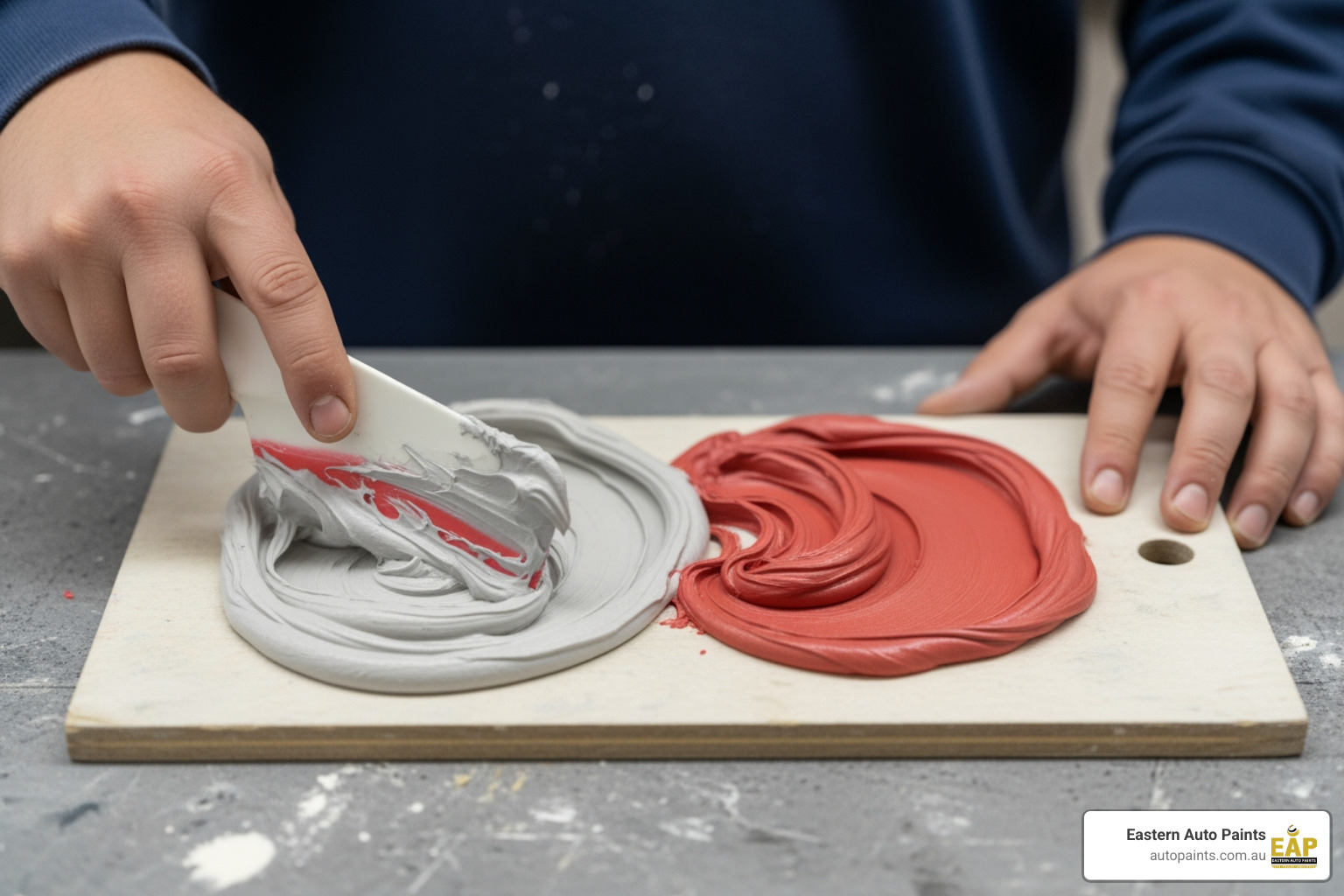
Dispense only what you can apply within the 3-5 minute working time. It's better to mix a second small batch than to waste material.
The golden rule is the 2% ratio of hardener to filler. For products like our U-POL Fantastic Body Filler, this is a ribbon of hardener across a 10 cm (4-inch) puddle of filler. Too little hardener prevents proper curing; too much makes it brittle and cure too quickly.
Fold the hardener into the filler until you have a uniform colour with no streaks. Mix thoroughly but avoid vigorous stirring, which introduces air bubbles that can cause pinholes.
Application and Curing
Apply the filler methodically in layers. Using a plastic spreader or a metal one, apply the filler with firm, confident pressure to force it into every scratch for proper adhesion.
For deeper damage, build up in thin layers. The maximum thickness for a single application is 6 mm (1/4 inch). Thicker layers can crack, shrink, and fail to adhere. Apply one layer, let it cure, then add another.
Extend the filler slightly beyond the damaged area to help with blending later. Shape it as close to the original contour as possible while it's still workable to save sanding time.
Drying and Curing:
Body filler typically cures to a sandable state in 20–30 minutes at an ideal temperature of around 20–25°C. It’s ready when it feels firm and completely non-tacky. Temperature and humidity affect cure time, with cooler or damp conditions slowing the process. You can use a gentle, evenly applied heat lamp to speed it up if needed, but avoid excessive heat. Sanding too early will clog your sandpaper and can tear or lift the repair.
Shaping and Sanding Your Body Filler
Sanding sculpts the filler to match the panel's contour. Constantly feel the surface with your hand to check for a seamless transition.

Begin shaping with coarse 80-grit to 100-grit sandpaper on a sanding block. A body file ("cheese grater") can quickly knock down high spots, but use it carefully to avoid gouging.
Once the shape is correct, switch to 180-grit sandpaper for intermediate smoothing, followed by 240-grit for finishing. This progression is crucial to remove coarse scratches that can show through the final paint job.
Finally, feather the edges where the repair meets the original paint. Use a dual-action (DA) sander with 150-grit or 220-grit sandpaper to create a gradual, invisible transition. The repair should flow so smoothly into the surrounding panel that you can't feel the edge.
Finishing Your Repair and Avoiding Common Mistakes
After sanding, the final stage is to protect the repair and blend the finish. Attention to detail here is crucial for a seamless result.
Final Finishing Steps:
Once your body filler is smooth and feathered, apply a 2K primer over the entire repair area. Primer fills tiny imperfections, creates a uniform surface for paint, and provides essential corrosion protection.
For best results, apply a light guide coat (a dusting of contrasting paint colour) over the primer. When you sand the primer, any low spots will remain coloured, making them easy to spot and correct.
After the primer cures, wet or dry sand it with 400-grit or 600-grit sandpaper until it's perfectly smooth. This ensures a flawless foundation for your topcoat.
Painting the Repair:
We use advanced technology to provide precise colour matching spray paints for your vehicle. Apply several light, even coats of your matched basecoat colour, blending it into the surrounding paint. Finish with a high-quality clear coat to protect the basecoat and provide a factory-fresh gloss.
Common Mistakes to Avoid:
After 30 years of experience, we've seen these mistakes most often. Avoid them for a successful repair.
- Improper mixing: Using the wrong ratio or not mixing thoroughly causes soft spots and poor curing. Mix to a uniform colour with no streaks.
- Applying too thick: Exceeding the 6 mm (1/4 inch) maximum thickness per layer can cause cracking, shrinking, and delamination. Build depth with multiple thin layers.
- Sanding through pinholes: These tiny air bubbles will show through your paint. Minimise them with proper mixing and firm application. Fill any remaining pinholes with polyester putty before priming.
- Applying over rust or paint: This is a critical error. Body filler needs a clean, bare, roughened surface to bond properly and last.
- Insufficient drying time: Sanding before the filler is fully cured leads to smearing and a poor finish. Be patient and let it cure completely.
Pro Tips for a Long-Lasting Repair:
- Use heat lamps: In cool weather, heat lamps accelerate curing and ensure optimal hardness.
- Clean tools immediately: Wipe applicators and mixing boards with acetone before the filler hardens.
- Use fresh hardener: Old hardener loses potency and can cause improper curing.
- Always prime: Apply a quality primer or epoxy sealer over the filler before painting to protect it and ensure a durable, professional finish.
Frequently Asked Questions about Body Filler Use
Here are answers to the most common questions we receive about body filler.
What is the maximum recommended thickness for a body filler application?
The maximum thickness is 6 mm (1/4 inch) per layer. Applying it thicker is a common mistake that leads to improper curing, cracking, shrinking, and poor adhesion. For deeper damage, build it up in thin layers, letting each one cure completely before adding the next. Even premium fillers like our Roberlo ME1 Multifiller Express should be applied within sensible limits.
How long does body filler need to dry before I can start sanding it?
Most body filler is ready for sanding in 20 to 30 minutes at room temperature (around 20-25°C). However, this is only a guideline. Temperature and humidity make a huge difference; cold or humid conditions will significantly extend the curing time. Use a heat lamp in less-than-ideal conditions to help. The filler is ready when it is completely hard with no tackiness. Sanding too early will ruin your work.
Can I apply body filler directly over existing car paint?
No. Body filler requires a clean, roughened, bare metal surface to create a strong mechanical bond. Applying filler over paint is a recipe for failure. The paint itself can separate from the metal, or the filler's chemicals can react with the paint, causing delamination. You will not get the structural integrity needed for a lasting repair. Always take the time to sand the repair area down to bare metal using proper preparation techniques. It's more work upfront, but it's the only way to ensure the repair lasts.
If you're unsure about any aspect of your project, our team at Eastern Auto Paints is here to help. With 34 years of experience, we've seen it all. Contact us for expert advice custom to your specific repair.
Conclusion
Working with body filler doesn't have to be intimidating. Following the correct steps for preparation, mixing, and sanding ensures a professional, long-lasting repair. A lasting result depends on respecting the fundamentals: proper preparation and application technique.
At Eastern Auto Paints, we've supported automotive professionals and DIY enthusiasts across Australia for over 34 years. Our team understands these products inside and out. Whether you need a lightweight filler for minor scratches or a premium option for deeper dents, we can help you select the right product.
Our Melbourne-based store stocks everything from body filler and applicators to primers and colour-matched paints. We pride ourselves on providing the expert advice that turns a challenging repair into a successful one.
Achieving a flawless finish is about working methodically and using quality products. When you combine proper technique with professional-grade materials, you'll be amazed at what you can accomplish.
Find all the professional-grade body fillers and supplies you need at AutoPaints.com.au, or reach out to our knowledgeable team for personalised advice on your next project.