
How to Find Car Paint Code in 5 Easy Steps
Why the Paint Code on Your Car Is the First Step to a Flawless Finish
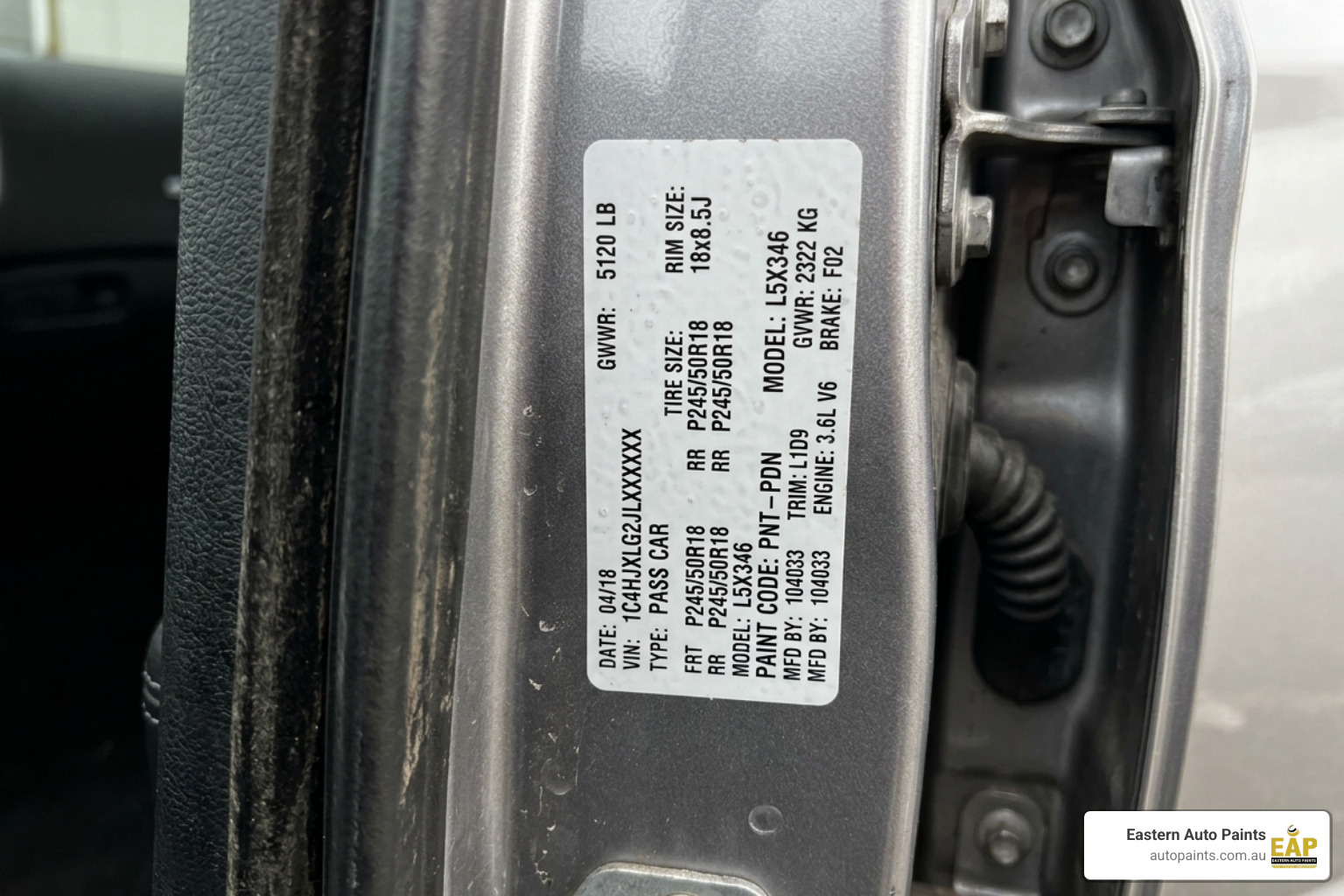
Finding the paint code on your car is the single most important step before ordering any touch-up paint. Without it, you are guessing, and a near-miss colour on a fresh repair can stand out more than the original scratch ever did.
Here is a quick answer if you just need the essentials:
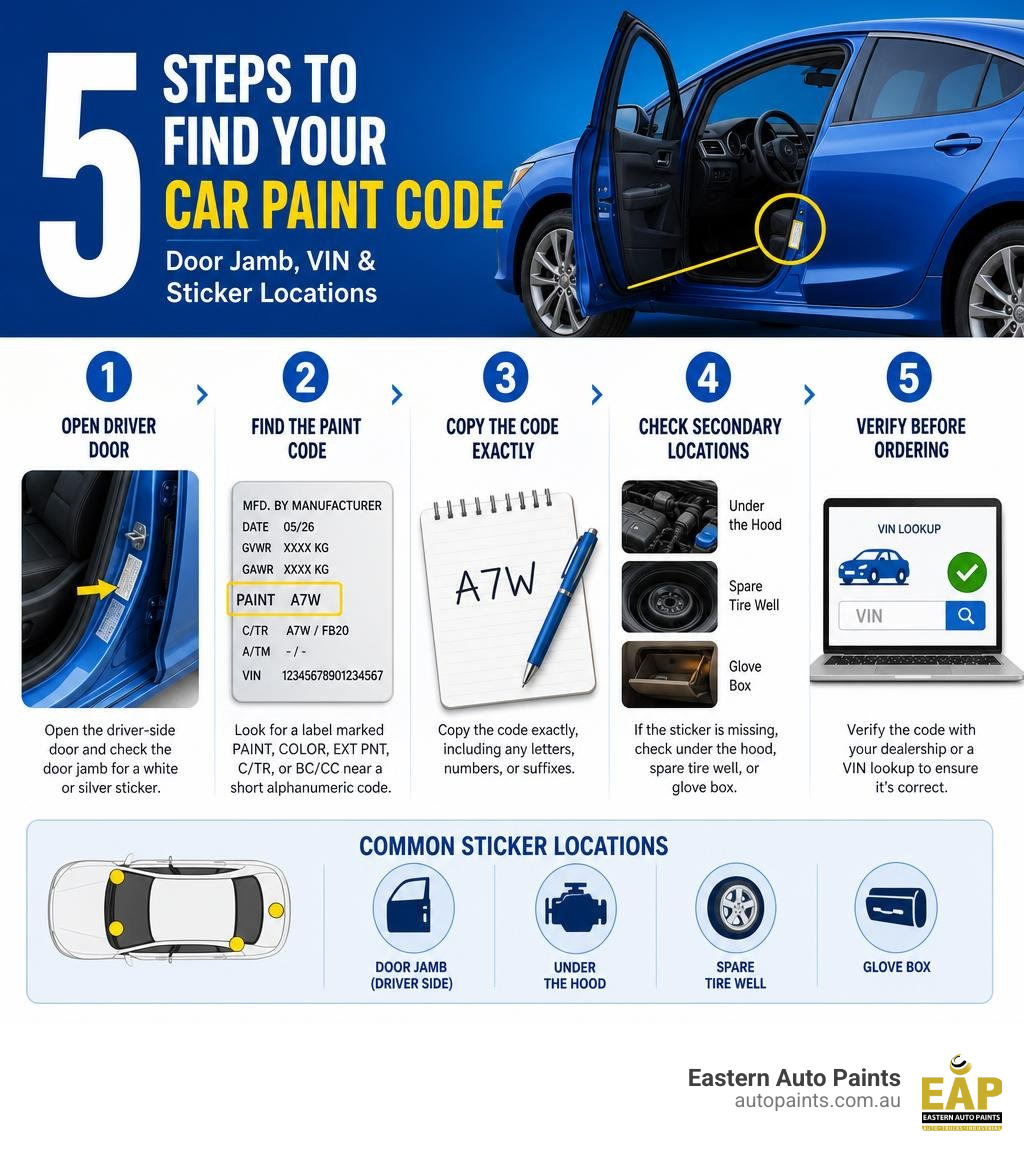
How to find your car paint code in 5 steps:
- Open the driver-side door and check the door jamb for a white or silver sticker.
- Look for a label marked PAINT, COLOR, EXT PNT, C/TR, or BC/CC near a short alphanumeric code.
- Copy the code exactly, including any letters, numbers, or suffixes.
- If the sticker is missing, check secondary locations: under the hood, spare tyre well, or glove box.
- Verify the code with your dealership or a VIN (Vehicle Identification Number) lookup before ordering paint.
The challenge is that every manufacturer places the sticker somewhere slightly different, and the code format varies widely. A Toyota code looks nothing like a BMW code, and confusing the two can send you down the wrong path entirely.
That is what this guide is here to solve. We will walk you through exactly where to look, how to read what you find, how to verify it is correct, and how to use it to get a result that genuinely blends with your factory finish. For a deeper dive into the lookup process, our How to Find Paint Code guide is a useful companion resource.
I'm James Maranis, owner of Eastern Auto Paints, and after more than 30 years working with coatings across automotive, industrial, and specialty applications, I've seen how often an incorrect paint code on a car leads to a mismatch that could have easily been avoided. In the sections that follow, we'll share the practical knowledge our team uses every day to help car owners and trade professionals get colour matching right the first time.
What is a Paint Code on a Car and Why Does It Matter?
The paint code on your car is a unique identifier assigned by the manufacturer that dictates the exact chemical recipe used to mix your vehicle's original finish. Unlike general colour names, which are primarily marketing terms, the code links directly to a precise technical formulation.
For instance, a manufacturer might call a shade "Crystal Black Pearl" or "Midnight Shadow," but they may use different pigments or flake sizes for that name across different models or production years. Relying solely on the marketing name can result in buying a formulation that does not match your specific vehicle.
Using the exact code is the only reliable way to ensure your touch-up paint blends seamlessly. To understand how these codes are used during the mixing process, you can read our Car Paint Colour Matching Guide, which explains how we translate these codes into physical paint.
Understanding the Paint Code on Car Formats
Automotive paint codes are typically short alphanumeric sequences, usually ranging between two and seven characters depending on the manufacturer. For example, Toyota codes are frequently three characters long, while General Motors codes often appear as a longer sequence beginning with letters like WA.
These formats vary by brand family, meaning a single colour shade can have multiple equivalent representations on a sticker. Understanding these variations helps you identify which part of the vehicle information label is actually the paint code rather than a trim or transmission code.
Because these labels contain a large amount of build data, pinpointing the correct sequence is critical. If you want to learn more about how paint formulations are structured, our guide on How to Understand Paint Colour Matching in 3 Easy Steps breaks down the fundamental concepts.
Solid, Metallic, Pearl, and Tri-Coat Finishes
The paint code also indicates the complexity of your vehicle's finish. A solid finish is the most straightforward, consisting of a simple basecoat colour followed by a protective clearcoat.
Metallic finishes introduce tiny aluminium flakes that catch the light, while pearl finishes utilise ceramic mica crystals to create a deep, shifting shimmer. Tri-coat finishes are even more complex, requiring a base colour coat, a translucent mid-coat containing the pearl or mica, and a final clearcoat layer.
Matching these multi-stage finishes requires precise techniques, as a standard single-stage touch-up pen cannot replicate the depth of a tri-coat pearl. For advanced tips on handling these complex finishes, you can consult our resource on Professional Tips for a Perfect Car Colour Match on Vehicles.
How to Find Your Vehicle's Paint Code: Locations and Formats
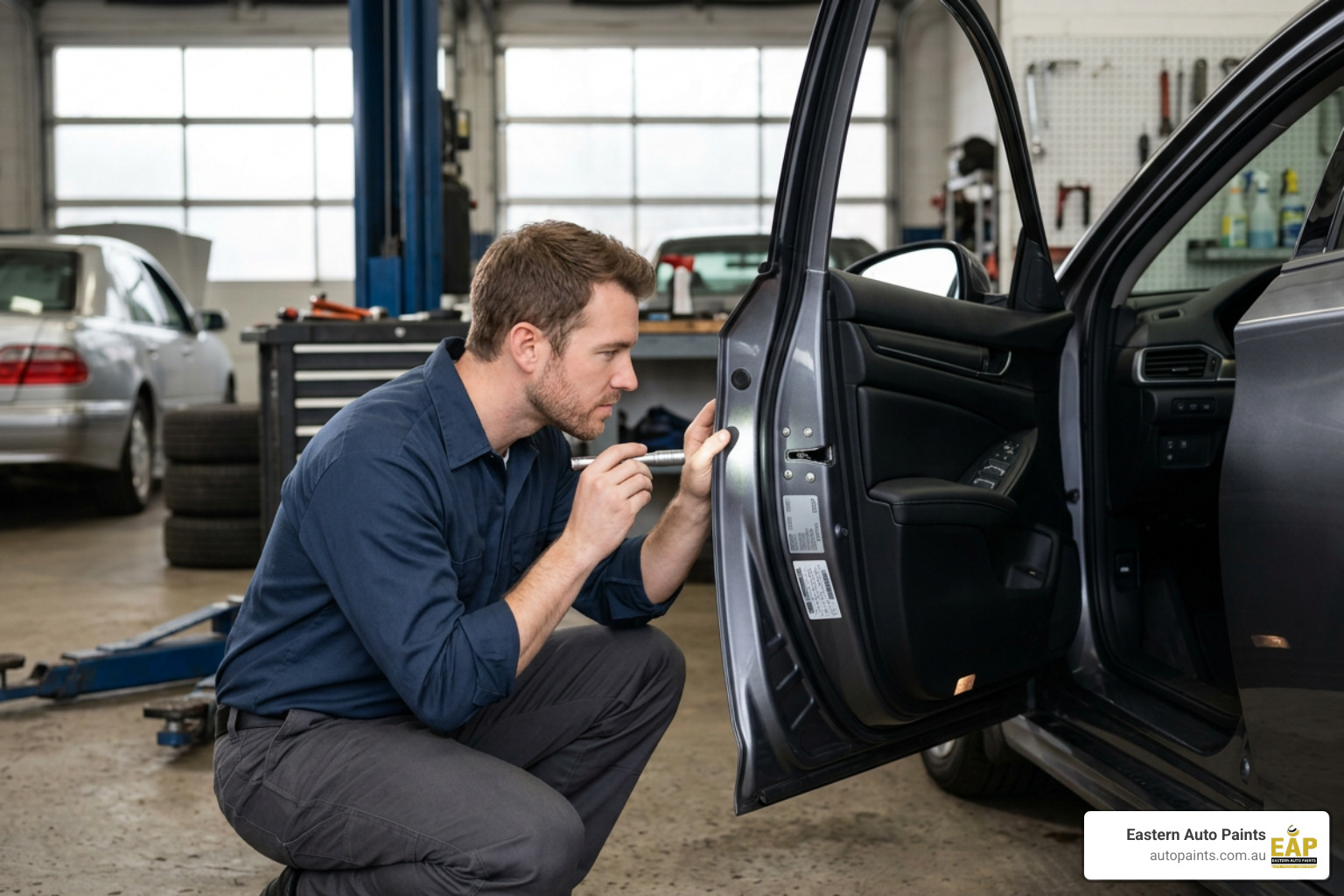
Locating the physical sticker on your vehicle is the most reliable way to identify your paint code. While the driver-side door jamb is the most common location across many brands, manufacturers have placed these labels in various secondary spots over the years.
Finding the sticker sometimes requires a brief search of the vehicle. Common secondary locations include the engine bay, the trunk compartment near the spare tire, or inside the glove box.
To help you narrow down your search, we have compiled a table of the most common locations and formats used by major manufacturer groups.
| Manufacturer Group | Primary Sticker Location | Common Code Format | Label Identifiers to Look For |
|---|---|---|---|
| Toyota & Lexus | Driver-side door jamb | 3-digit alphanumeric | C/TR (e.g., C/TR: 1C8) |
| Honda & Acura | Driver-side door jamb | Usually 5 to 6 characters, often with a hyphen | PAINT, COLOR (e.g., NH-731P) |
| Ford & Lincoln | Driver-side door jamb | 2-digit alphanumeric | EXT PNT, EXTERIOR PAINT |
| General Motors | Driver-side door jamb or glove box | Varies by model and year, often using WA, U, or L identifiers | BC/CC, WA, U, L (e.g., WA-L8240 or U8240) |
| BMW & Mini | Engine bay strut tower or door jamb | Typically a 3-digit code; label wording and location vary by model | Farbcode, Paint Code |
| Audi & Volkswagen | Spare tire well or trunk floor | Typically 3 to 4 alphanumeric characters | Paint No., Lacknr. (e.g., LY9C) |
Step-by-Step Guide to Finding the Sticker
To find the sticker systematically, start by opening the driver-side door and examining the door pillar and the door jamb itself. Look for a durable white, black, or silver metal or vinyl label containing bar codes and tyre pressure information.
If it is not there, pop the hood and inspect the radiator support panel, the firewall at the back of the engine bay, or the top of the strut towers. These locations are particularly common on older vehicles and European models.
For hatchbacks, wagons, and sedans, lift the boot carpet and check the spare tyre well or the underside of the boot lid. Some brands, particularly within the Volkswagen Audi group, place a paper build sheet in this area which contains the paint code.
Verify the Paint Code on Car with Your VIN
If you find a code but want to be absolutely sure before mixing paint, you can verify it using your vehicle's 17-character VIN. The VIN is unique to your vehicle and is recorded in the manufacturer's build database alongside the exact paint formula used on the assembly line.
You can contact the parts desk of a local dealership for your brand and ask them to look up the paint code using your VIN. This is an excellent way to confirm your findings, especially if the physical sticker is partially damaged or faded.
Using the VIN to cross-reference your findings helps prevent errors caused by misreading similar characters, such as the number zero and the letter O. For more details on matching paint using factory codes, see our article on Touch Up Paint Colour Match.
Manufacturer-Specific Locations (Toyota, Honda, Ford, GM, BMW, Audi)
Toyota and Lexus place their paint codes on the driver-side door jamb, typically on a black identification plate. Look for the letters "C/TR" (which stands for Colour and Trim) and use the three-character code immediately following it.
Ford vehicles also keep the code on the driver-side door pillar, usually at the bottom of the manufacturing label under the words "EXT PNT" or "EXTERIOR PAINT." These codes are typically two characters long and may consist of letters, numbers, or a combination of both.
General Motors vehicles often display their paint codes on a Service Parts Identification (SPID) label, which can be located in the glove box, the trunk, or the door jamb. The code is usually noted near the bottom of the sticker, often prefixed with "WA" and sometimes followed by "U" (upper colour) or "L" (lower colour) for two-tone designs.
To explore the nuances of mixing paint based on these brand-specific codes, read our guide on Mixing Matching Car Paint Colours.
Best Practices for Ordering and Applying Your Touch-Up Paint
Once you have identified the correct code, the next step is selecting the right paint product and applying it correctly. Achieving a durable repair requires proper preparation and the use of quality auto paints and clearcoats.
Applying touch-up paint is a process that depends heavily on the size of the damage and your working environment. Taking your time during the preparation phase will always yield a more reliable result.
What to Do If the Paint Code Sticker Is Missing or Faded
If your vehicle's paint code sticker is completely missing, faded, or unreadable, do not despair. Your first option is to use a VIN lookup tool or contact a local dealership parts department to retrieve the factory code from the manufacturer's database.
However, if the vehicle has been repainted in a non-original colour by a previous owner, the factory paint code will no longer match the current finish. In this situation, the best approach is to have the colour scanned using a professional spectrophotometer at a specialist paint supplier.
Our team at Eastern Auto Paints can assist with advanced colour scanning and custom mixing to match the current state of your vehicle's finish. If you are dealing with a missing sticker or an aftermarket paint job, please contact our team so we can help you find the correct solution.
Choosing the Right Paint Product for Your Damage
The type of paint product you choose should match the scale of the damage you are repairing. For tiny rock chips smaller than a pencil eraser, a touch-up pen or a fine brush-in-bottle is often the most appropriate choice.
For larger scratches, scuffs, or repaired panels, a spray application can help achieve an even laydown of metallic or pearl flakes. Choose a colour-matched aerosol product suited to the repair area and finish you are working with.
Aerosol cans provide a much more uniform finish over larger areas than a brush, making them one of the best ways to blend repairs into the surrounding panels.
Essential Steps for a Professional-Grade Application
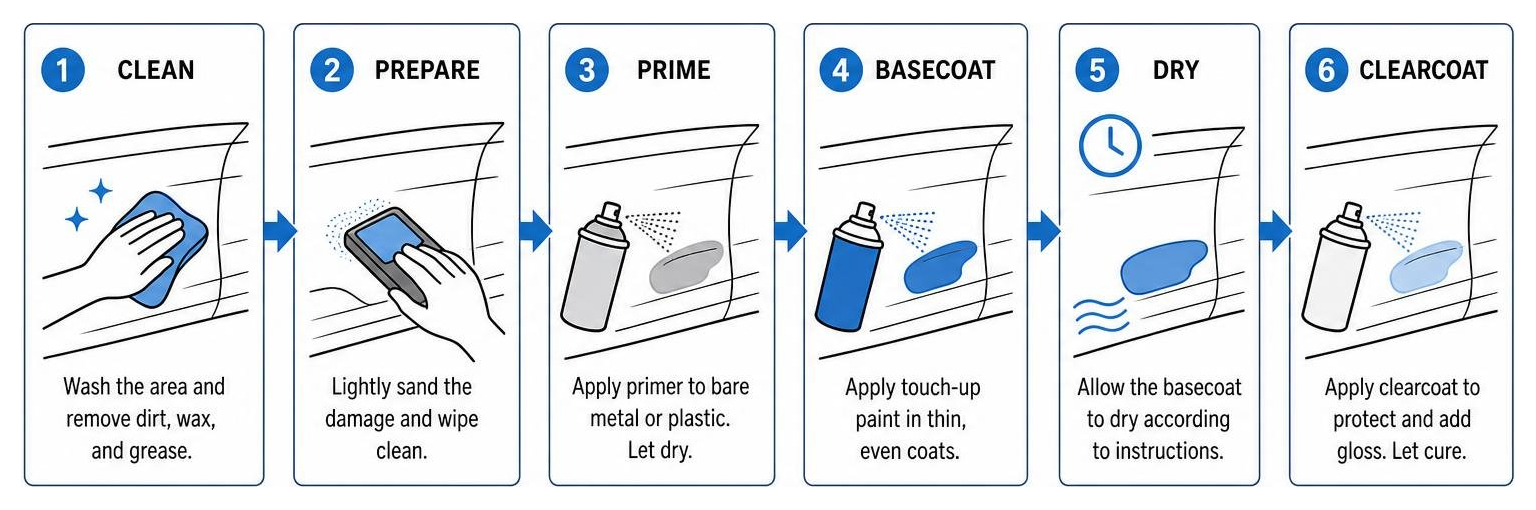
Before applying any paint, the surface must be thoroughly cleaned, free of wax, grease, and rust, and lightly sanded to promote adhesion. If you are painting over bare metal or plastic, applying a primer is a necessary step to prevent peeling and rust. When sanding, ensure you only use sandpaper grits between 80 and 2000 to prepare the surface correctly.
You could consider using a 1K primer for quick, simple repairs, or a 2K primer for maximum build and corrosion resistance. That 1K paint will typically require additional finishing steps or topcoats, such as a high-quality clearcoat 2K, to achieve a durable professional result.
To accelerate the curing process and ensure an even, deep dry of your coatings, professional workshops often utilise infrared drying technology. You could consider using a portable unit like the JV1 Velocity Infrared Drying Head 1 to cure your primers, basecoats, and clearcoats quickly and efficiently. For larger setups, the JV2 Velocity Infrared Drying Head 2 or the JV3 Velocity Infrared Drying Head 3 offer expanded coverage and power.
Get Expert Colour Matching and Premium Paint Supplies
At Eastern Auto Paints, we have supplied high-quality automotive, truck, and industrial coatings for over 34 years from our locations in Victoria. Our team combines deep technical knowledge with advanced colour-matching technology to help you get the exact shade you need, whether you are a professional panel beater or an advanced DIY enthusiast.
We stock a comprehensive range of premium refinish products, custom aerosol cans, and professional spray equipment. We always recommend getting in touch with our team to discuss your project requirements before starting, as results will vary depending on surface preparation, application technique, and environmental conditions.
To get started on your next repair, visit our colour matching page or contact our team directly for expert advice and premium supplies.
Frequently Asked Questions About Paint Codes
Where is the paint code on my car?
The paint code is typically located on a metal or vinyl identification sticker inside the driver-side door jamb. If it is not visible on the door pillar or jamb, you can check secondary locations such as under the hood on the radiator support, inside the glove box, or under the boot carpet in the spare tyre well.
Can I find my car's paint code using the VIN?
You can find your car's original factory paint code by contacting a local dealership parts department and providing them with your 17-character Vehicle Identification Number. The dealership can access the manufacturer's build database to retrieve the exact paint code assigned to your vehicle when it was manufactured.
What is the difference between a paint code and a colour name?
A colour name is a marketing term used by vehicle manufacturers to describe a paint shade, which can sometimes represent slightly different formulations across different models or years. A paint code is a technical alphanumeric sequence that refers to the exact chemical recipe required to mix and match that specific paint formulation.
What should I do if my car has been repainted?
If your vehicle has been repainted in a non-original colour by a previous owner, the factory paint code on the door jamb sticker will no longer be accurate. In this case, you will need to visit a professional paint supplier to have the current finish scanned with a spectrophotometer to create a custom-matched formulation.