
Paint Code Secrets Revealed Plus Expert Colour Matching
Why Your Car's Paint Code is the Secret to a Perfect Finish
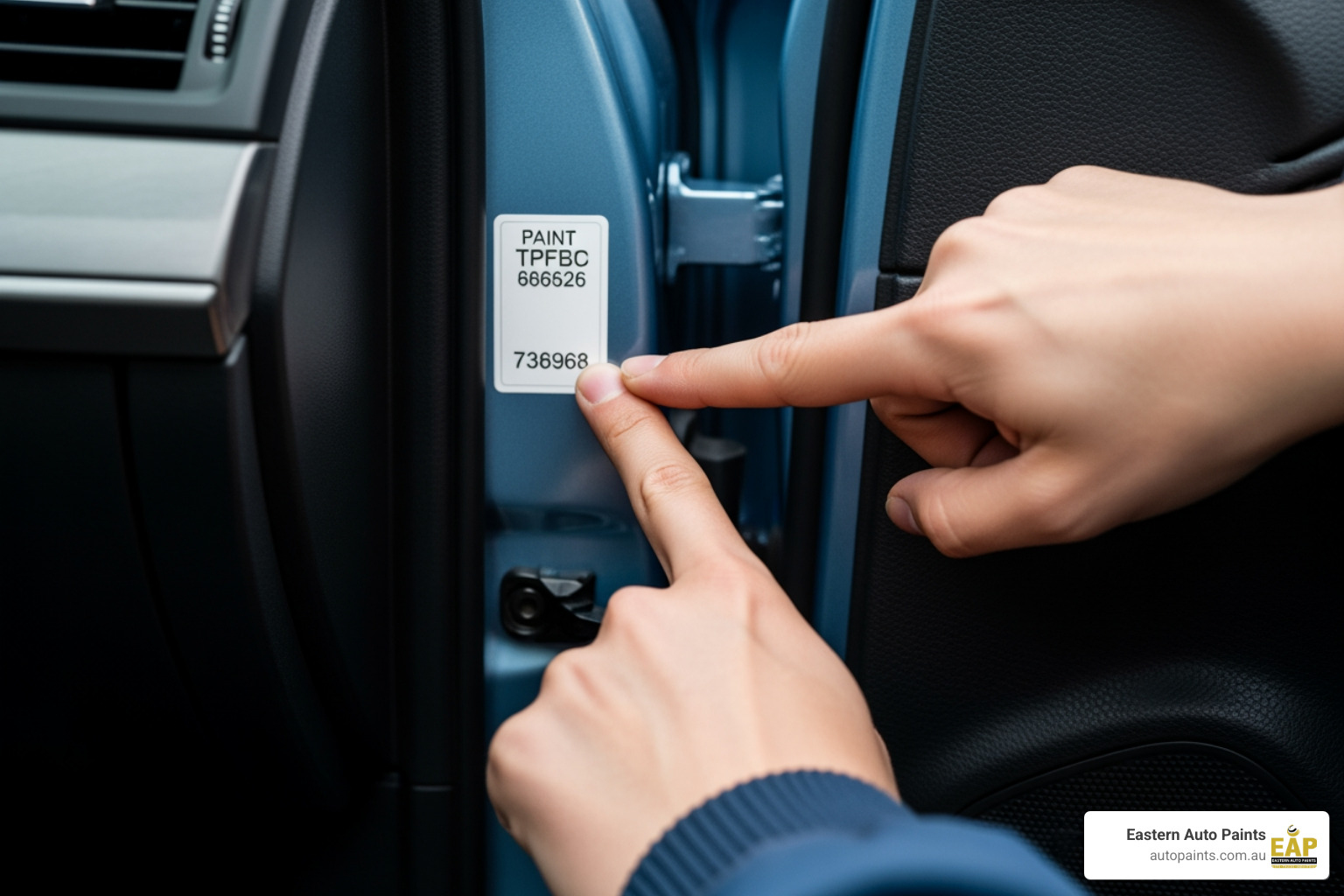
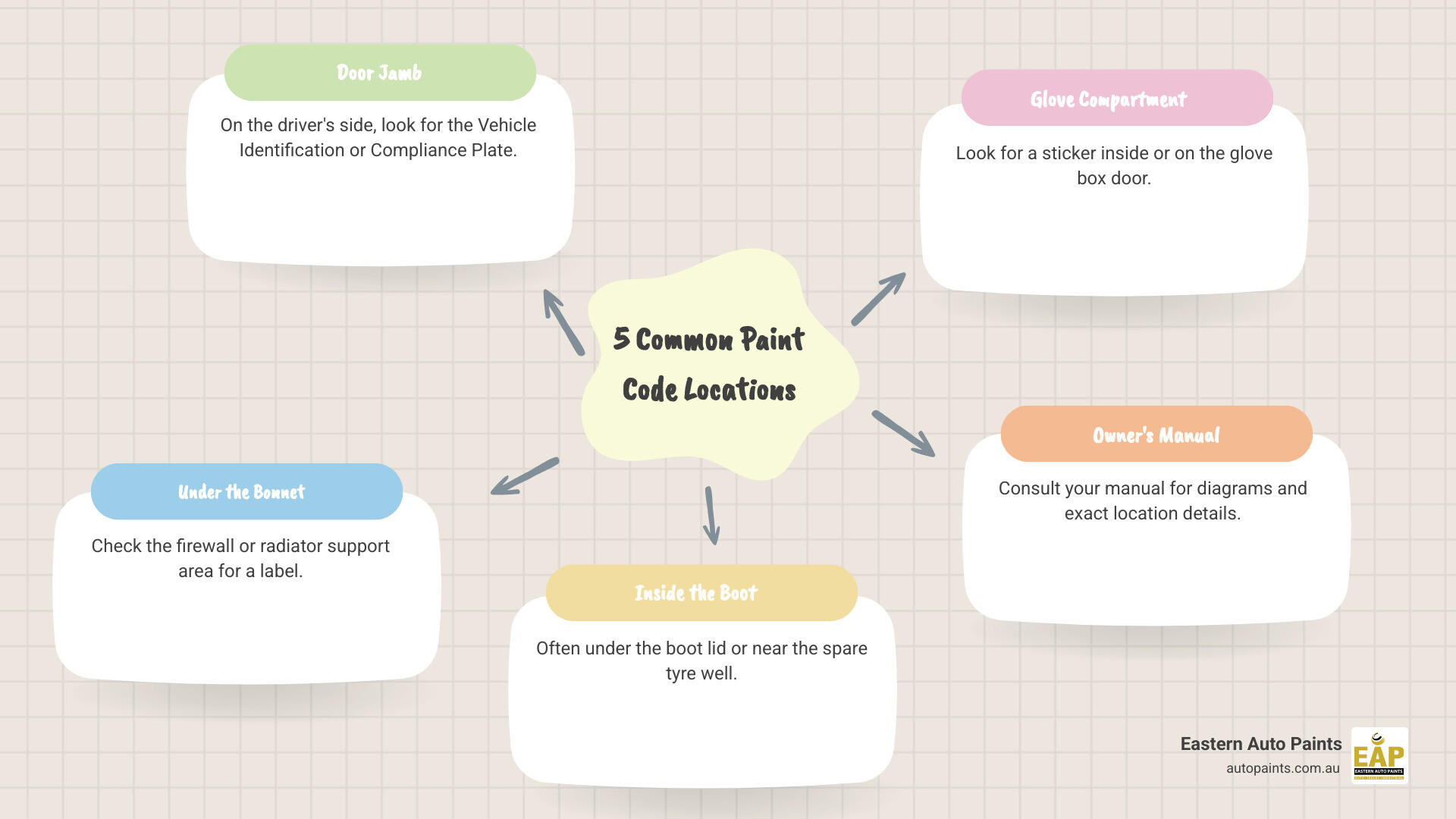
How to find paint code on your vehicle is simpler than you might think. Your paint code is typically located on a sticker in one of these common spots: the driver's side door jamb, under the bonnet on the firewall or radiator support, inside the boot, in the glove compartment, or near the spare tyre well. Look for a label called the Vehicle Identification Plate or Compliance Plate, where the code appears as a combination of letters and numbers, often preceded by labels like "EXT PNT" on Ford vehicles or "C/TR" on others.
When a scratch is staring you down, or a chip reveals bare metal underneath, you need more than just any paint. You need the exact formula that matches your vehicle's finish. That's where your paint code comes in. It's not a colour name like "Midnight Blue" or "Velocity Red," those are marketing terms that can vary between model years and even manufacturers. Your paint code is a unique identifier, a precise formula that ensures your touch-up blends seamlessly with your original factory finish.
What is a Vehicle Paint Code?
Your vehicle's paint code is a specific alphanumeric sequence assigned by the manufacturer to identify the exact paint formula used on your car. Think of it as a fingerprint for your vehicle's colour. While a colour might be called "Crystal White" across different models, the actual paint code (something like "NH-603P" for Honda or "U1" for Ford) tells you the precise mix of pigments, metallics, and base materials that create that specific shade.
This code is found on your Vehicle Identification Plate or Compliance Plate, a sticker or metal tag that contains important manufacturing information. The paint code is separate from your VIN (Vehicle Identification Number), though both appear on similar labels. The VIN identifies your specific vehicle, while the paint code identifies the colour formula used in production.
Why You Absolutely Need It for Repairs
Without the correct paint code, you're essentially guessing at your colour match. Even if two cars look identical at first glance, production line variations mean the paint might differ slightly. Using the wrong code can result in mismatched panels that are glaringly obvious in certain lighting conditions, especially with metallic or pearl finishes, where the flake size and distribution matter enormously.
For touch-up work, the paint code ensures your repair blends invisibly with the surrounding finish. This is critical not just for aesthetics, but for your vehicle's resale value. Prospective buyers will notice mismatched paint, and it raises questions about the quality of previous repairs. Professional results depend on starting with the right formula, which is why every automotive paint supplier will ask for your paint code before mixing your colour.
I'm James Maranis, and over my 30 years in the coatings industry, I've seen countless DIY repairs go wrong simply because someone ordered paint based on a colour name instead of learning how to find paint code correctly. Once you have that code, the rest of the process becomes straightforward, whether you're doing a minor touch-up or planning a more extensive repair.
How to Find Your Vehicle's Paint Code: A Step-by-Step Guide
Finding your vehicle's paint code is the crucial first step to ensuring any paint repair or customisation perfectly matches the original finish. This code is typically found on a Vehicle Identification Sticker or Compliance Plate somewhere on your car. The exact location can vary significantly by manufacturer and even by model year. We've found that knowing these common spots can save you a lot of time.
Decoding the Sticker: Paint Code vs. Paint Name
It's vital to understand the difference between a paint code and a paint name. Paint names, such as "Velocity Blue" or "Radiant Silver," are often marketing terms. They can sometimes be used for slightly different shades across various models or even change over time while the underlying paint formula remains the same. Paint codes, however, are a consistent and reliable identifier. They do not change, making them the most accurate way to find matching paint.
The paint code is usually an alphanumeric sequence, ranging from two to five characters. It might be clearly labelled as "Paint Code," "Colour Code," "EXT PNT," or "C/TR." Always look for this specific code, not just the appealing colour name.
Here's an example of how a single paint code can have different marketing names:
| Paint Code | Common Colour Name | Marketing Name (Example 1) | Marketing Name (Example 2) |
|---|---|---|---|
| K1 | White | Arctic White | Pure White |
| NH-603P | Pearl White | White Diamond Pearl | Taffeta White |
| Z1 | Black | Ebony Black | Nighthawk Black Pearl |
This table highlights why relying solely on a colour name can lead to a mismatch. Our expert team at Eastern Auto Paints always prioritises the paint code to ensure you get the exact colour you need.
Common Hiding Spots for Your Car's Paint Code
The location of your paint code varies depending on your vehicle's make and model. Here are the most common places to check:
- Driver's Side Door Jamb: This is one of the most frequent locations. Open the driver's door and look at the sticker or label on the door frame (B-pillar) or on the edge of the door itself. This label often includes the VIN and other manufacturing details.
- Under the Bonnet: Pop the bonnet and inspect the firewall (the panel separating the engine compartment from the cabin) or the radiator support (the cross-member at the front of the engine bay). Sometimes it's a sticker, other times a riveted metal placard.
- Inside the Boot: Lift the boot lid and check the underside of the lid itself, or inside the boot well, sometimes near the spare tyre.
- Glove Compartment: Open your glove box and look for a sticker inside, often on the inner lid or side wall.
- Owner's Manual: Your vehicle's owner's manual often contains a dedicated section detailing the paint code. This is a great resource if you're having trouble locating the physical sticker.
If you're struggling to find it, don't worry. The placement can be tricky, and sometimes the label might be faded or obscured.
A Specific Guide on How to Find Paint Code on a Ford
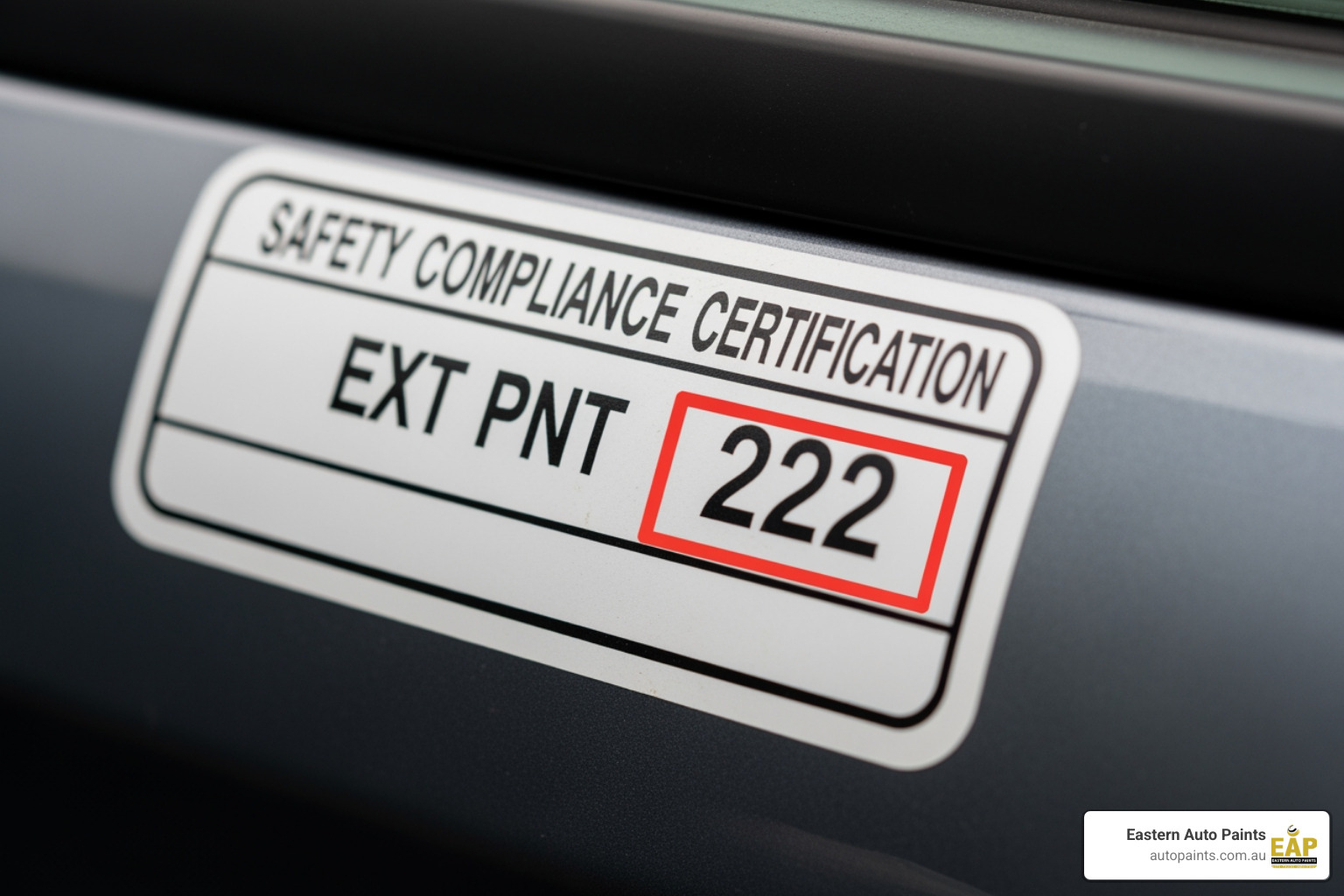
For Ford vehicles, the paint code is typically located on the Safety Compliance Certification Label, often found on the driver's side door pillar. You'll want to look for the "EXT PNT" (Exterior Paint) label, which will be followed by a two-character code. This code is your precise paint identifier. Older Ford vehicles might have a code with more than two characters.
For example, on a Ford, the label might look something like this: EXT PNT: YZ This "YZ" would be your paint code.
If you own a Ford and need assistance with how to find paint code or cross-referencing it for the correct paint, our team at Eastern Auto Paints has extensive experience with all major manufacturers. We can help guide you through the process. Link to EAP's expert advice for Ford paint codes.
What to Do If You Can't Find the Paint Code
Sometimes, despite your best efforts, the paint code sticker might be missing, damaged, or simply unreadable. This is a common issue, especially with older vehicles. If you find yourself in this situation, here are a few steps you can take:
- Check Your Owner's Manual: As mentioned, your owner's manual often lists the paint code.
- Contact a Dealership: Provide your VIN (Vehicle Identification Number) to a local dealership for your vehicle's make. They can usually look up the original paint code in their database.
- Use Online VIN Decoders: Several online resources allow you to enter your VIN and retrieve various vehicle specifications, including the paint code.
- Seek Professional Assistance: If all else fails, or if you prefer expert help, our team at Eastern Auto Paints in Melbourne can assist. We're well-versed in tracking down elusive paint codes and can provide guidance. Contact our expert team for help.
From Code to Colour: Achieving a Flawless Match
Once you have your paint code, you're halfway to achieving a flawless repair. However, the journey from a numerical code to a perfectly matched colour on your vehicle can still be complex. Factors like sun fade, weathering, and even subtle production line variations mean that simply ordering paint by code isn't always enough to guarantee an invisible repair. This is where advanced colour matching comes into play.
How to Find Paint Code and Purchase the Right Product
With your paint code in hand, purchasing the correct product becomes much easier. We offer a wide range of touch-up kits and colour matching spray paints that are custom-mixed to your vehicle's exact code.
When purchasing, always provide the paint code. Do not rely on the colour you see on your computer or phone screen, as display calibrations and lighting can make colours appear inaccurate. Our systems use precise code to formulate your paint, ensuring the closest possible match to the original factory finish. For larger repairs or if you're undertaking a full restoration, we can provide larger quantities of paint, including PPG Industrial Paints and Protec Automotive Paint Systems, mixed to your exact specifications.
The Professional's Secret: Advanced Colour Matching for a Perfect Finish
While your vehicle's paint code provides the original formula, real-world conditions introduce variables. Over time, UV exposure and environmental factors can cause your car's paint to fade or shift slightly. This means that a fresh coat of paint mixed strictly to the factory code might still appear slightly different from your vehicle's aged paint. This is particularly true for older vehicles or those that have spent a lot of time outdoors.
This is where advanced colour matching technology becomes indispensable. At Eastern Auto Paints, we utilise sophisticated tools like a spectrophotometer. In simple terms, this device "reads" the existing paint on your vehicle. It analyses the light wavelengths reflected from the surface, providing a detailed breakdown of the colour's composition. This allows us to account for any fading or variations that have occurred since the vehicle left the factory.
Using the data from the spectrophotometer, our expert technicians can then create a custom paint formula. This ensures that the new paint not only matches the original code but also blends seamlessly with your vehicle's current, aged finish. This advanced colour-matching service is crucial for achieving truly professional and undetectable repairs. You can find more information about our colour matching services on our website.
Why Choose Eastern Auto Paints for Your Paint and Colour Matching Needs
For over 34 years, Eastern Auto Paints has been Melbourne's trusted partner for high-quality automotive, truck, and industrial paints. We are a leading supplier, known for our expert staff and excellent service, and trusted by professionals across Victoria, Sydney, and Queensland. Our commitment to advanced colour-matching technology ensures superior results for every project.
We offer a comprehensive range of automotive car paint supplies, from primers and clear coats to specialised finishes. Our extensive inventory includes solutions for diverse needs, such as a wide array of powdercoat colours and textured powdercoat colours, suitable for everything from vehicle wheels to industrial applications. We also supply high-performance PPG Industrial Paints and Protec Automotive Paint Systems, ensuring durability and a pristine finish.
As a certified distributor, we provide access to top brands like Jotun powdercoat colours, renowned for their quality and extensive colour range. For application, we stock professional-grade equipment, including Sata Jet X Digital Pro spray guns and various Anest Iwata spray guns, ensuring precision and efficiency. Our commitment to innovation extends to offering solvent recycling machines, promoting sustainability and cost-effectiveness for our clients. Additionally, we provide versatile epoxy floor paint that can be tinted to any colour.
Whether you're a seasoned professional or tackling a DIY project, our team is here to provide the expert advice and quality products you need. Don't hesitate to contact our team for personalised assistance.
Frequently Asked Questions
- What types of automotive paints do you offer? We offer a wide range of paints, including automotive spray paint, touch-up kits, primers, and clear coats to meet various project needs. Our selection covers everything from acrylic to 2K clear and 2K primers, ensuring you find the right product for any repair or restoration.
- How do I choose the right paint for my car? Choosing the right paint starts with finding your vehicle's paint code. Once you have this, consider the type of repair (e.g., small scratches or full-body respray) and the desired finish. Our expert team can help you select the ideal product, whether it's a custom aerosol, a touch-up kit, or a larger quantity of paint.
- Can you match my car's factory colour? Yes, absolutely! We use advanced colour-matching technology, including spectrophotometers, to create precise matches for your car's factory paint, even accounting for age and environmental fading. This ensures a seamless blend with your existing finish.
- Do you offer products for DIY projects? Absolutely! Our automotive car paint supplies include user-friendly options for DIY enthusiasts. We provide products like custom aerosol spray cans and touch-up kits, along with guidance to help you achieve professional results from your own workshop.
- What makes your products stand out? Our products stand out because they are sourced from trusted, industry-leading brands like PPG, Protec, Jotun, Sata, and Anest Iwata. This ensures superior quality, durability, and finish. Additionally, we provide unparalleled expert advice and support to ensure every project, from simple touch-ups to complex restorations, is a success.