
The Best Way to Prep Plastic for Automotive Paint
Why Plastic Primer for Cars Is the Foundation of a Lasting Finish
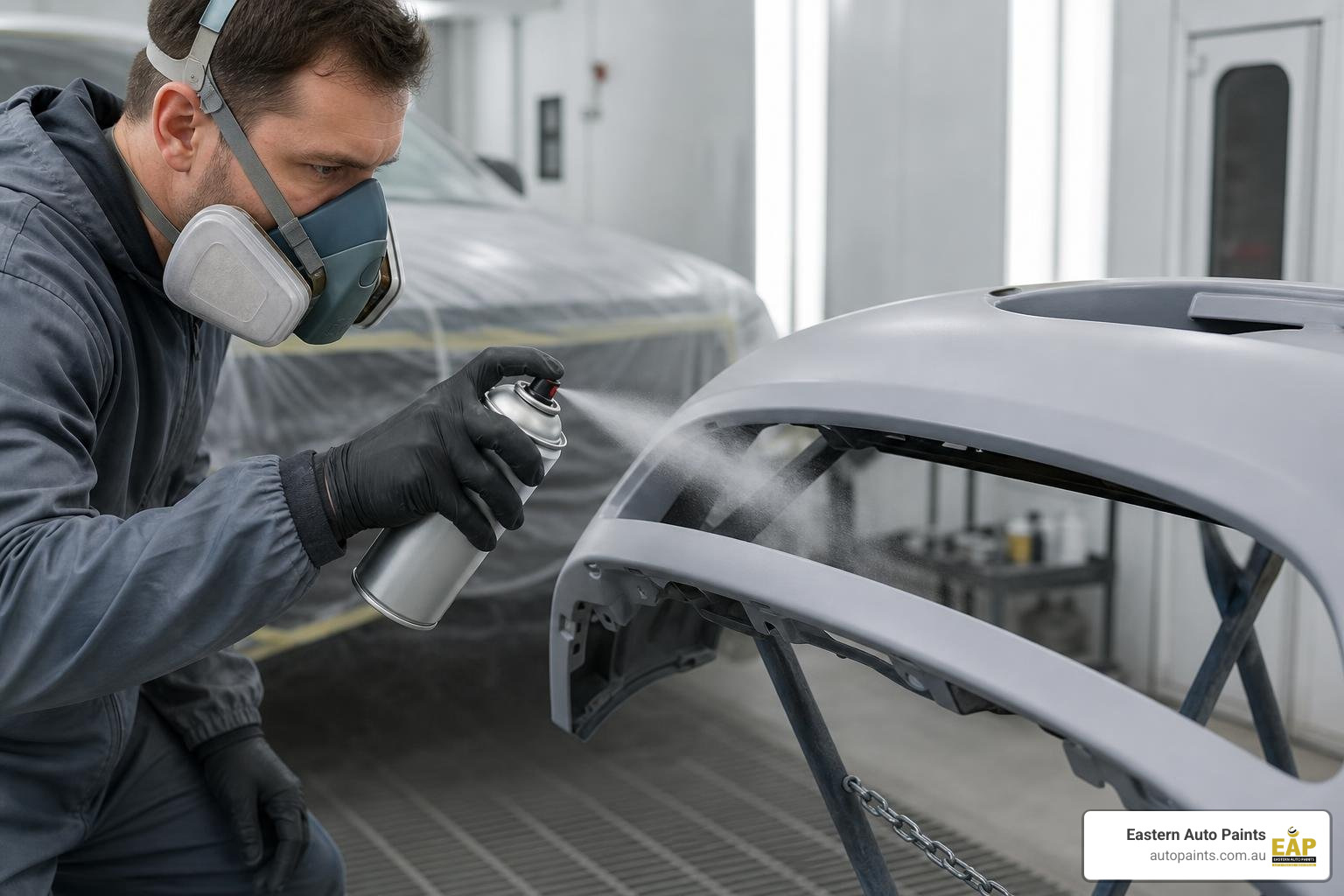
Using the right plastic primer for cars is the single most important step between bare plastic and a paint job that actually holds. Without it, even the best automotive topcoat will peel, crack, or delaminate, often within months of application.
Here is a quick summary of what you need to know:
What is plastic primer for cars? A specialised coating applied to bare automotive plastic before painting. It acts as a chemical bridge between the non-porous plastic surface and the topcoat, creating the adhesion that standard primers cannot achieve on their own.
Why do you need it?
- Automotive plastics have very low surface energy, meaning standard paint cannot bond directly to them
- Plastic parts flex under load, so the primer must be flexible enough to move with the material without cracking
- New plastic parts often carry mould release agents from manufacturing that prevent adhesion without proper preparation
- Skipping primer leads to paint peeling, bubbling, and costly rework
Key steps in the process:
- Clean and degrease the plastic surface thoroughly
- Scuff or sand to remove gloss and improve mechanical adhesion
- Apply a dedicated plastic primer or adhesion promoter (PP (polypropylene), ABS (acrylonitrile butadiene styrene), TPO (thermoplastic olefin), and other plastic types each have specific needs)
- Follow the manufacturer's technical data sheet (TDS) for flash-off times and recoat windows
- Apply your chosen topcoat within the manufacturer's recommended window
Who needs plastic primer? Anyone painting automotive bumpers, trim, dashboards, mirror covers, or any other plastic body component, whether it is a spot repair or a full panel refinish.
For a full breakdown of compatible products and how to choose the right primer for your job, explore our automotive paint supplies.
Plastics now make up a significant proportion of the materials used in modern vehicle construction, driven by the need to reduce weight and meet emissions standards. That shift has made plastic priming one of the most frequently misunderstood steps in automotive refinishing. Get it right and your paint job is durable, flexible, and professional. Get it wrong and you are stripping it back and starting over.
I am James Maranis, owner of Eastern Auto Paints, and with more than 30 years in the coatings industry, I have seen how often a failed paint job on plastic comes down to skipping or rushing the primer stage. Understanding which plastic primer for cars suits your specific substrate and job scale is exactly the kind of technical guidance our team is here to help with. Read on and we will walk you through everything you need to make the right call.
Why This Issue Should Not Be Ignored
When refinishing a vehicle, it is incredibly tempting to focus all your attention on the final colour coat and the high-gloss clear. However, neglecting the foundational layers on plastic components is a recipe for a costly and frustrating failure. Unlike steel or aluminium panels, automotive plastics present a unique set of physical and chemical challenges that require highly specialised preparation.
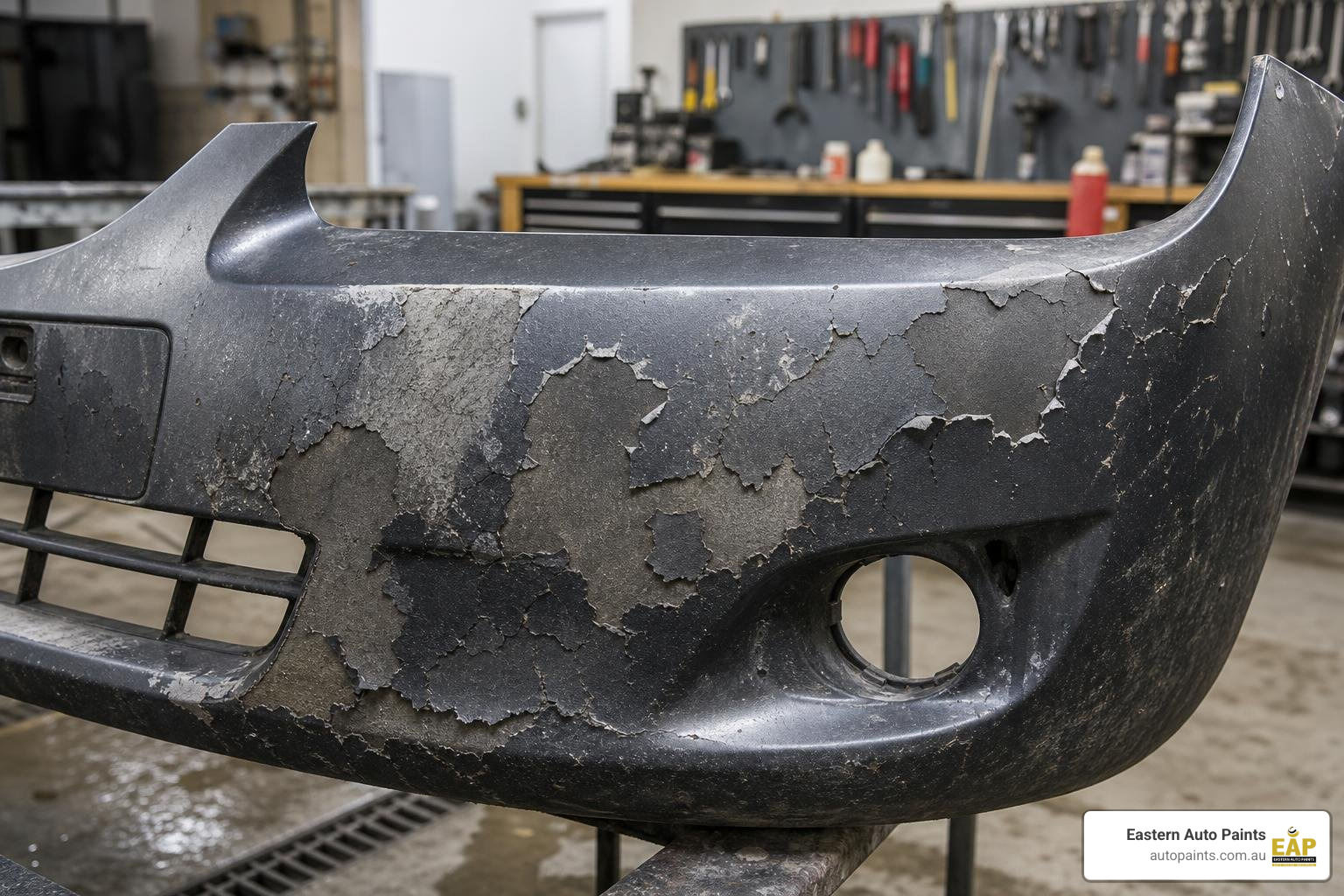
If you bypass a dedicated plastic primer, the consequences usually show up quickly. The most common issue is complete adhesion failure. Because raw automotive plastics are non-porous and chemically inert, topcoats cannot form a secure mechanical or chemical bond with the substrate. Over time, the paint will begin to lift, bubble, and peel away in large sheets, especially when subjected to high-pressure washing or minor road debris impact.
Substrate flexibility is another critical factor. Automotive plastic components, such as front and rear bumpers, side skirts, and mirror covers, are engineered to flex and absorb minor impacts without breaking. If you apply a standard rigid primer or topcoat directly to these flexible surfaces, the paint film cannot bend with the underlying plastic. The result is spider-web cracking and flaking along the stress points of the panel.
Environmental exposure also accelerates this deterioration. Vehicle plastics are constantly subjected to extreme temperature fluctuations, direct sunlight, and moisture. As the plastic expands and contracts in the sun, any coating applied without a proper flexible primer will quickly shear away. Repairing a flaking, peeling plastic panel is far more labour-intensive than doing the job right the first time, as every trace of the failed paint must be completely stripped back to the bare substrate before you can start again.
Common Symptoms, Challenges, or Questions: Why You Need Plastic Primer for Cars
We frequently speak with trade professionals and serious automotive enthusiasts who are struggling with paint jobs that have failed on plastic parts. They often want to know why plastic behaves so differently from metal, and why their standard primers simply do not work. The answer lies in the material science of automotive plastics.
First, most modern vehicle plastics possess what is known as low surface energy. In simple terms, this means the surface behaves like a freshly waxed car, causing liquids, including paints and standard primers, to bead up rather than wet out and bond. Without a chemical bridge to alter this surface energy, paint simply sits on top of the plastic as a fragile, unbonded film.
Second, plastic is highly susceptible to static charge. When you sand or wipe down a plastic panel, it generates static electricity that actively attracts dust, lint, and airborne contaminants. If you spray paint directly onto a statically charged, contaminated surface, you will inevitably end up with fish-eyes, dirt inclusions, and immediate paint delamination.
Finally, raw plastic components from the factory often carry invisible chemical residues. During the manufacturing process, chemical release agents are sprayed into the moulds to help the newly formed plastic parts release cleanly. If these mould release agents are not chemically neutralised and removed during prep, they will completely destroy the adhesion of any paint applied over them.
To combat these challenges, we supply a range of specialised solutions, including easy-to-use aerosol primers that are specifically formulated to bite into difficult plastic substrates and provide the perfect foundation for your colour coat.
Understanding the Role of Plastic Primer for Cars
A high-quality plastic primer for cars does not just sit on top of the panel; it acts as a vital chemical bridge. It is formulated with special resins and solvents that slightly swell or bite into the top microscopic layer of the plastic substrate. This creates a secure, permanent chemical bond that standard primers cannot match.
In addition to promoting adhesion, these specialised primers act as a flexible bonding agent. They remain elastomeric after curing, allowing the entire paint system to expand, contract, and flex along with the plastic panel. This flexibility is what prevents the topcoat from cracking when a bumper gets bumped or when the vehicle sits under the hot Australian sun. By sealing the non-porous surface and creating a uniform, receptive layer, a dedicated plastic primer ensures the long-term durability and gloss retention of your final finish.
The Difference Between Dedicated Plastic Primers and General-Purpose Primers
It is common to wonder if a general-purpose primer or a standard metal primer can do the job. The short answer is no. Standard primers are engineered to prevent corrosion on metal or to fill porous wood and masonry surfaces. They lack the specific chemical formulation required to bond with low-surface-energy plastics.
General-purpose primers also lack the flexibility additives found in dedicated plastic primers. When applied to a flexible bumper, a standard metal primer dries hard and brittle. At the first sign of panel flex or temperature change, the brittle primer layer will fracture, causing the entire paint system above it to fail. Dedicated plastic primers are engineered specifically for substrate compatibility, ensuring that the chemical bond remains intact even under physical stress.
What a Personalised Experience Actually Looks Like
At Eastern Auto Paints, we believe that choosing the right refinishing products should never be a guessing game. For our trade partners and serious DIY customers across Melbourne, a personalised experience means having direct access to real technical expertise and premium, industry-approved products. We do not just hand you a can off the shelf; we work with you to understand the exact type of plastic you are working with, the scale of your project, and the equipment you have available.
Because different plastics require different preparation steps, our team provides tailored guidance to ensure you get the perfect bond. Whether you are refinishing a raw aftermarket bumper in a professional spray booth or performing a small spot repair on a side mirror in your home workshop, we help you select the exact primers, cleaners, and topcoats for the job.
For smaller repairs or hard-to-reach areas where setting up a full spray gun is impractical, we can package professional-grade coatings into aerosol cans. This gives you the convenience of an aerosol format without sacrificing the quality, durability, and colour accuracy of a professional-grade automotive paint system.
The Value of Consistency and an Ongoing Relationship
In the automotive refinishing industry, consistency is everything. For collision repair shops, fleet managers, and custom builders, knowing that your paint materials will perform exactly the same way every single time is critical to maintaining shop throughput and avoiding costly rework. This is why we focus on building genuine, long-term partnerships with our commercial and trade customers.
One of the key benefits of working with us is our precision colour-matching capability. We maintain a vast database of saved colour formulations, allowing us to replicate exact factory finishes and custom blends for repeat customers. When you bring a plastic bumper or trim piece to us, we do not just look up a generic paint code. We utilise advanced spectrophotometer technology and our deep industry experience to formulate a colour that accounts for paint weathering, batch variations, and substrate differences.
By partnering with us, you gain a dependable supply partner who understands your business, keeps your preferred products in stock, and stands behind every litre of paint we sell. To learn more about how we achieve flawless colour matches on both metal and plastic panels, explore our colour matching services.
What to Expect at Eastern Auto Paints
When you step into our Bayswater head office or our trade showroom and warehouse in Dandenong South, you are entering a professional, trade-focused environment. We are proud to be a PPG Select Distributor, a certified Jotun Australia distributor, and the master wholesale distributor for Concept Paints in the South East Victoria region. These partnerships mean we supply only authentic, high-quality, professional-grade coatings.
Our showrooms are fully equipped to support trade professionals, industrial applicators, and serious restorers alike. You will find a comprehensive range of premium spray guns, paint preparation consumables, safety gear, and heavy-duty workshop equipment designed to keep your shop running efficiently.
Whether you need a high-volume screw compressor or a specialised infrared drying lamp, our team has the technical knowledge to guide you toward the right equipment for your specific workspace and budget. We focus on clear, honest communication and expert advice, ensuring you leave with the exact tools and knowledge required to get the job done right the first time.
When to Get in Touch or Take Action
If you are planning an automotive refinishing project that involves plastic panels, the best time to get in touch with us is during the planning phase. Rather than waiting until you run into adhesion issues or paint defects, speaking with our team early allows us to help you map out the entire preparation and application process.
Whether you are a commercial body shop looking to streamline your plastic repair workflow, or a dedicated enthusiast embarking on a classic car restoration, we are here to support you. We can help you identify the specific plastic substrates on your vehicle, recommend the correct cleaning and sanding protocols, and supply the exact primer and colour systems designed for those materials.
If you are facing a challenging repair or need advice on matching a difficult factory finish on a plastic bumper, please contact our team for expert advice. Our experienced team is ready to provide the technical support and premium products you need for a flawless, durable result.
Practical Solutions and Reassurance: The Conceptual Process of Prepping Plastic
Achieving a professional-grade finish on automotive plastics does not require secret trade secrets, but it does require strict adherence to a conceptual preparation workflow. Because plastics are highly sensitive to chemical contaminants and static electricity, your preparation phase must be meticulous.
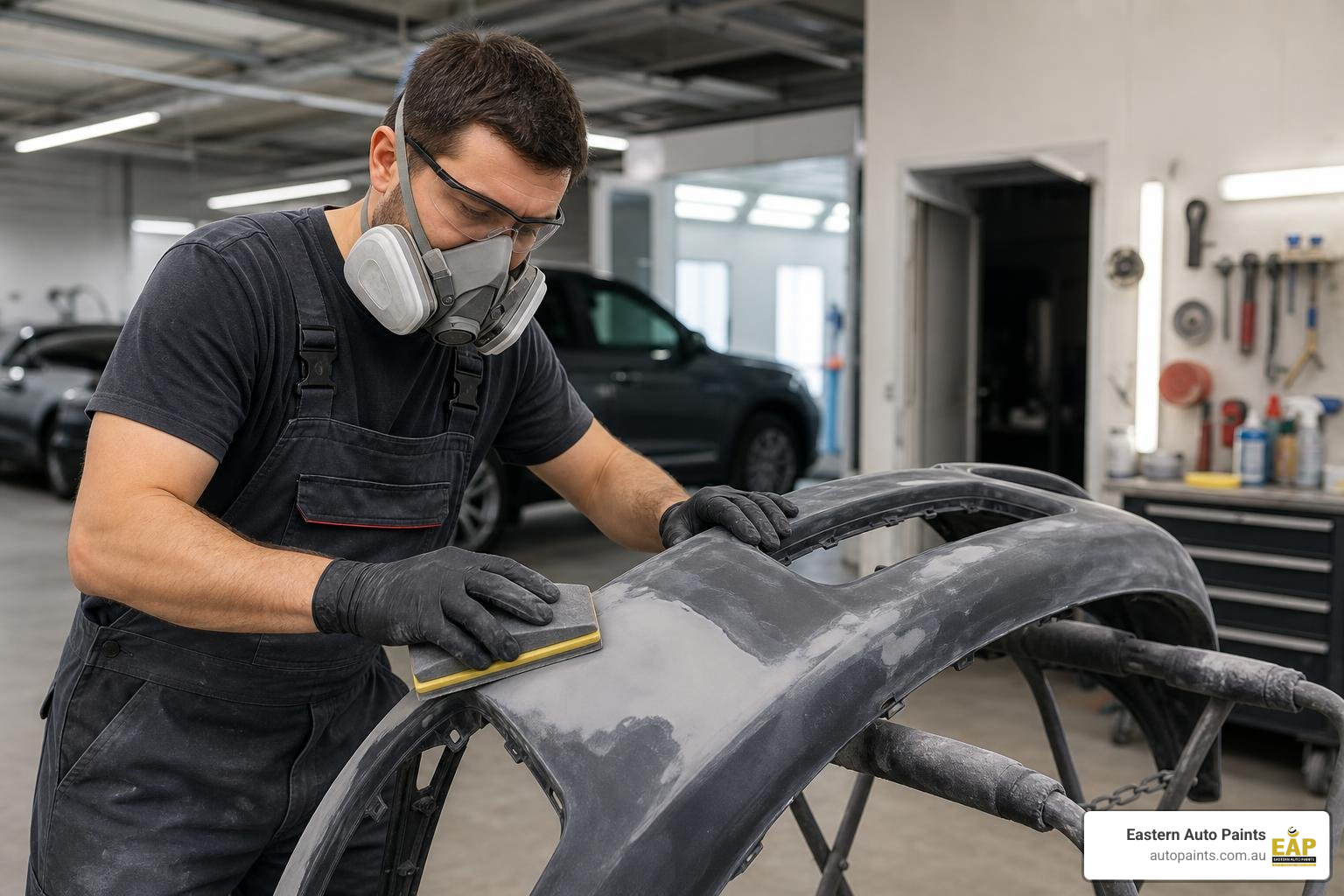
The conceptual process of prepping plastic always begins with thorough cleaning. Before any sanding block or abrasive sheet touches the panel, the surface must be completely degreased to remove road grime, tar, silicone polishes, and mould release agents. Wiping a dirty panel with sandpaper will only grind the contaminants deep into the plastic, leading to inevitable paint defects later on.
Once the surface is chemically clean, the next step is to create a mechanical key. Because plastics are smooth and non-porous, they must be lightly abraded to give the primer a surface to grip. This is typically done using specialised abrasive pads or high-quality sanding sheets along with a dedicated matting paste. After scuffing, the panel is cleaned once more with an anti-static degreaser to neutralise static charge and remove any remaining sanding dust.
Choosing the Right Plastic Primer for Cars for Your Specific Job
Selecting the correct primer format is highly dependent on the scale of your repair, your workspace, and the specific plastic substrate you are painting. In the professional refinishing industry, we categorise these primers into single-pack (1K) and two-pack (2K) systems, each serving as a different tool for different needs.
- 1K Plastic Primers and Adhesion Promoters: These are single-component, ready-to-spray products that do not require an activator or hardener. They are highly convenient, fast-drying, and dry to a very thin, semi-transparent film. If you are working on a small spot repair, a side mirror cover, or a brand-new raw plastic bumper that is already smooth and free of defects, a 1K adhesion promoter is often the most practical choice.
- 2K Plastic Primers: These are two-component systems that require mixing with a specific hardener or activator before application, initiating a chemical cure. They offer high-build properties, allowing you to fill minor sand scratches, repair halos, and surface imperfections on repaired plastic panels. If you are refinishing a large panel that has undergone extensive plastic welding or body filler work, a flexible 2K primer surfacer is what you would reach for.
Because mixing ratios, pot life, and substrate compatibilities vary significantly between brands and product lines, always consult the manufacturer's technical data sheet (TDS) for the exact specifications of your chosen product. For larger, high-durability trade applications, explore our range of professional 2K primers.
Conceptual Steps for Successful Application
When you are ready to apply your plastic primer for cars, the application technique must focus on achieving a thin, uniform, and consistent film. Unlike metal primers, which are often applied in heavy coats to build thickness, plastic adhesion promoters must be kept thin. Applying too much product can actually soften the plastic substrate and severely compromise paint adhesion.
The application process conceptually involves spraying light, even passes with consistent overlap. Between these passes, the solvents in the primer must be allowed to evaporate, a process known as flash-off. Once the primer has dried within the manufacturer's specified window, the topcoat should be applied promptly to ensure a strong chemical bond between the primer and the colour coat.
Because solvent-based primers release volatile organic compounds (VOCs) during application, safety must always be your top priority. Always work in a well-ventilated space, such as an approved spray booth, and use personal protective equipment (PPE) in line with the product label, the manufacturer's safety data sheet (SDS), and relevant WorkSafe Victoria guidance before starting.
Achieving a Professional Finish on Automotive Plastics
In summary, achieving a professional, long-lasting finish on automotive plastics requires a systematic approach. By thoroughly degreasing the substrate, creating a proper mechanical key through sanding, and applying a dedicated 1K or 2K plastic primer, you establish the essential chemical bridge needed to prevent peeling, cracking, and environmental degradation.
Whether you are performing a minor spot repair or refinishing a complete bumper, following these structured preparation and application steps ensures your topcoat adheres securely and remains flexible. If you are ready to begin your next project or need assistance selecting the right primer system, please contact our team for expert advice, or browse our range of professional automotive primers online.
Frequently Asked Questions About Plastic Primer for Cars
How do I choose between a 1K and a 2K plastic primer for my automotive project?
Choosing between a 1K (single-pack) and a 2K (two-pack) plastic primer depends entirely on the scale of your project and the condition of the substrate. 1K primers are single-component, ready-to-use products that dry quickly through solvent evaporation, making them highly practical for small spot repairs, trim pieces, or brand-new, undamaged raw plastic bumpers.
In contrast, 2K primers require a separate hardener or activator to initiate a chemical cure, resulting in a much tougher, highly durable, and chemical-resistant film. You would typically choose a 2K primer when you need high-filling properties to smooth out repairs, sand scratches, or bodywork on larger plastic panels. Always refer to the manufacturer's instructions for the specific application requirements of each system.
How does the colour-matching process work for plastic car parts?
At Eastern Auto Paints, our colour-matching process combines advanced technology with decades of industry experience. When you bring a plastic part or a paint code to our Bayswater or Dandenong South locations, we use a professional spectrophotometer to analyse the exact shade, metallic flake, and gloss level of your existing paint.
Because plastic substrates can absorb paint slightly differently than metal panels, and because factory paint can fade over time, our experienced professionals utilise advanced formulation software and precise digital adjustments to ensure a seamless blend. We then mix the paint using premium tinter systems to provide an accurate match for your specific vehicle.
What personal protective equipment (PPE) is required when spraying plastic primer?
Spraying automotive primers and paints exposes you to hazardous solvents and airborne particulates, meaning proper personal protective equipment (PPE) is essential. At a minimum, you should wear a high-quality, properly fitted respirator designed for organic vapours and particulates, safety glasses to protect your eyes from overspray, and chemical-resistant gloves to prevent skin contact with solvents.
Because safety requirements vary depending on the chemical composition of the product (especially when using 2K products containing isocyanates), you must always consult the manufacturer's safety data sheet (SDS) and follow WorkSafe Victoria guidelines for your specific workspace setup.
Where can I find the exact mixing ratios, drying times, and flash-off windows for my primer?
Exact technical specifications, including mixing ratios, flash-off times, drying windows, and gun setups, are highly product-specific and can only be found on the manufacturer's technical data sheet (TDS) or the product label.
Because applying these products outside of their engineered parameters can lead to immediate paint failure, we strongly advise against using generic guidelines. You can access the TDS for any product we supply by speaking with the Eastern Auto Paints team, or by visiting the manufacturer's official website.
Is a professional spray setup required, or can I use an aerosol plastic primer for cars?
Both professional spray setups and high-quality aerosol cans are excellent options, representing different tools for different needs. A professional spray gun setup connected to a workshop compressor offers maximum control over fan size, fluid flow, and air pressure, making it the ideal choice for full-panel refinishing and high-volume trade environments.
However, for small spot repairs, side mirrors, door handles, or hard-to-reach trim pieces, a premium aerosol plastic primer is highly practical, cost-effective, and eliminates the need for extensive spray gun cleanup. Our team can help you determine which format is best suited to your specific workspace and project scale.