
Navigating Solvent Waste Systems, Services, and Smart Strategies
Why Smart Solvent Waste Management Matters
Solvent waste management is the process of safely handling, storing, recycling, and disposing of used industrial solvents. A smart strategy protects worker health, reduces operational costs, and ensures you meet strict regulatory requirements.
Key benefits include:
- On-site recycling can recover up to 99% of used solvents for reuse.
- Off-site services provide professional pickup, processing, and disposal.
- Proper waste segregation prevents cross-contamination and lowers disposal costs.
- Regulatory compliance requires correct labelling, tracking, and record-keeping.
- Cost savings can reach up to 95% on new solvent purchases and 90% on disposal fees.
If your automotive repair shop, refinishing business, or industrial facility uses solvents, you're generating hazardous waste. This waste can either be a constant drain on your budget or, with the right approach, a valuable resource. The solvents you discard often retain over 80% of their original effectiveness, meaning you're throwing money away with every disposal drum.
Poor management has high stakes. It exposes workers to hazardous chemicals, puts your business at risk of serious EPA fines, and costs you thousands in unnecessary purchases and disposal fees. Conversely, businesses that implement smart solvent waste management see dramatic cost reductions, simpler compliance, and a smaller environmental footprint.
With over 30 years in the coatings industry, we at Eastern Auto Paints have seen how proper solvent management transforms businesses. We help workshops and industrial facilities across Melbourne steer these challenges with expert advice and proven solutions. Modern recycling technology has changed the game, making it easier than ever to turn waste into a resource.
The High Cost of Waste: Challenges and Environmental Concerns
Industrial solvents are designed to be powerful, which makes them incredibly useful but also potentially hazardous once they become waste. Managing this waste isn't just a business process—it's a critical environmental and health issue.
Many solvents are volatile organic compounds (VOCs) that evaporate easily, contributing to ground-level ozone (smog) and poor air quality. Improper disposal, such as pouring them down drains or allowing them to seep into the ground, poses a significant risk of water contamination. This can pollute groundwater and surface water, harming ecosystems and making water sources unsafe. For this reason, discharging solvents into municipal sewers is strictly prohibited.
The health hazards are also a major concern. Many solvents are toxic if inhaled, absorbed through the skin, or ingested. Some contaminants, like heavy metals, can bioaccumulate, building up in living organisms and leading to serious health issues like nervous system disorders and cancer.
Furthermore, environmental agencies like EPA Victoria impose strict regulations on hazardous waste. Failure to comply can lead to heavy fines and legal action. Businesses are held to a "cradle-to-grave" liability, meaning they are responsible for their waste from generation to final disposal, even if it's handled by a third party.
Environmental Benefits of Recycling
Solvent recycling offers a far better alternative to traditional disposal methods like landfill or incineration. At its core, recycling is about resource conservation. Instead of manufacturing new "virgin" solvents—an energy-intensive process—we can clean and reuse what we already have.
This practice dramatically reduces the volume of hazardous waste sent to landfills, lessening the risk of air and water pollution. For example, a facility generating 1 million litres (approx. 264,000 gallons) of solvent waste per month could reuse 80% of it through recycling. This would cut their hazardous waste stream to just 200,000 litres (approx. 52,800 gallons), a massive reduction. By turning a liability into an asset, recycling supports a circular economy and aligns your business with modern sustainability goals. You can learn more about the equipment involved in our A Comprehensive Guide to Solvent Recyclers.
Health and Safety Risks
The potent nature of industrial solvents creates inherent health and safety risks for workers. Inhalation of solvent vapours can cause dizziness, headaches, and even long-term organ damage. Skin contact can lead to irritation, dermatitis, or absorption of harmful chemicals into the bloodstream.
When spraying automotive paints containing solvents, these risks are amplified. This is why adequate ventilation and personal protective equipment (PPE) are non-negotiable. We strongly advocate for using appropriate PPE masks when handling any solvents.
For spray applications involving two-pack (2K) paints with isocyanates, standard respirators are often insufficient. An atmosphere-supplying system, such as an Air Fed Mask, is typically required to provide adequate protection. Always conduct a workplace risk assessment to determine the specific PPE needed for your operations.
Know Your Waste: A Breakdown of Industrial Solvent Types
Effective solvent waste management starts with understanding the specific types of solvents you use. Their chemical properties dictate how they must be handled, stored, and recycled.
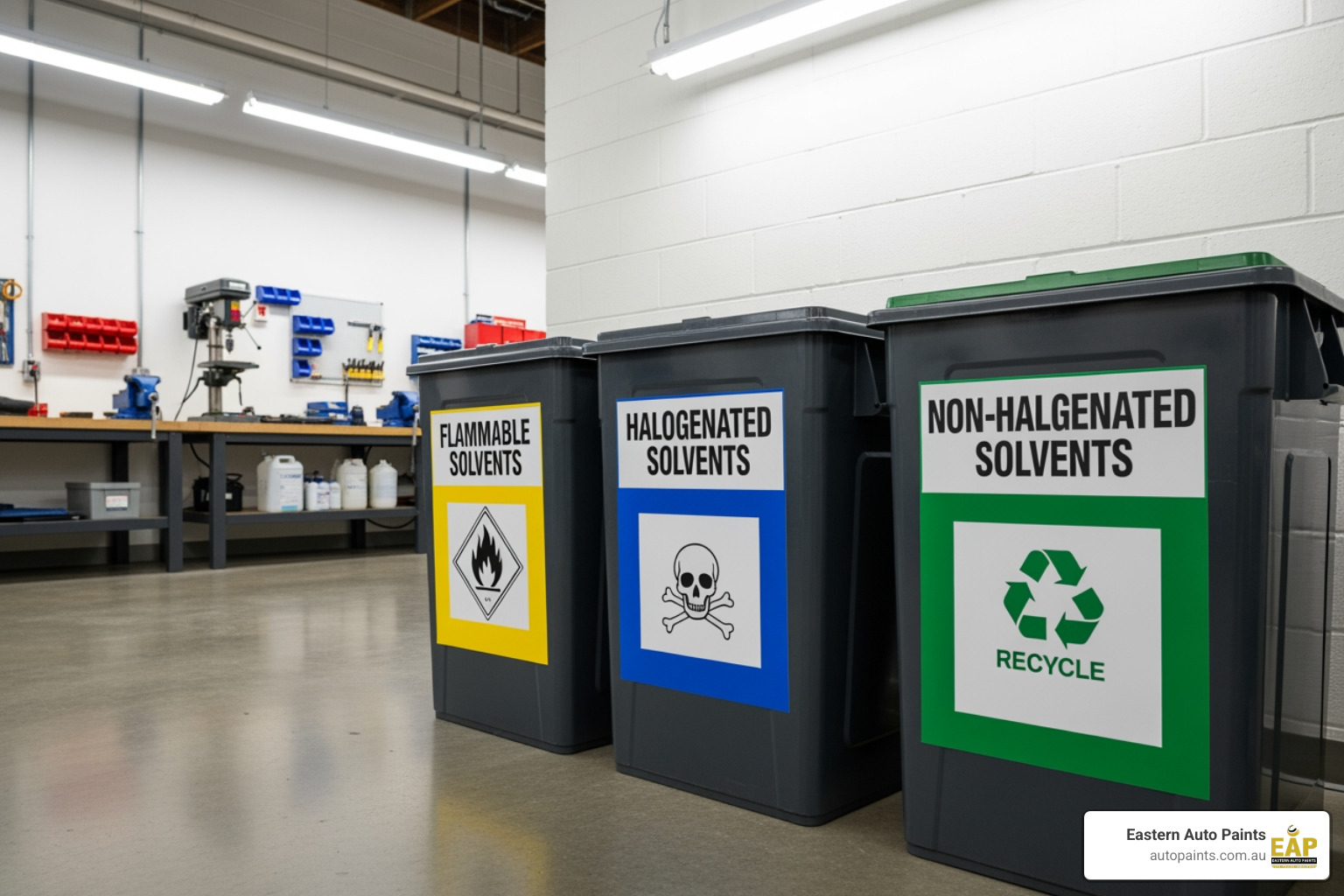
Proper waste segregation is critical. Mixing different solvent types can create dangerous chemical reactions, make recycling impossible, or dramatically increase disposal costs. For example, mixing halogenated and non-halogenated solvents means the entire batch must be treated as the more expensive halogenated waste. This makes accurate hazardous waste classification essential.
Halogenated vs. Non-Halogenated Solvents
Industrial solvents are broadly divided into two main categories for waste management purposes.
Halogenated solvents contain a halogen element like chlorine or fluorine. Common examples include methylene chloride and trichloroethylene. They are excellent degreasers but are generally more toxic and environmentally persistent, making their disposal more complex and costly.
Non-halogenated solvents do not contain halogens. This group includes common chemicals like Acetone, Toluene, and Methanol used in paints and cleaners. While still hazardous, they are often simpler and cheaper to recycle if kept separate. Halogens are highly reactive nonmetallic elements, and contaminating a non-halogenated waste stream with even a small amount of halogenated solvent forces the entire volume to be managed as the more expensive waste type.
Paint Solvents and Residues
In the automotive and industrial paint industries, paint solvents and residues are a major waste stream. This waste is a complex mixture of solvents, pigments, and resins like acrylic, epoxy, and polyurethane. Many of these wastes contain VOCs (Volatile Organic Compounds) that contribute to air pollution.
It is the generator's responsibility to determine if paint waste is hazardous. Waste can be classified as a listed hazardous waste (if it appears on a specific regulatory list) or a characteristic waste. A waste is considered characteristic if it is ignitable, corrosive, reactive, or toxic. Our team can help you understand these crucial classifications.
Other Contaminants
Used solvents are often contaminated with other substances that affect recycling. These include:
- Heavy metals: Lead, chromium, or cadmium from pigments or industrial processes.
- Oils and greases: From cleaning machinery.
- Debris and solids: Dust, paint particles, and sludge.
- Water: Mixed in during cleaning processes.
These contaminants must be managed, as they lower the purity of recovered solvent and create a residue that still requires proper disposal.
The Solution: Modern Technologies for Solvent Recycling
Modern technology offers advanced solvent waste management solutions that focus on recovery and reuse, which is both environmentally responsible and economically smart. We offer cutting-edge solutions for on-site recycling, allowing businesses to process their own solvent waste in their workshops. For those with smaller volumes, off-site services provide a comprehensive alternative where licensed facilities handle the entire process.

How Solvent Recycling Machines Work
On-site solvent recycling machines operate on the principle of distillation—a straightforward process that separates pure solvent from contaminants.
Here’s how it works:
- Heating: Contaminated solvent is placed in a boiling chamber and heated to its boiling point. The solvent turns into a vapour, leaving heavier contaminants like paint solids, oils, and metals behind.
- Cooling: The pure solvent vapour travels into a cooling condenser, where it turns back into a high-purity liquid.
- Collection: The clean, liquid solvent is collected in a separate container, ready for reuse. The leftover sludge is concentrated in the boiling chamber for easy, cost-effective disposal.
This process can yield recovered solvent that is up to 99.5% pure, making it suitable for its original application. We supply high-quality, UK-made UNIC solvent recyclers, such as the UNIC USD45XPE and UNIC USD60XPE, which are professional-grade systems perfect for most Australian businesses.
Key Recycling Technologies
While simple distillation is highly effective, more advanced technologies can handle complex solvent mixtures and achieve even higher purity. These include:
- Batch Fractional Distillation: Separates mixed solvents with different boiling points.
- Thin-Film Evaporators: Ideal for heat-sensitive or viscous materials.
- Molecular Sieves: Used to remove water to achieve exceptional dryness and purity.
The right technology depends on your specific solvent types, contamination levels, and desired purity. As detailed in technical documents like the EPA's AP-42, Vol. I, CH 4.7: Waste Solvent Reclamation, the science can be complex. Our experts can help you determine the best and most cost-effective approach for your needs.
The Business Case for Effective Solvent Waste Management
Implementing effective solvent waste management is a shrewd business decision that directly benefits your bottom line. The return on investment (ROI) from solvent recycling is often significant, improving both financial health and operational efficiency.
Beyond cost savings, smart solvent management demonstrates a commitment to sustainability, which can improve your brand reputation with customers and partners. It also ensures a consistent supply of clean solvent, reducing the logistical headaches of frequent waste disposal.
Economic Benefits
The financial advantages of recycling solvents are clear and can quickly justify any initial investment.
- Reduced Solvent Purchases: By recycling, you can cut your need for new virgin solvent by up to 95%. This delivers immediate and substantial savings on raw material costs.
- Lower Disposal Costs: Hazardous waste disposal is expensive. Recycling can reduce your disposal volume by around 90%, leading to a dramatic reduction in these fees.
- Reduced Transportation Fees: On-site recycling means fewer hazardous waste pickups, which directly lowers transportation costs.
- Simplified Regulatory Burden: Generating less hazardous waste can simplify reporting requirements, saving administrative time and effort.
These are tangible benefits that directly impact profitability. One company reported saving over $50,000 in solvent and disposal expenses over 20 years. We invite you to Explore our Clean Up & Recycling solutions to see how these savings could apply to your business.
Environmental and Compliance Benefits
Beyond the economic case, smart solvent waste management delivers crucial long-term benefits.
- Waste Minimisation: Reusing solvents drastically reduces the amount of hazardous waste you generate, conserving natural resources and lessening the burden on landfills.
- Smaller Carbon Footprint: Manufacturing new solvents is energy-intensive. Recycling reduces the demand for new production and its associated greenhouse gas emissions.
- Improved Corporate Image: Environmental stewardship is highly valued. Sustainable practices like solvent recycling demonstrate responsibility to your customers, employees, and community.
- Reduced Liability: Managing your solvent lifecycle on-site or through reputable recyclers minimises your "cradle-to-grave" liability and the risks associated with off-site transport and disposal, helping prevent costly fines.
Staying Compliant: Navigating Hazardous Waste Regulations
Navigating the regulatory landscape for solvent waste management is an essential part of doing business responsibly. In Australia, businesses must follow guidelines from state-level bodies like EPA Victoria. The core principles of safe handling, however, are universal.
Regulatory frameworks, such as those outlined in the US Title 40 code, place clear responsibilities on waste generators to ensure hazardous materials are managed safely from creation to final disposal.
Key Steps for Compliance in Solvent Waste Management
To ensure your business remains compliant, focus on these key steps:
- Waste Characterisation: You must accurately identify and classify your waste streams to determine if they are hazardous based on their properties (e.g., ignitable, corrosive, toxic) or if they are on a regulated list.
- Proper Storage and Labelling: Store hazardous waste in appropriate, sealed containers. Labels must clearly state "Hazardous Waste," identify the contents, and show the date accumulation began.
- Use Licensed Transporters: Only use transport companies that are licensed to carry hazardous materials.
- Manifesting and Tracking: Use a hazardous waste manifest to track waste from your site to its final destination at a licensed facility. This creates a paper trail for compliance.
- Record Keeping: Maintain complete records of all waste management activities, including manifests, waste analyses, and employee training logs. These documents are crucial for demonstrating compliance during audits.
Tracking and Managing Your Waste Stream
Effective tracking is vital for optimising recycling and ensuring compliance. This starts with understanding what you generate.
- Waste Stream Analysis: Regularly analyse your waste to understand its composition, volume, and recycling potential. For unique waste streams, some services offer lab testing to find the best handling solution.
- Optimising Recycling: A clear understanding of your waste helps you segregate it effectively and choose the right recycling equipment to maximise recovery.
- Protocols and Training: Develop clear, written protocols for handling solvent waste and ensure all relevant employees receive comprehensive training. Training resources, such as the how-to videos and guides developed for Ontario's registry, illustrate universal best practices for safe handling and documentation that can be adapted anywhere.
Frequently Asked Questions about Solvent Waste Management
We often hear similar questions from our clients about solvent waste management. Here are some of the most common ones, along with our expert answers.
How much money can a business save by recycling solvents?
The savings are substantial. Businesses can reduce new solvent purchases by up to 95% and cut hazardous waste disposal fees by up to 90%. With lower transportation costs as well, the return on investment for on-site recycling equipment is often realised within months, not years.
What is the first step to implementing a solvent recycling program?
The first step is a waste stream assessment. You need to:
- Identify the types of solvents you use and what they are contaminated with.
- Quantify the volume of waste you generate.
- Evaluate whether an on-site recycling machine or an off-site service is the best fit for your volume and waste type.
Once you have this information, you can make an informed decision. Contact us for expert advice to help you get started.
Can all types of solvents be recycled?
Most common industrial solvents, including acetone, toluene, and alcohols, are readily recyclable. Halogenated and non-halogenated solvents can both be recycled, but they must be kept separate to avoid complicating the process and increasing costs. The feasibility depends on the type and level of contamination. A professional assessment is the best way to determine the recyclability of your specific waste streams.
Partnering for a Smarter, Cleaner Future
Effective solvent waste management is a strategic decision that delivers powerful economic, environmental, and safety benefits. For businesses in Melbourne, Dandenong South, Bayswater, and across Victoria, it's a clear path to reducing costs, protecting your team, and building a more sustainable operation.
With over 34 years of experience, Eastern Auto Paints provides comprehensive solutions that cover every aspect of your workshop's needs. Our expertise extends beyond supplying high-quality automotive paints to helping you implement smart, compliant waste management practices.
Whether you are considering an on-site solvent recycling machine or need expert guidance on navigating hazardous waste regulations, our team is here to help. We believe in providing solutions that create a more efficient and profitable future for your business.
We invite you to Explore our full range of workshop equipment, including our UNIC solvent recyclers. For custom advice on your specific needs, please Visit us for tailored advice on your solvent waste management needs. Let's work together for a smarter, cleaner future.