
Find the Best Shop Air Compressor Without Overpaying for Extra Power
Choose the Best Shop Air Compressor for Reliable Workshop Air

Eastern Auto Paints helps trade painters and serious restorers choose the best shop air compressor by matching air delivery to the tools they use most. The right unit keeps spray equipment and pneumatic tools working consistently; an undersized compressor can cause pressure drops, frequent recovery cycles and avoidable moisture issues.
Key Takeaways
- Prioritise airflow in CFM or SCFM at your working pressure, not headline horsepower.
- Choose a tank and duty cycle that suit continuous work such as sanding and spray painting.
- Consider a stationary, belt-driven unit for regular workshop use and a portable unit for intermittent tasks.
- Plan for clean, regulated air with suitable air tools fittings.
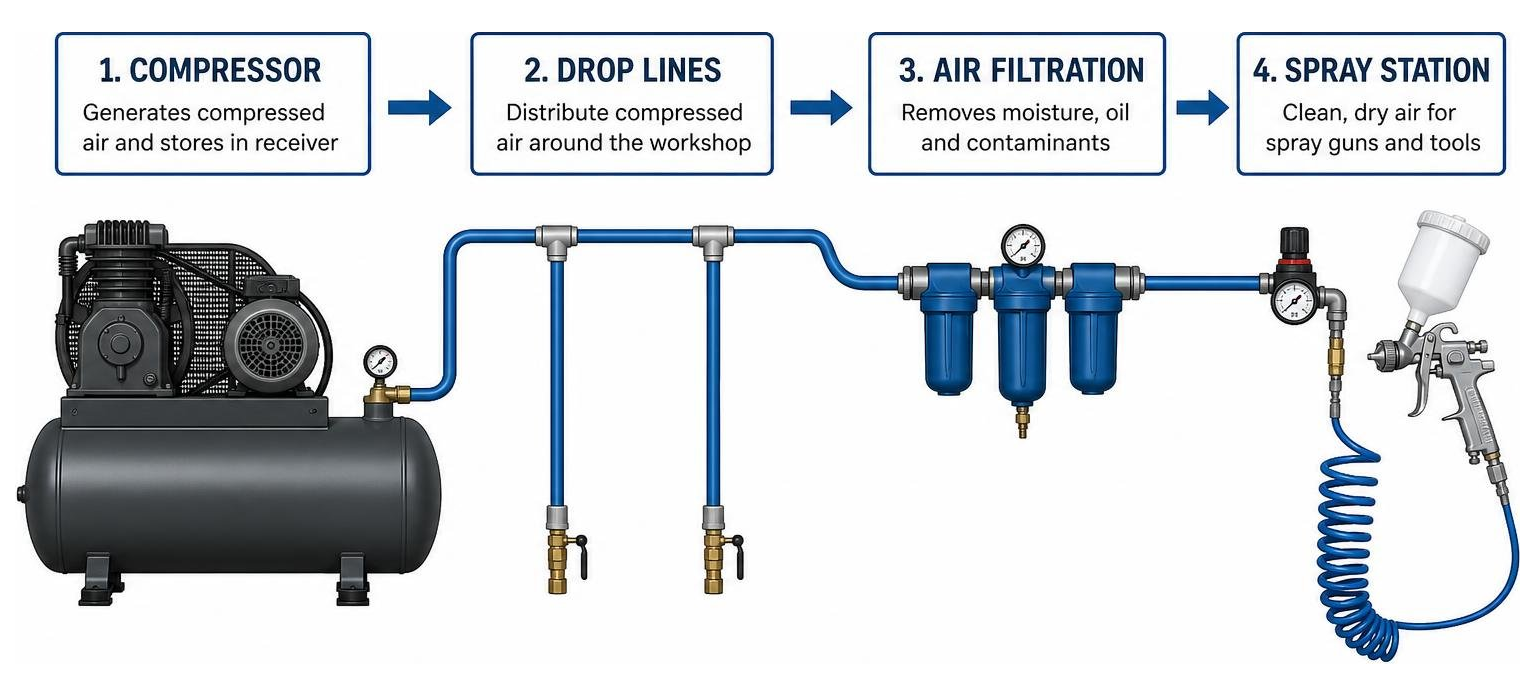
At Eastern Auto Paints, we look at the whole compressed-air setup, including the compressor, receiver tank, air lines, filtration and the equipment being supplied. Our aim is to help you select capacity that supports dependable refinishing work without paying for output your workshop will not use.
Reliable results come from informed choices, not the biggest machine on the floor. This guide compares practical compressor configurations for vehicle restoration, professional refinishing and industrial applications, then explains how to protect that investment through correct air treatment and maintenance.
Key Criteria to Choose the Best Shop Air Compressor for Your Workshop

Selecting the right compressor system requires looking past basic marketing claims and focusing on how compressed air behaves under practical workshop conditions. The heart of any reliable air setup lies in balancing volume delivery, operating pressure, storage capacity, and the continuous running demands of your specific pneumatic tools.
Sizing Airflow and Pressure: Finding the Best Shop Air Compressor Capacity
When evaluating performance, standard cubic feet per minute (SCFM) or litres per minute (L/min) at a designated working pressure, typically measured in pounds per square inch (PSI) or bar, serves as the primary metric. Different pneumatic equipment places vastly different loads on a compressed air network:
- Fastening tools (such as brad nailers or intermittent impact guns) require minimal airflow in short bursts.
- Constant-demand tools (such as dual-action orbital sanders, die grinders, and high volume low pressure (HVLP) spray guns) demand uninterrupted airflow for extended periods.
If the delivery rate of the pump falls below the consumption rate of an active tool, the receiver pressure rapidly falls below the required working threshold. This causes air tools to lose torque and paint atomisation to deteriorate mid-application. For dedicated paint booths, selecting the best compressor for HVLP operations ensures the delivery rate cleanly accommodates the high air volume required for smooth, consistent atomisation. Application pressures and fluid settings vary across coating types; always consult the manufacturer's technical data sheet (TDS) or product label before configuring operating lines.
Portable vs Stationary Air Compressors for Garages and Workshops
Workspace footprint and mobility requirements determine whether a portable or stationary configuration is most practical.
When you would use a portable compressor:
- Ideal for trade operations needing flexibility across service bays, mobile repair setups, or small dedicated workspace corners.
- Direct-drive portable units feature compact footprints and integrated wheels, making them straightforward to reposition.
- Well-suited for intermittent pneumatic tasks, fastener driving, inflation, and spot repairs.
When you would use a stationary compressor:
- Ideal for dedicated refinishing workshops, panel shops, and high-volume restoration facilities.
- Large vertical or horizontal receivers store significant air reserves, reducing motor cycling frequency.
- Belt-driven designs run at lower pump speeds, managing thermal buildup during extended operational blocks.
When setting up a smaller residential or private workshop space, reviewing dedicated guidance on a compressor for home garage environment helps ensure electrical supply and space constraints are properly addressed.
Piston vs Rotary Screw Compressors: Performance and Duty Cycles
Compressors fall into distinct operational categories based on pump mechanism and duty cycle ratings. Understanding the mechanical differences helps avoid premature equipment wear.
| Compressor Type | Compression Mechanism | Duty Cycle Profile | Typical Workshop Application |
|---|---|---|---|
| Single-Stage Piston | Reciprocating piston compresses air directly into receiver in one stroke | Intermittent duty | General mechanical work, light sanding, spot touch-ups |
| Two-Stage Piston | Air compressed in primary cylinder, cooled, then compressed in secondary cylinder | High-demand cyclic duty | Full panel resprays, heavy sanding, multiple tool bays |
| Rotary Screw | Continuous counter-rotating intermeshing helical screws | 100% continuous duty | Commercial body shops, industrial coating lines, multi-operator booths |
Oil-Lubricated vs Oil-Free Pump Technology
When you would use an oil-free compressor:
- Selected in environments where zero oil contamination is mandatory right at the source or where maintenance resources are minimal.
- Requires no crankcase lubricant checks or oil top-ups.
- Offers convenience for light-duty, mobile, or occasional utility tasks.
When you would use an oil-lubricated compressor:
- Selected for trade workshops, panel repair centres, and commercial facilities demanding extended service life.
- Oil bath lubrication keeps cast-iron cylinders, wrist pins, and bearings cooled and lubricated under heavy mechanical loads.
- Substantially longer operational lifespan under regular workshop duty when serviced according to schedule.
Both compressor types require standard safety equipment, including an ASME-rated safety relief valve, pilot unloader valves, and thermal overload protection on the electric motor to protect against mechanical binding or voltage irregularities.
Noise Levels and Workshop Environment Considerations
Noise emissions directly impact operator comfort and workplace safety. Direct-drive units and high-speed pumps generate higher sound profiles (often ranging from 80 dBA to over 90 dBA), whereas low-speed, belt-driven cast-iron piston pumps and rotary screw systems operate significantly quieter.
To manage acoustic impact in smaller workshops:
- Mount stationary units on heavy-duty elastomeric vibration isolation pads.
- Position intake filters outside the immediate working bay or install dedicated intake silencing mufflers.
- Ensure regular tensioning of drive belts to prevent high-pitched slipping noise.
Personal protective equipment (PPE) requirements vary by task and environment; consult relevant SafeWork or WorkSafe guidance and local workshop safety protocols to determine appropriate hearing protection.
Top Workshop Compressor Configurations for Trade and Restoration
Automotive refinishing and panel restoration place stringent demands on compressed air stability. Sizing must account for simultaneous tool usage, such as continuous dual-action sanding preceding high-flow topcoat application. For a complete overview of specialised refinishing setups, explore our selection of Anest Iwata compressors alongside our Anest Iwata compressors complete guide.
Compact Workshop Solutions for General Pneumatics and Touch-Up
Anest Iwata NBC20C-90:
- When you would use this: Excellent for medium-sized repair facilities and dedicated trade bays running intermittent pneumatic hand tools and standard touch-up guns.
- Key Configuration: 2.0 HP electric motor mounted on a substantial 90-litre receiver tank, delivering 225 L/min at 145 PSI (10 bar).
- The Anest Iwata NBC20C-90 provides dependable cast-iron reliability for general shop pneumatics.
Anest Iwata NB20C-50:
- When you would use this: Suited for workshops where floor space is limited but professional cast-iron pump reliability is still required for assembly, spot repair, and mechanical work.
- Key Configuration: 2.0 HP motor paired with a space-saving 50-litre receiver, outputting 225 L/min at 145 PSI (10 bar).
- The Anest Iwata NB20C-50 suits compact workshop layouts requiring consistent air delivery.
Best Shop Air Compressor Models for Automotive Refinishing and Trade Use
Anest Iwata NB30-90 Piston Compressor:
- When you would use this: Built for serious automotive restorers and busy paint bays running full-sized spray guns and pneumatic surface preparation tools.
- Key Configuration: 3.0 HP motor paired with a 90-litre tank, delivering 390 L/min at 145 PSI (10 bar) to comfortably handle continuous air demand.
- The Anest Iwata NB30-90 is designed for heavy-duty trade refinishing and daily sanding.
Anest Iwata ECO & Trinity Rotary Screw Systems:
- When you would use this: Designed for commercial body shops and industrial facilities operating continuous multi-gun spray booths, high-demand sanding banks, and continuous production lines.
- Key Configuration: The Anest Iwata Eco Screw Compressor range and the fully integrated Anest Iwata Trinity11 Mk2 11kW 8Bar 270 Litre Screw Tank with Filters and Dryer deliver smooth, pulsation-free air with 100% continuous duty cycles. Integrated refrigerated dryers and micro-coalescing filtration ensure clean air directly from the receiver.
Air Treatment and Essential Maintenance for Long-Term Reliability
Compressing ambient air concentrates natural atmospheric moisture and particulate matter. Without adequate downstream treatment, moisture enters airlines, leading to fisheyes in clearcoats, blistering in basecoats, and internal corrosion in pneumatic tools.
Installing multi-stage air filter and regulators directly after the receiver removes bulk moisture, oil mist, and particulate matter. For fine atomisation when operating professional spray equipment, clean air ensures consistent fluid break-up and uniform fan patterns across every coat.
Preventative Maintenance Checklist for Trade Compressors
Consistent maintenance extends pump operating life and maintains full CFM output:
- Daily: Drain accumulated condensation from receiver tanks manually or inspect automatic drain valves.
- Weekly: Inspect oil levels via the pump sight glass on lubricated models; verify air intake filters are clean and free of overspray.
- Monthly: Check drive belt tension and inspect all line connections for audible air leaks.
- Quarterly / Biannually: Change compressor pump oil using non-detergent synthetic compressor oil as specified by the pump manufacturer; replace paper intake filter elements.
- Annually: Test the safety pressure relief valve manually and inspect the integrity of the air receiver tank.
Why This Issue Should Not Be Ignored
Operating an undersized or improperly treated compressed air system compromises the quality of every coating applied in your shop. Pressure dropouts during a clearcoat pass can cause orange peel, dry spray, and uneven film build, turning a routine job into hours of unnecessary wet sanding and compounding. Furthermore, running a pump beyond its rated duty cycle generates extreme heat, causing oil carbonisation, valve failure, and shortened motor life.
Common Symptoms, Challenges, or Questions
Trade workshops and restorers frequently encounter specific warning signs that point to compressed air bottlenecks:
- Pressure Drop at the Gun: The gauge on the wall reads full pressure, but pulling the trigger causes the line pressure to plummet, indicating restrictive pipe diameters or an undersized compressor pump.
- Moisture at the Tool: Water droplets discharging from blowguns or sanders signal that the air receiver is saturated or cooling lines lack proper drop legs and coalescing filtration.
- Continuous Pump Running: A compressor motor that fails to cycle off during moderate tool use is operating beyond its duty cycle, increasing thermal wear and power consumption.
What a Personalised Experience Actually Looks Like
At Eastern Auto Paints, we do not believe in one-size-fits-all equipment recommendations. When you speak with our team at our Bayswater or Dandenong South locations in Melbourne, Victoria, we walk through the exact air consumption profiles of your current spray guns, sanders, and air tools.
We evaluate your available workshop power supply (single-phase 240V versus three-phase 415V), spatial layout, noise preferences, and future equipment plans. This tailored evaluation ensures you invest in a compressor package that provides clean air delivery without paying for unneeded industrial capacity.
The Value of Consistency and an Ongoing Relationship
Establishing an ongoing relationship with a dedicated trade supplier ensures your workshop maintains consistent performance year after year. From sourcing the correct replacement filtration elements and synthetic compressor lubricants to matching specialty spray equipment to your air line capacity, consistent support keeps your workflow running without unexpected downtime. As your workshop expands from spot repairs to multi-bay refinishing, we help scale your compressed air infrastructure seamlessly.
What to Expect at Eastern Auto Paints
When you partner with Eastern Auto Paints, you receive industry-backed technical advice rooted in decades of practical automotive and industrial refinishing experience. Our team provides:
- Accurate CFM and pressure requirement assessments across all major tool types.
- Access to premium compressors and replacement service components.
- Advanced colour-matching services and technical support for professional coating systems.
- Complete workshop fit-out advice, spanning air filtration, pipework layouts, and regulated spray booth connections.
When to Get in Touch or Take Action
If your current compressor struggles to keep up with continuous sanding, exhibits thermal cutouts, or allows moisture into your spray booth, it is time to upgrade your air supply. Equipping your workshop with the right compressed air infrastructure eliminates finish defects, protects pneumatic tools, and elevates overall refinishing efficiency.
Reach out to our specialist team via our Contact Page, browse our full range of compressors, explore our professional workshop equipment, or visit our trade counters in Melbourne to discuss your workshop requirements.
Frequently Asked Questions About Shop Air Compressors
What size compressor is needed to run spray guns and air sanders continuously?
Continuous pneumatic tools like dual-action orbital sanders and HVLP spray guns generally require compressors delivering substantial airflow at standard working pressures. A compressor with a pump output of at least 350 to 390 L/min paired with a 90-litre or larger receiver is typically suitable for individual continuous spray operations. Commercial setups running multiple tools concurrently require rotary screw systems or multi-stage industrial units with larger receivers to maintain uninterrupted pressure.
What is the difference between single-stage and two-stage compressors?
A single-stage compressor draws ambient air and compresses it to final tank pressure in one piston stroke. A two-stage compressor compresses air in a primary, larger cylinder, directs it through an intercooler tube to dissipate heat, and then compresses it to a higher final pressure in a secondary, smaller cylinder. Two-stage units are suited for higher operating pressures, offer greater thermal efficiency, and manage heavy workshop workloads effectively.
How often should workshop compressor tanks be drained of moisture?
Receiver tanks should be drained of accumulated condensation daily in active trade environments, or after every work session in smaller workshops. When ambient air is compressed, water vapour condenses along the internal walls of the receiver. Failing to drain this moisture reduces effective tank volume, promotes internal tank corrosion, and increases the likelihood of water travelling downstream into paint lines and air tools.
What causes pressure drops between the compressor tank and the spray gun?
Pressure drops typically stem from undersized air line piping, excessively long or narrow air hoses, restrictive quick-connect fittings, or clogged filter elements. While the compressor tank gauge may show full pressure, high airflow demand through narrow or restrictive lines causes friction loss, resulting in lower pressure at the tool trigger. Using smooth-bore airlines of adequate internal diameter and high-flow fittings resolves this restriction.
Should I choose an oil-lubricated or oil-free compressor for automotive spray painting?
Oil-lubricated compressors are generally preferred for trade workshops due to their durability, quieter operation, and extended service life. However, because lubricated pumps can release trace oil vapour into the airstream, a multi-stage filtration system including a particulate filter, coalescing filter, and oil-vapour absorber must be installed before the spray gun. Oil-free units eliminate oil vapour at the pump but typically have shorter service intervals under heavy daily duty cycles.