
The Definitive Guide to Compare Powder Coating Colors
How to Compare Powder Coating Paint Colours
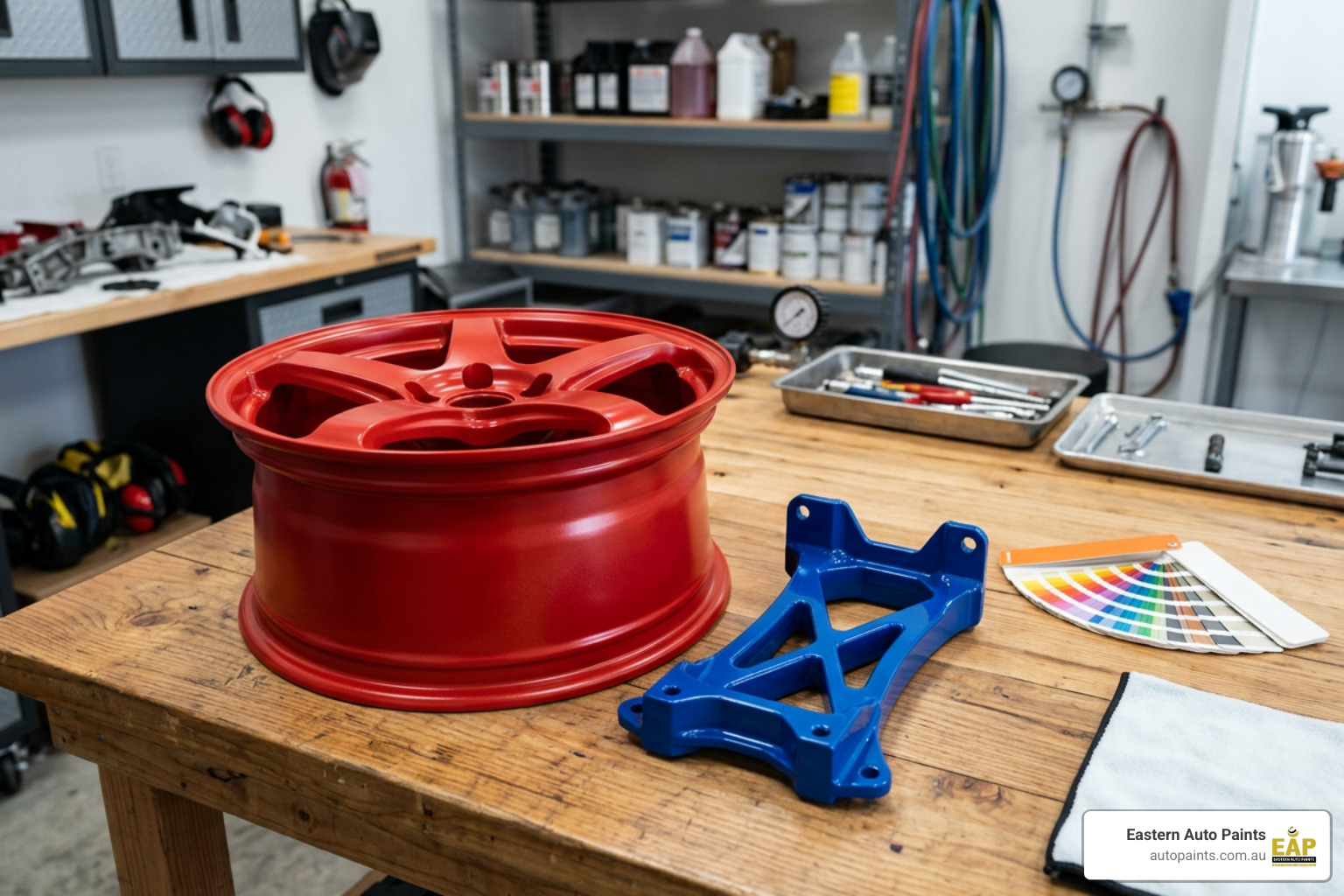
The right powder coating paint colours make a restored wheel, bracket, chassis part or fabricated component look intentional and professionally finished. The wrong choice can make a close colour match look noticeably different once gloss, texture, lighting, metal preparation and curing are taken into account.
Key Takeaways
- Start with the required colour system, such as RAL or COLORBOND steel colours, where a recognised match is needed.
- Compare physical coated samples, not only online images, under the lighting where the part will be used.
- Choose the finish as carefully as the shade: smooth matt, satin, gloss and textured coatings can change the perceived colour.
- Match the powder chemistry and primer system to the substrate and service environment before coating.
- Explore our guide to different types of powder coating colours for a closer look at available finishes.
At Eastern Auto Paints (EAP), we help trade applicators, workshops and serious restorers narrow down colour choices before material reaches the booth. We look beyond the colour name to consider the part, substrate, desired appearance and whether a powder-coated finish needs to be replicated for a repair or touch-up.
Our approach is built around practical coating knowledge, reliable product guidance and clear colour-matching advice. That means helping you select a finish that suits the job rather than relying on a screen image or a colour description alone.
Core Categories of Powder Coating Paint Colours
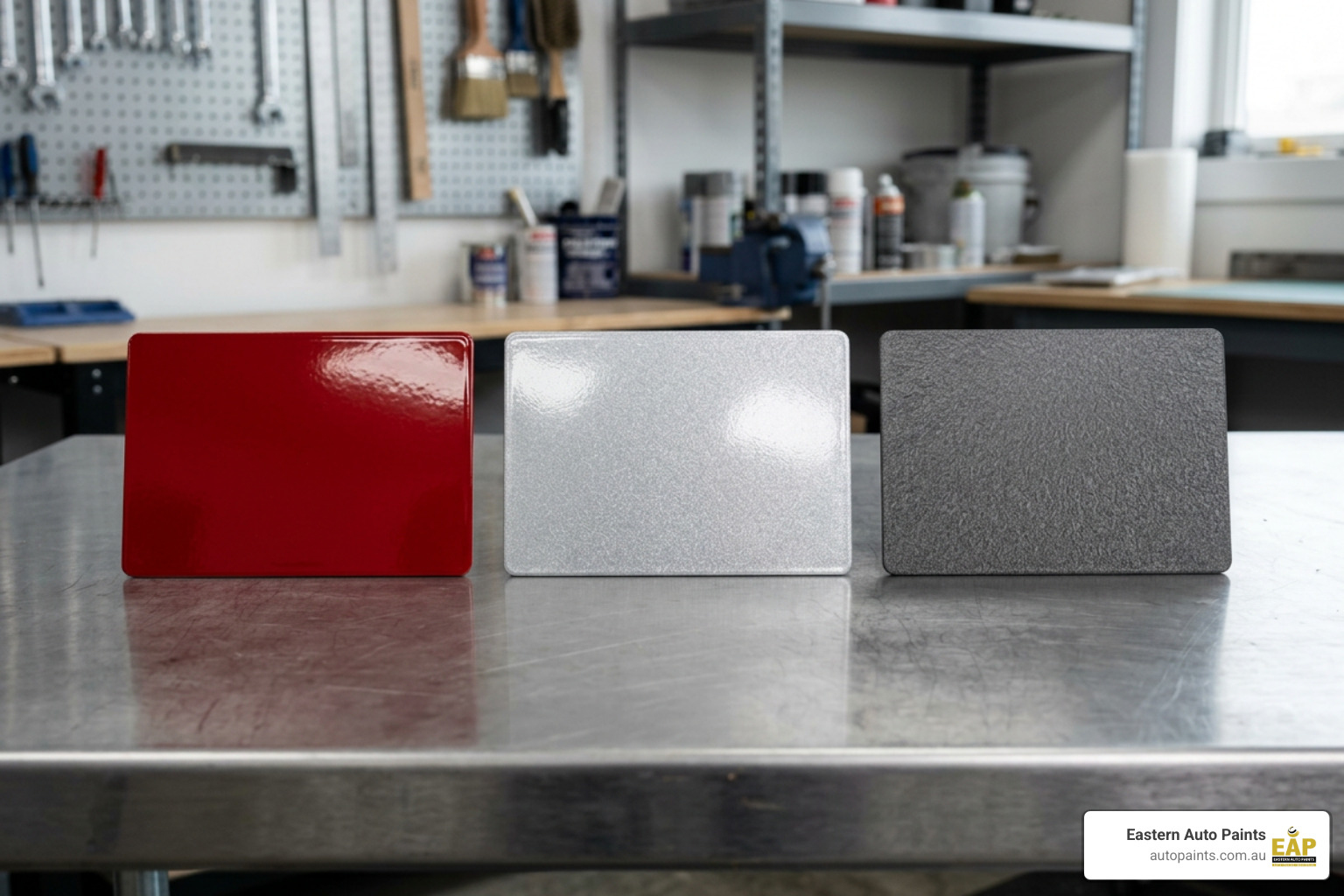
Evaluating different powder coating options involves understanding how distinct resin systems and pigments interact with light. While liquid paint relies on solvent evaporation to form a film, thermosetting powder coatings rely on electrostatic deposition and heat curing to melt, flow, and chemically cross-link into a resilient protective layer. Discovering the characteristics of each category ensures the final coated metal component aligns with your performance expectations and aesthetic requirements. You can read more about broad applications in our powder coatings complete guide.
The perceived colour of a cured powder finish depends directly on the combination of resin chemistry, pigment loading, gloss retention, and surface profiling. Application parameters and curing schedules vary by formulation, so always consult the manufacturer's technical data sheet (TDS) or product label before processing your parts.
| Finish Category | Visual Appearance | Texture Profile | Typical Applications |
|---|---|---|---|
| Solid Gloss / Satin | Crisp, uniform colour reflection | Smooth, flat film | Automotive chassis, architectural framing, machinery brackets |
| Solid Matt | Non-reflective, low-sheen depth | Smooth, subtle velvet | Modern trim accents, industrial housings, interior fixtures |
| Metallic / Pearlescent | Sparkling lustre with dynamic shift | Smooth to subtle sparkle | Custom alloy wheels, decorative facades, vehicle components |
| Textured / Ripple | Patterned, light-diffusing surface | Tactile, raised profile | Equipment enclosures, high-wear tools, cast iron restoration |
| Anodised Style | Translucent, metallic sheen | Smooth, low-glare sheen | High-end architectural extrusions, bespoke metalwork |
Solid, Gloss, and Satin Formulations
Solid colour powders utilise pure pigment dispersions suspended within polyester, epoxy, or hybrid resins to provide full opacity across the substrate.
High-gloss solids suit components where clean light reflection, easy wipe-down maintenance, and a classic vibrant finish are important. They can help accentuate intricate fabrication curves and are often considered for strong reds, whites, and other crisp solid colours, including options such as Jotun Signal Red Powdercoat or Jotun Bright White Powder Coat.
Satin and matt solids are better suited to projects that need a more restrained, contemporary appearance. They soften glare across broad panels, suit vehicle trim, chassis components, and architectural metalwork, and can support modern dark themes with products such as Jotun Matt Black Powder Coat.
Application variables like transfer efficiency, gun voltage, and preheating can subtly alter film laydown, which is why reviewing the relevant product label and testing on metal panels beforehand is standard trade practice.
Metallic, Pearlescent, and Textured Effects
Special effect powders introduce metallic flakes or specific texturing agents into the thermosetting compound to create visual depth and physical tactility.
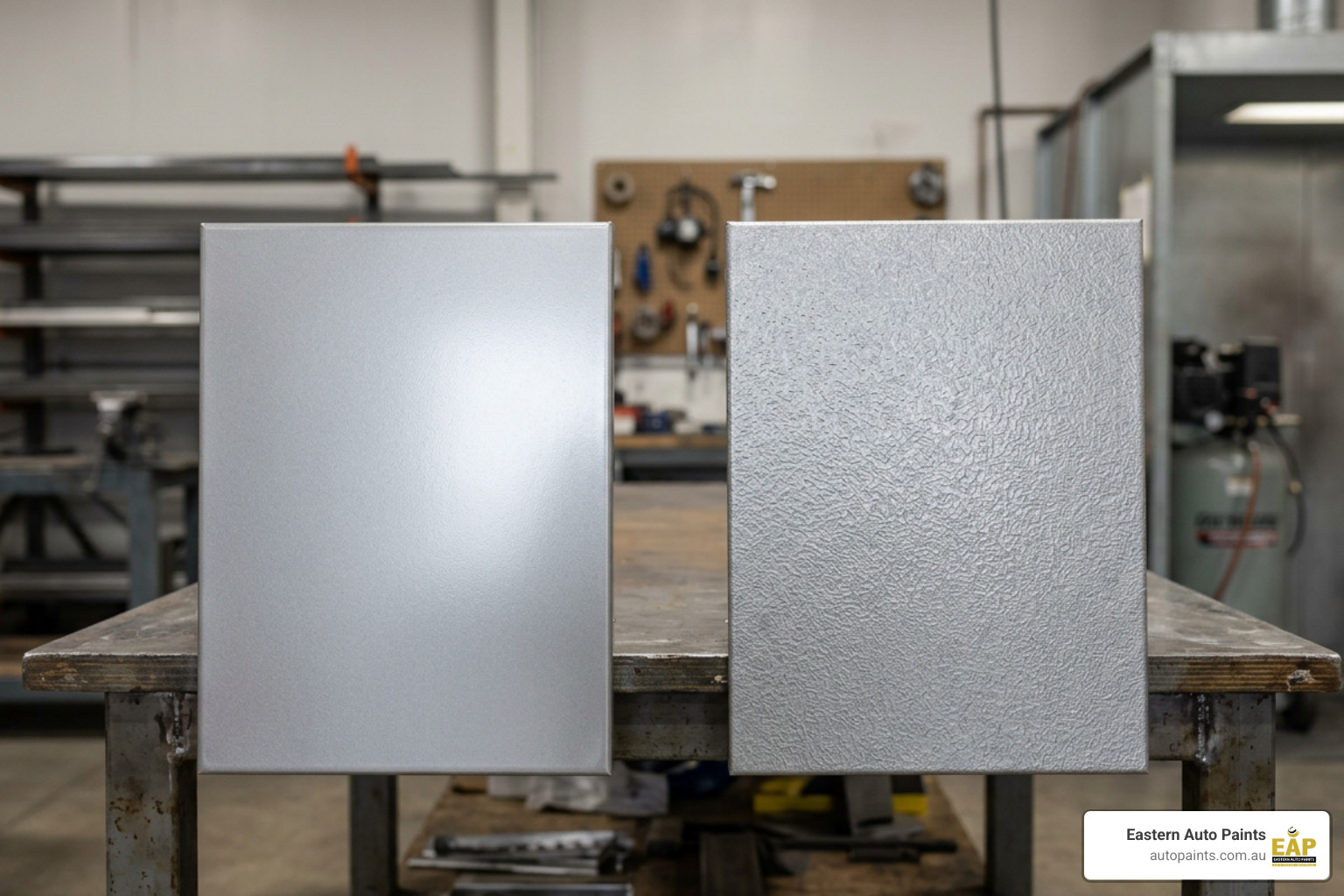
Metallic and pearlescent finishes are useful when a component needs a high-end sparkle that shifts under different viewing angles and sunlight. They are often chosen for wheel rims, bull bars, decorative architectural accents, and balanced silver finishes such as Jotun RAL 9006 Matt Silver Powder Coat.
Textured and ripple finishes help disguise minor surface imperfections, pitting, and grinding marks that a smooth powder may highlight. They can also improve tactile grip and reduce the visibility of handling marks on switchboards, toolboxes, industrial equipment, and restoration parts, with options such as Jotun Storm Grey Ripple Powdercoat and Jotun Sahara Black Powdercoat.
Standardised Palettes: RAL Matching and Colorbond Systems
Working with standardised colour systems eliminates guesswork when integrating powder-coated components with pre-existing structural elements or matching industrial equipment. Whether you are coating architectural window extrusions or fabricating custom vehicle accessories, cross-referencing industry palettes provides consistent colour reproduction.
Matching Colorbond Architectural Shades
Matching powder coatings directly to established building standards enables seamless harmony between metal panels, roof sheeting, flashings, gates, and window frames.
Light neutral tones suit projects that need bright, clean, heat-reflecting profiles, including options such as Jotun Surfmist Colorbond® Powdercoat. They also support subdued natural aesthetics that complement landscaping and light brickwork.
Contemporary greys and earthy tones are often selected for architectural framing and industrial designs that need modern, neutral depth. Jotun Basalt Colorbond®, Jotun Woodland Grey Colorbond® Powdercoat, and Jotun Ironstone Colorbond® Powdercoat can support deep grey profiles for structural columns and garage framework, while Jotun Pale Eucalypt Colorbond® Powdercoat suits exterior trims that need a foliage-inspired finish.
International RAL Standards in Industrial Coatings
The international RAL Classic system provides standard colour definitions globally across machinery, commercial transport, and industrial infrastructure.
Standardised RAL colours are useful when fabricating replacement panels, brackets, or guards for imported industrial and manufacturing machinery. They also help commercial fixture projects maintain identical colour batches across multiple fabrication facilities, with common utility shades including Jotun RAL 7035 Light Grey Powder Coat, Jotun RAL 9005 Flat Black Powder Coat, and Jotun RAL 9016 Traffic White Matt Powder Coat.
Technical Selection: Durability Standards, LRV, and Environmental Suitability
Selecting a powder coating involves balancing colour aesthetics with environmental resilience. Powder formulations differ significantly in their chemical resistance, ultraviolet (UV) stability, and film flexibility.
Architectural and Industrial Standards for Powder Coating Paint Colours
Durability standards such as the American Architectural Manufacturers Association (AAMA) standards and Australian Standard AS 3715 guide specifiers on how long a coating retains its colour and film integrity.
Standard durable polyesters suit interior metalwork, general industrial brackets, residential interior trim, and components protected from extreme sun and moisture exposure. They are often chosen for projects needing a balanced, general-purpose decorative coating with reliable mechanical toughness.
Super durable polyesters and fluoropolymers are more appropriate for exterior architectural facades, structural balustrades, commercial curtain walls, and automotive external components exposed to high ultraviolet (UV) exposure. They are intended for installations where prolonged resistance to chalking, colour fading, and gloss loss under intense sun is a key requirement.
Always check the manufacturer's technical data sheet for verified performance metrics and approved substrate preparation criteria.
Selecting Powder Coating Paint Colours for High-Durability Applications
Atmospheric corrosivity ranges from mild indoor settings to severe marine and industrial exposure zones.
Standard finishes suit mild inland environments where components face minimal airborne salts, chemical exposure, or standing moisture. They are also suitable for dry industrial settings where mechanical abrasion resistance is the primary operational concern.
Specialised protective systems are better suited to severe coastal zones, industrial chemical plants, or components frequently exposed to marine wash. Heavy-duty equipment may require multi-tier barrier systems using professional formulations from our Jotun powder coatings collection.
Substrate Preparation, Primers, and Touch-Up Methods
The ultimate appearance and longevity of any powder coating depend on proper surface preparation and compatible base coats. Contamination, residual scale, or incorrect profile depths will compromise adhesion and distort the topcoat finish.
Substrate Compatibility and Anti-Corrosive Primers
Different metals present unique challenges during the powder coating curing process. Aluminium requires thorough degreasing and chemical conversion etching to promote strong chemical adhesion and corrosion resistance. Mild steel generally requires abrasive blasting to remove mill scale and create an anchor profile for subsequent coats. Galvanised steel and castings can trap air and moisture, which may cause micro-bubbling, also called outgassing, during oven curing if they are not properly preheated and sealed.
Applying an anti-corrosive primer provides an essential barrier for harsh conditions. Using a high-grade primer such as Jotun Primax Protect Grey Epoxy Powdercoat shields the base metal from moisture ingress and filiform corrosion. Learn more about comprehensive system design across our complete powder coatings range.
Exact Colour Touch-Ups and Maintenance
During transport, installation, or heavy field service, coated items can experience minor chips or mechanical abrasions. Powder coating cannot be selectively remelted on an assembled, finished structure, which makes liquid aerosol touch-up matching the industry standard approach for fast remediation.
When resolving minor surface damage, clean and de-nib the damaged edge, then feather the border smoothly to prevent visible ridges. Select a dedicated colour-matched spray can, such as our powdercoat colour spray cans, custom aerosols, or specialised textured spray paint for ripple profiles. For blending guidance, follow our practical instructions in how to use powdercoat colour spray paint.
For automotive components like alloy wheels, explore our specialised guide on wheel powder coating in Melbourne to evaluate preparation and refinishing steps.
Why This Issue Should Not Be Ignored
Selecting a powder coat colour purely based on a digital screen swatch or a printed leaflet can lead to disappointing results. Digital monitors emit light, whereas powder-coated metals absorb and reflect ambient light depending on their pigments, gloss levels, and texture profiles. A colour that appears subtle on a monitor may present as significantly brighter or darker once cured onto an aluminium extrusion or steel chassis.
Ignoring substrate chemistry and environmental exposure conditions also leads to premature coating failure. Applying a standard interior-grade powder to an external automotive bull bar or coastal architectural railing can result in rapid chalking, fading, and peeling. Addressing colour selection, resin choice, and primer compatibility early in your project planning ensures the finished piece performs reliably in its intended operating environment.
Common Symptoms, Challenges, or Questions
Trade applicators and automotive restorers encounter several common hurdles during colour selection and application.
Metamerism is one of the most common challenges. A powder-coated panel can match a liquid painted car body under fluorescent workshop lighting, then appear noticeably different under natural midday sunlight.
Gloss misalignment can also change the result. Even when the colour code is correct, choosing high gloss instead of satin or matt can fundamentally alter how deep the colour appears.
Edge coverage and opacity need careful attention, especially with light and bright colours. Applicators manage film build carefully so the underlying dark primer or bare metal does not show through.
Outgassing imperfections may appear as small pinholes in cured powder over cast aluminium or porous hot-dipped galvanised steel components.
Field touch-up mismatches occur when standard hardware spray cans fail to replicate the distinct sheen or tone of architectural powder coatings.
What a Personalised Experience Actually Looks Like
When you consult our team, we do not simply hand over a colour card and leave you to guess. We take the time to evaluate the specific metal substrate, the component's geometry, its intended service environment, and the application equipment being used.
Whether you visit our trade counters in Bayswater or Dandenong South or contact our technical team remotely, we look at actual physical colour chips under balanced lighting. If you are blending powder-coated items with existing automotive body panels, we utilise advanced colour matching technology to supply custom aerosol touch-up solutions that closely reflect the intended sheen and tone of the cured powder.
The Value of Consistency and an Ongoing Relationship
For fabricators, commercial coaters, and restoration workshops across Victoria, maintaining batch-to-batch consistency is vital for customer satisfaction. Working alongside a dedicated supplier ensures your coating materials, primers, and matched touch-up sprays remain uniform across extended production runs.
An ongoing relationship provides direct access to reliable advice whenever you encounter challenging substrates, shifting project specifications, or urgent turnaround schedules. We maintain deep inventory across industry-standard colour collections, ensuring your workflow proceeds without unnecessary delays.
What to Expect at Eastern Auto Paints
At Eastern Auto Paints, our focus is on providing dependable, trade-grade coating solutions backed by practical industry expertise. When working with us, you can rely on experienced staff who understand the nuances of powder resins, curing chemistry, and substrate preparation.
We provide access to industry-standard colour ranges, including extensive selections from our Jotun paints inventory, along with precision matching capabilities for wet paint and aerosol touch-up systems designed to replicate powder finishes.
Our team can also advise on supporting workshop equipment, from air compressors to specialised spray guns. We stock dependable Anest Iwata compressor configurations, ranging from compact workshop units to industrial screw models, each engineered for consistent airflow during demanding spray applications.
For safety and compliance, we direct customers to manufacturer technical data sheets, product labels, and Safe Work Australia or WorkSafe Victoria standards for all personal protective equipment (PPE) requirements.
When to Get in Touch or Take Action
You should reach out for expert guidance when starting a new fabrication or restoration project that requires precise colour coordination between powder-coated parts and liquid-painted panels. We can also help when you are sourcing high-durability powders or anti-corrosive primers for harsh service environments.
Our team is available when you need exact colour-matched touch-up aerosols to repair installation blemishes or transport marks, or when you are upgrading workshop equipment, air filtration, or protective gear to enhance application consistency.
For personalised technical advice and product recommendations, contact our team through our contact page or visit our Melbourne trade locations.
Frequently Asked Questions About Powder Coating Paint Colours
What is the significance of Light Reflectance Value when selecting colours?
Light Reflectance Value measures the percentage of visible light that a coated surface reflects compared to what it absorbs. Dark colours reflect less light, absorbing more solar heat, while lighter colours reflect more light, helping maintain cooler substrate temperatures on exterior installations. Considering this value assists designers in achieving the desired visual contrast, glare control, and thermal performance across architectural and automotive metalwork.
How do substrate types impact the final powder coat finish?
Different substrates influence heat transfer rates, surface anchor profiles, and outgassing behaviour during the oven cure cycle. Dense steel sections require longer dwell times to reach the correct metal temperature compared to thin aluminium extrusions, and porous metals like castings or galvanised steel can release trapped air that creates micro-pinholes if not preheated or sealed with a suitable primer. Always review the technical data sheet for your specific substrate preparation and cure parameters.
How should damaged powder-coated surfaces be repaired on site?
Minor scratches and installation chips are repaired by cleaning the damaged area, de-nibbing loose edges with fine abrasive paper, and feathering the surrounding transition zone. Because cured powder coating cannot be reflowed on site, applying an exact colour-matched liquid spray aerosol formulated to replicate the powder's colour and gloss level provides a protective, visually seamless repair.
Why do some powder colours require different film builds?
Lighter colours, such as bright whites and high-visibility yellows, naturally have lower opacity compared to dark grey or black pigments. Applicators manage the applied powder thickness to ensure complete visual hiding and prevent the underlying substrate or primer colour from shadowing through the cured topcoat. Exact film build targets should always be verified against the manufacturer's technical specifications.
How do environmental conditions dictate powder coating selection?
Operating environments subject metal coatings to differing levels of moisture, airborne salts, chemical pollutants, and solar ultraviolet radiation. Inland, sheltered components require standard durable polyester formulations, while severe coastal, industrial, or high-sunlight marine installations demand super durable polyesters, fluoropolymers, or multi-coat epoxy primer systems to resist chalking, fading, and substrate corrosion over time.
Can powder coat finishes be accurately colour-matched to existing paint?
Powder coatings can be matched to recognised colour standards like RAL and building palette codes, as well as custom matched to existing liquid paint colours. Achieving a visual match requires aligning both the colour pigment and the gloss level, such as matt, satin, or full gloss. Viewing physical coated metal swatches under the intended lighting conditions ensures an accurate match before coating the final parts.