
Unlock Efficiency: A Guide to Solvent Recycler Machines
Why Solvent Recycler Machines Matter in Paint Workshops

Solvent recycler machines can turn used gun wash and cleaning solvent into a reusable workshop resource through controlled distillation. Used well, they support a cleaner, more consistent workflow for spray gun cleaning; used without the right equipment, chemical checks and safety processes, they can create avoidable handling, residue and maintenance challenges.
Key Takeaways
- Solvent recyclers heat contaminated solvent, collect the vapour, then condense it back into liquid solvent.
- Paint solids, pigments and other higher-boiling contaminants remain behind as residue for appropriate disposal.
- Batch units suit intermittent workshop use, while continuous systems suit higher-volume production environments.
- Solvent type, waste volume, available utilities and hazardous-area safety requirements should guide machine selection.
- Learn more in A Comprehensive Guide to Solvent Recyclers.
For trade applicators and serious vehicle restorers, the practical appeal is straightforward: a recycler can help keep cleaning solvent available for suitable non-critical tasks while reducing the amount of used solvent stored in the workshop. At Eastern Auto Paints (EAP), we help customers consider how solvent recycler machines fit alongside their spray equipment, coating system and everyday clean-up practices.
Our focus is on smarter coating solutions that help automotive, industrial and marine customers work with greater confidence. That means practical guidance, reliable equipment choices and an emphasis on safe, durable workshop processes before moving into the details of how solvent recycling works.
How Solvent Recycler Machines Work in Paint Workshops
Understanding how solvent recycler machines function inside a busy refinishing or industrial setting begins with the fundamental physics of distillation. When spray guns, paint lines, and fluid cups are cleaned, the resulting waste mixture consists of volatile organic solvents blended with solid resins, pigments, clearcoat hardeners, and heavy binders. Because the solvents themselves have boiling points lower than the dissolved paint solids, thermal distillation allows us to boil off the clean chemical component and separate it from liquid or solid sludge.
In a standard workshop setup, dirty cleaning fluid is poured into a sealed boiling chamber. Heat is applied to the chamber jacket, raising the fluid temperature until the solvent transforms into vapour. This vapour rises into a separate condensing system, where fan-forced air or recirculating cooling water extracts heat, returning the purified vapour back to liquid form. The distilled solvent flows directly into a receiving container, ready to be repurposed for gun washing and equipment clean-up.
Distillation Principles in Solvent Recycler Machines
The internal heating mechanisms of professional solvent recycler machines are designed to deliver even, controlled thermal energy without creating hot spots that could ignite flammable vapours or bake paint residue onto vessel walls. Most industrial units utilise an indirect electric thermal oil jacket. The electric heating element warms a specialised heat transfer oil surrounding the distillation vessel, distributing uniform heat across the floor and walls of the chamber.
Precise temperature regulation is controlled via digital proportional-integral-derivative (PID) controllers. Operators calibrate the heating temperature based on the specific boiling point of the solvent blend being processed. For atmospheric distillation systems, the jacket temperature is typically programmed above the boiling point of the liquid to drive vapourisation. When processing heavier solvents or mixtures with higher boiling thresholds, vacuum-assisted distillation devices can be attached. By pulling a vacuum inside the boiling vessel, atmospheric pressure is lowered, allowing heavy solvents to boil and vapourise at substantially lower temperatures. This conserves electrical energy and prevents thermal breakdown of sensitive chemicals.
Batch vs Continuous Solvent Recycler Machines
Selecting between batch and continuous recycling systems depends on the daily volume of waste solvent generated in your facility. Batch solvent recyclers process a fixed capacity per cycle. The operator fills the distillation chamber with dirty solvent, secures the lid, selects the operational profile, and starts the cycle. Once processing is complete and the automatic cool-down phase finishes, the operator opens the unit, removes the concentrated sludge, and prepares the vessel for the next run. For detailed guidance on matching machine capacity to daily spray operations, explore our resource on A Comprehensive Guide to Solvent Recyclers.
Continuous solvent distillation systems are designed for high-throughput automotive refinishing plants and industrial manufacturing facilities. These automated units feature smart auto-feeding systems driven by compressed-air pneumatic diaphragm pumps. As clean solvent vapourises and leaves the boiling chamber, liquid level sensors detect the drop in volume and automatically pump fresh dirty solvent into the tank. This allows continuous operation throughout multiple work shifts, dramatically increasing processing capacity while minimising manual labour requirements.
Core Operational Benefits and Chemical Compatibility
Integrating distillation equipment into your paint department brings clear operational advantages. By recovering clean cleaning thinners on-site, workshops maintain a constant inventory of solvent for washing spray guns, flush lines, and pressure pots without relying solely on fresh chemical shipments. Furthermore, minimising liquid waste volume reduces site storage requirements and helps workshops adhere to strict workplace safety frameworks. For additional background on establishing compliant handling workflows, review our article on Solvent Waste Management.
Compatible Solvents and Chemical Reclaim
Modern distillation machinery can handle a broad spectrum of organic chemicals used across automotive refinishing, metal fabrication, and composite manufacturing. Common workshop fluids suitable for recycling include:
- General wash thinners and acrylic lacquers
- Universal two-pack (2K) reducers and urethane thinners
- Pure acetone and methyl ethyl ketone (MEK)
- Aromatic hydrocarbons including xylene and toluene
- Isopropyl alcohol (IPA) and ethanol cleaning blends
- Epoxy reducers and specialised equipment flushing agents
When reclaiming complex blends, such as gun wash containing mixed primers, clearcoats, and basecoats, it is critical to verify chemical compatibility. Solvents containing nitrocellulose or highly reactive peroxide additives require specialised handling precautions to prevent exothermic reactions during heating. Always consult product safety data sheets before processing specialised chemical blends, and explore our full range of Hardeners, Reducers and Solvents for initial mixing requirements.
Safety Standards and Hazardous Location Ratings
Because solvent distillation involves heating flammable liquids above their flashpoints, equipment construction must satisfy strict explosion-protection standards. Equipment installed in paint mixing rooms or spray areas where flammable vapours may be present must conform to national hazardous area standards, such as those detailed by SafeWork Australia.
Key safety infrastructure built into compliant recyclers includes:
- Explosion-proof electrical enclosures rated for hazardous environments
- Thermal limit switches to prevent oil overheating
- Automatic over-pressure relief valves and sealed vapour paths
- Static grounding leads with low earth resistance limits to prevent static sparks
- Failsafe power-outage memory systems that safely shut down operations during electrical interruptions
Selection Factors and Maintenance Guidelines
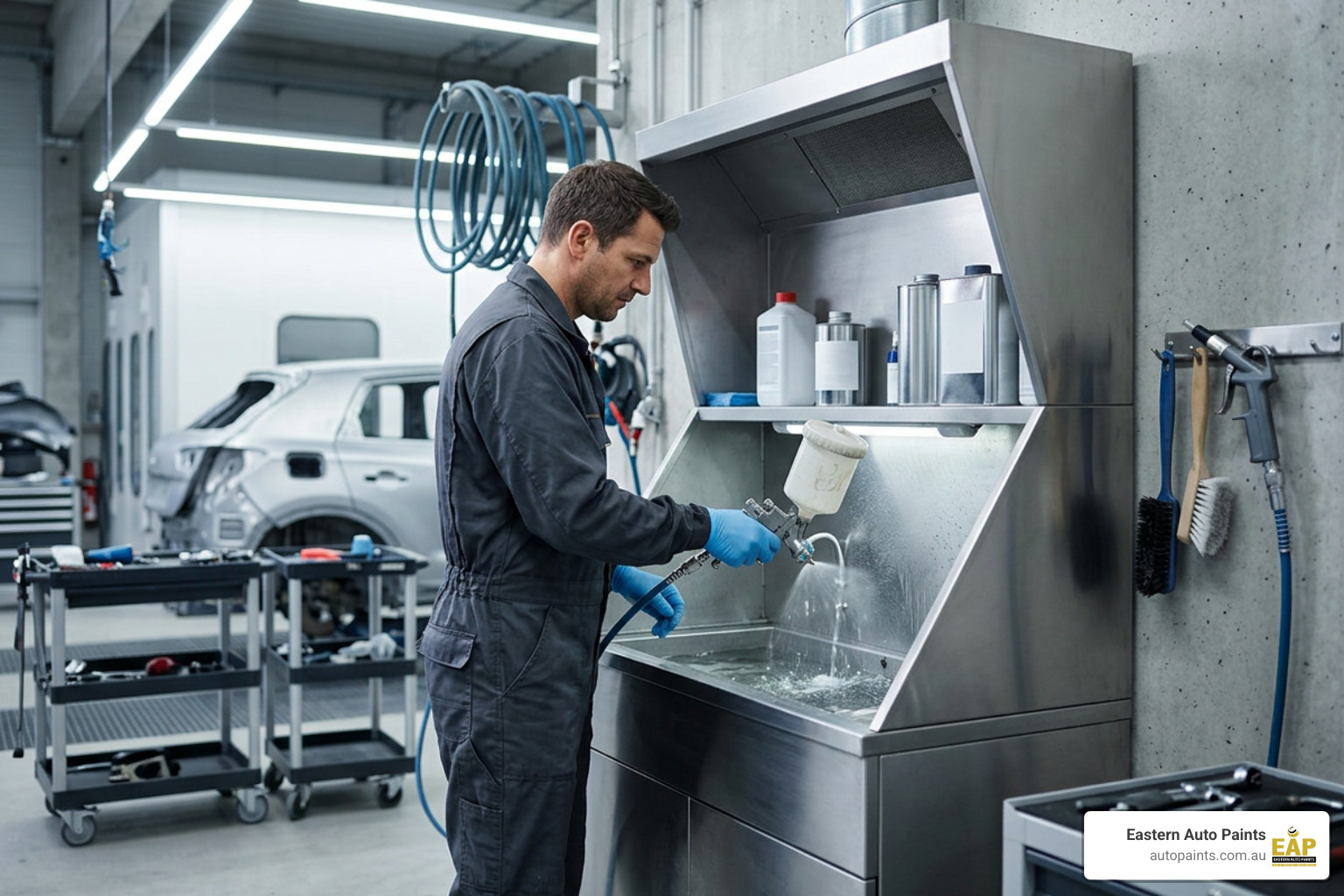
Choosing the correct machine for your workshop requires balancing chemical throughput, utility availability, and facility space. Workshops processing low to moderate amounts of gun wash typically opt for compact, air-cooled batch units, whereas large facilities require dedicated utility hookups including high-capacity single or three-phase power, clean compressed air for pneumatic pumps, and recirculating water chillers for continuous vapour condensation.
Simple vs Fractional Distillation Technologies
Simple distillation units evaporate solvent vapours directly into a cooling condenser. This technology excels at separating single solvents or mixed solvent wash blends from non-volatile solid contaminants like paint resins and pigments. Simple distillation recovers high-purity gun wash liquid that is perfect for non-critical wash-up tasks.
Fractional distillation utilises a specialised fractionating column positioned between the boiling vessel and the condenser. This column contains structured packing that allows multi-stage condensation and re-evaporation cycles. Fractional systems are ideal when a workshop needs to separate multiple volatile solvents with close boiling points from one another, producing reclaimed solvents of extreme chemical purity.
Sludge Removal, Maintenance, and Equipment Care
Proper maintenance ensures operational longevity and consistent distillation efficiency. Operating procedures should always prioritise clean residue extraction. High-temperature distillation bags, designed to line the inner boiler chamber, allow solid paint sludge to collect inside a removable bag. Once cooled, the bag containing dried residue can be lifted out intact, eliminating manual scraping and protecting non-stick boiler coatings.
Routine maintenance steps include:
- Inspecting cover seals and lid gaskets for wear, replacing damaged seals immediately
- Checking heat-transfer oil levels and replacing thermal fluid according to service intervals
- Cleaning condenser fins or flushing water tubes to maintain peak cooling performance
- Testing the pH level of incoming waste solvent to ensure it falls within a neutral operating range, avoiding acidic attack on copper or stainless steel condenser tubes
- Utilising dedicated scrapers and non-abrasive tools from our Clean-Up and Recycling Equipment range
Commercial Recycler Options for Automotive Refinishing
_compressed.webp?alt=media&token=f908652e-5689-48be-a8b9-acbf732bf5e8 "commercial automated solvent distillation machine set up in a refinishing facility")
For commercial refinishing operations seeking reliable on-site reclamation, dedicated distillation machines provide robust performance built for daily trade use. When choosing between capacity options, each unit serves specific workshop scale requirements:
- UNIC USD45XPE Solvent Recycler: You'd use this machine for small- to medium-sized refinishing operations requiring an efficient, automated batch distillation unit to manage daily gun-wash volume in a compact footprint.
- UNIC USD60XPE Solvent Recycler: You'd use this machine for higher-volume paint shops and multi-booth facilities needing expanded batch capacity to process larger quantities of waste solvent per shift.
When selecting commercial equipment, our team at Eastern Auto Paints works closely with workshop managers across Victoria to evaluate daily solvent volume, utility hookups, and hazardous-area ventilation setups. Always consult the manufacturer's technical data sheet (TDS) or product label for exact operating parameters, cycle settings, and facility setup guidelines. Whether your facility operates out of Bayswater, Dandenong South, or greater Melbourne, establishing an efficient recycling workflow ensures your technicians have constant access to clean washing fluids while keeping your spray booth operations running smoothly. For personalised equipment consultations and site advice, contact our team directly.
Explore our range of equipment and expert support:
- Contact Us
- Clean-Up and Recycling Equipment
- Hardeners, Reducers and Solvents
- UNIC USD45XPE Solvent Recycler
- UNIC USD60XPE Solvent Recycler
Frequently Asked Questions About Solvent Recycler Machines
How long does a standard solvent distillation batch take?
A typical batch cycle on a standard distillation unit takes time to process from startup to final vapourisation. Processing speed depends on the thermal capacity of the heating jacket, the specific boiling point of the solvent blend, and ambient cooling efficiency. Cycle times and thermal settings vary by equipment model, so operators should always refer to the manufacturer's technical data sheet (TDS) or product manual for exact specifications. Following completion of the heating cycle, machines enter an automatic cool-down phase, allowing internal temperatures and pressure to drop safely before the vessel can be opened.
Can a recycler handle mixed paint thinners and gun wash?
Yes, standard atmospheric solvent recyclers handle mixed wash thinners, basecoat reducers, and clearcoat gun wash extremely well. Because dissolved paint resins, pigments, and cured hardeners have boiling points significantly higher than organic solvents, the recycler distils the combined volatile solvent blend into a clear liquid while leaving solid paint sludge behind. The resulting reclaimed fluid is ideal for washing spray guns and cleaning fluid lines.
What safety setup is required for operating distillation equipment?
Operating solvent distillation hardware safely requires installing the unit in a well-ventilated, dedicated hazardous area compliant with local workplace safety standards. Electrical supplies must meet explosion-proof ratings for flammable vapour zones, and the machine frame must be connected to an earth ground lead to dissipate static electricity. Readers should consult the product label, technical data sheet (TDS), and relevant SafeWork or WorkSafe guidance for product-specific PPE needs and site safety requirements before operating equipment.
How does thermal oil heating work in solvent recovery equipment?
Thermal oil heating utilises an electric immersion element submerged in a sealed jacket of specialised heat-transfer fluid surrounding the boiling chamber. This design prevents direct contact between high-temperature heating elements and volatile solvent vapours. The oil distributes gentle, uniform heat across the floor and sidewalls of the vessel, preventing hot spots that could scorch paint sludge or degrade sensitive solvent molecules.
Why is testing solvent pH important before starting a batch cycle?
Testing the pH level of dirty waste solvent is essential to protect the internal metallurgy of the distillation vessel and condenser. Contaminated solvents containing acidic strippers or caustic cleaning agents outside a neutral pH range can corrode copper or stainless steel condenser tubes during vapourisation. Confirming neutral pH prevents chemical attack, ensuring long equipment service life and pure distillate output.