

Sandpaper Secrets: Mastering Body Filler with the Right Grit
Why the Right Sandpaper Grit is Crucial for Body Filler
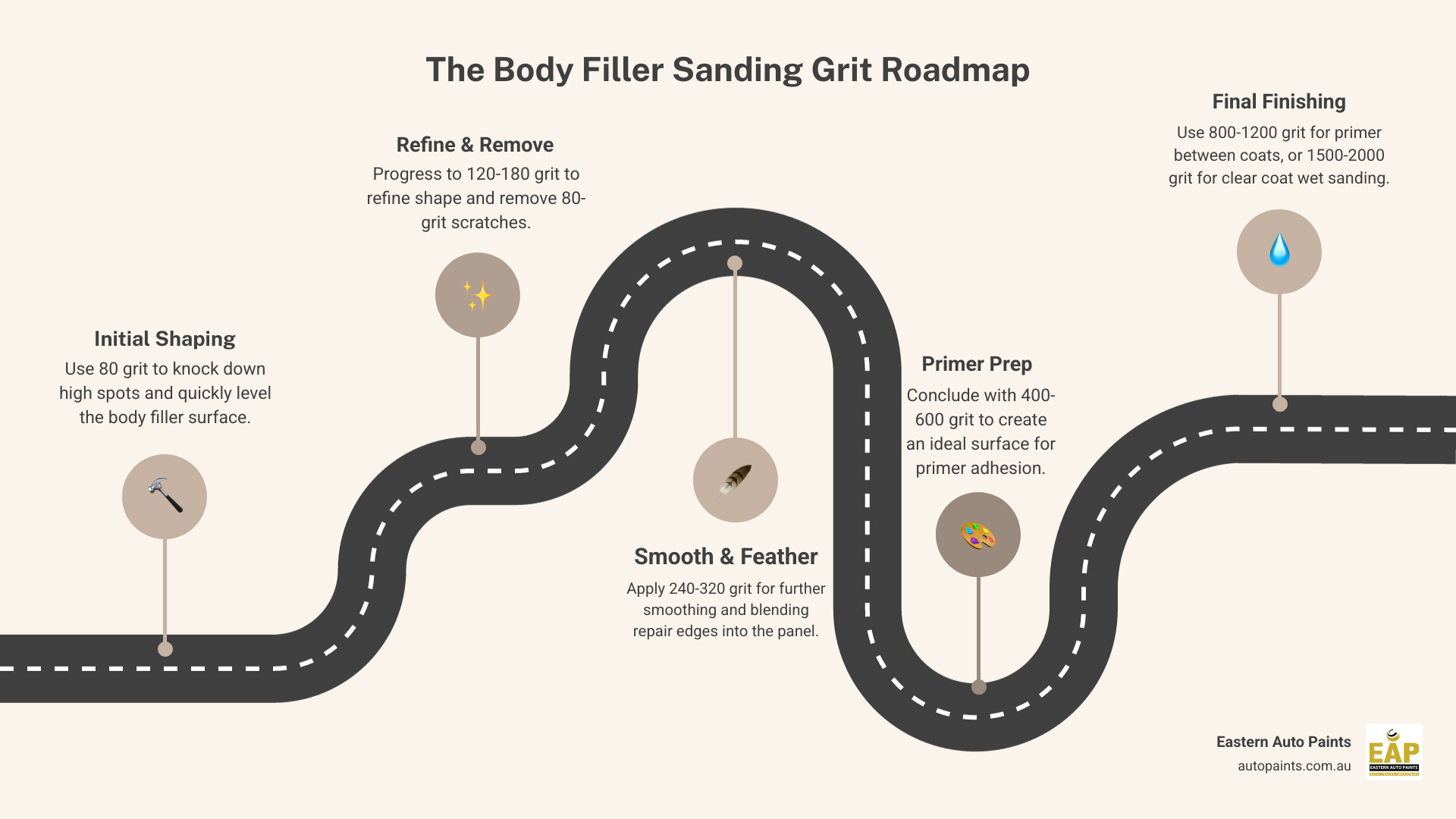
What grit sandpaper for body filler depends on the stage of your repair, but here's the quick answer:
Quick Grit Guide for Body Filler:
- 80 grit - Initial shaping and knocking down high spots
- 120-180 grit - Refining the shape and removing 80-grit scratches
- 240-320 grit - Further smoothing and feathering edges
- 400-600 grit - Final preparation before primer application
- 800-1200 grit - Wet sanding primer between coats (if needed)
- 1500-2000 grit - Final wet sanding of primer or clear coat
Before you paint your car, you'll need to sand it properly, or the paint won't stick. You may also need to shape and straighten the surface using body filler. The challenge is knowing which sandpaper grit to use at each stage. Using the wrong grit can either leave deep scratches that show through your paint job or create a surface so smooth that primer won't adhere properly.
Sandpaper grit numbers indicate the size of the abrasive particles bonded to the backing material. Lower numbers, like 80 grit, have larger, coarser particles that remove material quickly. Higher numbers, like 600 gri,t have much finer particles that create a smooth surface. The secret to professional results is understanding when to use each grit and how to progress through them systematically.
The goal isn't just to make your repair smooth. You're creating mechanical adhesion so that primer and paint can grip the surface properly. Think of it like building a foundation for a house. If you skip steps or use the wrong materials, everything built on top will eventually fail.
Body filler work requires patience and the right approach. Sand scratches from coarse sandpaper must be removed step-by-step with progressively finer sandpaper to avoid showing up in the finished paint job. This is where many DIY projects go wrong. People jump from 80 grit straight to 400 grit, thinking they're saving time, but those deep scratches will telegraph through your primer and paint.
At Eastern Auto Paints, we stock a complete range of sanding products from 80 grit through to 2000 grit, specifically chosen for automotive applications. Whether you need sanding discs for your DA sander, wet and dry sheets for hand sanding, or quality sanding blocks to ensure even pressure, we have the tools you need.
The process of sanding body filler correctly involves several distinct stages. You'll start with coarser grits to shape the filler and knock down high spots. Then you'll progressively move through finer grits, with each step removing the scratches left by the previous one. Finally, you'll prepare the surface with very fine grits to create the perfect foundation for primer.
Understanding this progression is the difference between a repair that lasts years and one that fails within months. The automotive refinishing industry has established these grit progressions through decades of trial and error. Following this proven system will save you time, money, and frustration.
I'm James Maranis, and over my 30-plus years in the coatings industry, I've seen countless body filler repairs both done right and done wrong. The single most common mistake is rushing the sanding process or using improper sandpaper grits for body filler work, which is why I'm sharing this comprehensive guide based on real-world experience.
What grit sandpaper for body filler terms you need:
Understanding Sandpaper Grit Numbers
Sandpaper is graded by its grit number, which essentially tells you the size of the abrasive particles. The lower the grit number, the coarser the sandpaper, meaning it has larger, more aggressive particles. Conversely, a higher grit number indicates finer sandpaper with smaller particles, designed for smoother finishes. This system determines how much material is removed and the texture left behind.
In Australia, we commonly encounter sandpaper graded using the P-grading system (FEPA standard), where grit numbers are prefixed with a "P" (e.g., P80, P180). This system helps standardise the coarseness of sandpaper across manufacturers. Coarse grits are excellent for rapid material removal, such as shaping body filler or removing heavy paint. Fine grits, on the other hand, are used for smoothing surfaces and creating the perfect "key" – a microscopically textured surface that primer and paint can mechanically grip onto for optimal adhesion. Without this mechanical key, paint can delaminate or peel over time.
The Goal of Sanding Body Filler
The primary goal of sanding body filler is to achieve a perfectly level and smooth surface that seamlessly integrates with the surrounding panel. This involves carefully blending the repair area into the existing bodywork, feathering the edges so there are no noticeable transitions. The entire process is about preparing the surface, not just for aesthetics, but for the crucial step of primer application.
Proper sanding ensures that the primer has a uniform and appropriate surface to adhere to, which is vital for the longevity and quality of your paint job. It's about laying a flawless foundation that prevents future imperfections from appearing. For a deeper dive into selecting the right filler for your project, check out our In-depth Guide Compare Car Body Fillers.
The Step-by-Step Guide to What Grit Sandpaper for Body Filler
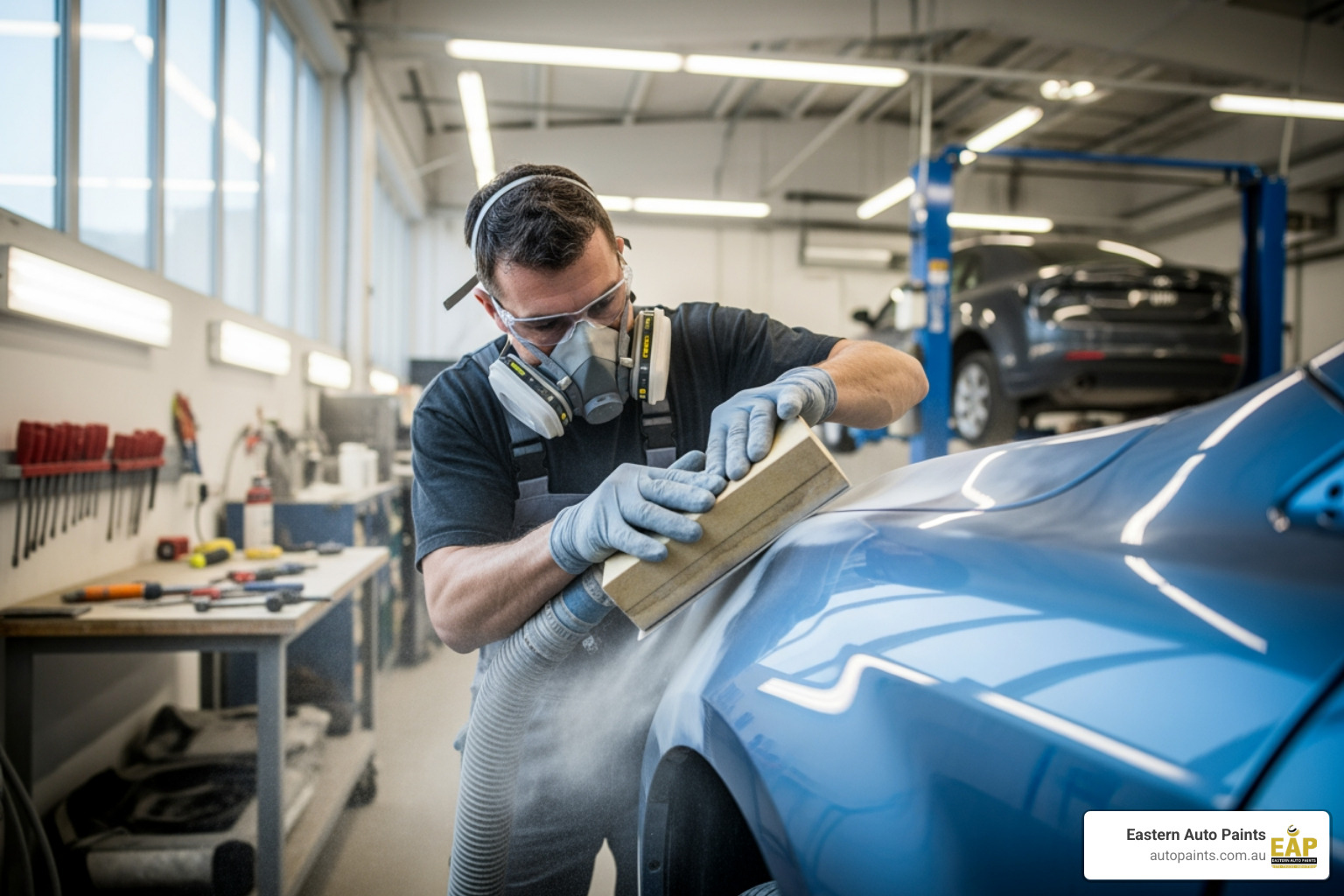
Mastering what grit sandpaper for body filler involves a systematic approach: initial shaping, progressive sanding, and final preparation. Each stage is crucial for achieving a repair that not only looks good but lasts. We'll also discuss the importance of a guide coat to help you spot imperfections along the way. At Eastern Auto Paints, we offer a wide range of body fillers and sanding sheets to support every step of your project.
Initial Shaping: Starting with the Right Coarseness
Once your body filler has cured, the first step is to aggressively shape it and knock down any high spots. This is where you bring the filler close to the original contour of the panel. For this initial shaping, we recommend starting with 80 grit sandpaper. This coarse grit allows for efficient material removal, quickly reducing the bulk of the filler.
When working on larger, flatter panels, using a sanding block is essential. A rigid block helps distribute pressure evenly, preventing you from creating new high or low spots. Always sand in a cross-hatch pattern, alternating your sanding direction to ensure an even cut. Avoid excessive pressure; let the sandpaper do the work. The goal here is to establish the basic shape and level the filler, not to make it perfectly smooth. 80-grit scratches are deep, and we'll address those in the next step. For comprehensive guidance on applying filler, read our guide on How to Bodyfiller Like a Pro.
The Progressive Sanding Process: From Coarse to Smooth
After the initial shaping with 80 grit, your surface will be relatively flat but covered in visible scratches. The next critical stage is to remove these coarser scratches and further refine the shape. This is where the progressive sanding process truly begins. We move to a finer grit, specifically 120-180 grit sandpaper. The purpose of this step is to completely eliminate all the 80-grit scratches. If you can still see any 80-grit marks after sanding with 120-180, you need to continue until they are gone.
This stage is also vital for feathering the edges of your repair. Feathering means gradually tapering the filler down to the original panel, creating an invisible transition. To help you identify any remaining imperfections, high spots, or persistent coarse grit scratches, apply a guide coat. This is a light dusting of contrasting powder or aerosol paint that you then sand through. Any guide coat remaining in low spots or scratches indicates areas that still need attention. You can find a variety of sanding discs suitable for this stage. For more detailed insights into effective sanding, refer to our Don't Get Bogged Down: Your Complete Guide to Body Filler Sanding.
Final Sanding: Preparing for a Flawless Primer Coat
The final stage of sanding body filler is about achieving a smooth, uniform surface, free of any visible scratches, that is ready for primer. After progressively working through the coarser grits, we now move to 240-320 grit sandpaper, followed by 400-600 grit. The 240-320 grit removes any remaining 120-180 grit scratches, further refining the panel's contour. Then, the 400-600 grit provides the ideal finish for primer adhesion, ensuring a smooth base that won't show texture through the final paint.
This step is critical because any scratches left at this stage will likely show through your primer and topcoat, especially with metallic paints. For many modern primers, particularly 2K systems, a 400-grit finish is perfect for adhesion. Some may even go to 600 grit for an exceptionally fine finish before applying primer. Depending on the product and preference, you might choose to sand dry or wet. Wet sanding with finer grits, such as our wet and dry sandpaper, can help reduce dust and achieve an even smoother finish. Always check the primer manufacturer's recommendations. Our range of 2K primers is designed to work perfectly with these finely sanded surfaces.
Advanced Tips and Common Mistakes to Avoid
Understanding what grit sandpaper for body filler is half the battle; the other half is knowing how to use it correctly and what pitfalls to avoid. Many common mistakes can compromise your repair, leading to a finish that simply won't last.
The Consequences of Using the Wrong Grit Sandpaper for Body Filler
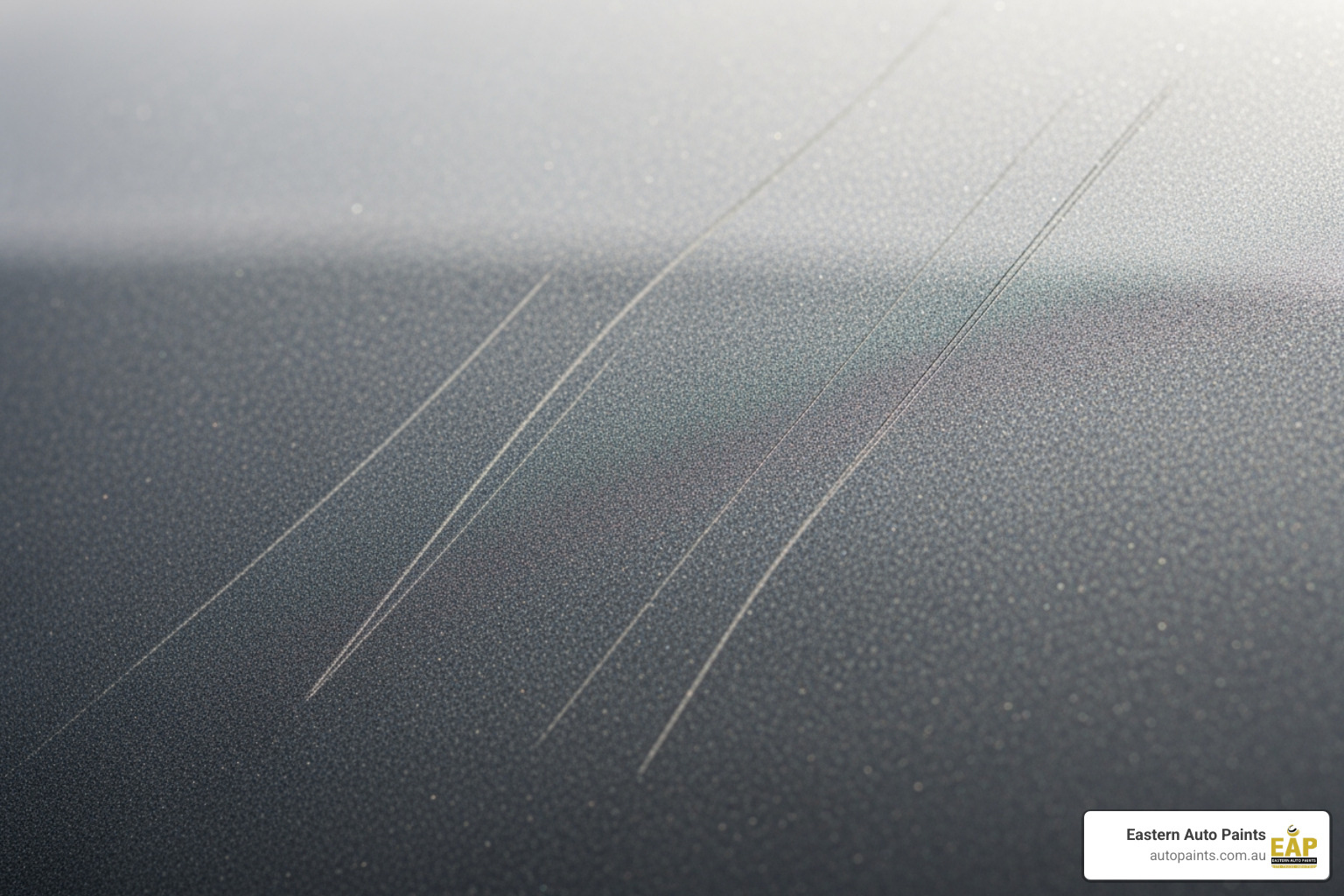
Using the incorrect sandpaper grit on body filler can lead to disastrous results. If you use a grit that is too coarse, such as jumping from 80 grit directly to 400 grit, you'll leave deep scratches that are impossible for primer to fill adequately. These coarse scratches will inevitably "telegraph" or "swell" through your primer and paint layers over time, becoming visible as unsightly lines or imperfections on your finished surface. This phenomenon, often called "sand scratch swelling," is a common culprit behind failed paint jobs.
Conversely, using sandpaper that is too fine too early can "glaze" the surface of the body filler. This creates a surface that is too smooth, lacking the microscopic texture needed for proper mechanical adhesion. Without this crucial "key," primer and subsequent paint layers will struggle to bond effectively, potentially leading to delamination, peeling, or chipping down the line. In either scenario, you'll end up wasting valuable time, materials, and effort. Proper surface preparation is foundational, and shortcuts here will always cost more in the long run. If you're dealing with rust before filler, ensure you address it properly; our Beginners Guide to Rust Repair and Prevention offers vital information.
How Filler Type and Tools Affect Your Grit Choice
The type of body filler you're working with can slightly influence your initial grit choice. For instance, some heavy-duty or reinforced fillers, like our U-POL FIBRAL Glass Fibre Filler, might initially benefit from the aggressive cutting power of an 80-grit disc to quickly knock down the bulk, especially if applying a thick layer. However, for most standard lightweight fillers and glazing putties, starting with 80 grit is sufficient, and then progressing to finer grits as outlined.
The tools you use are equally important. For large, flat panels, a rigid sanding block is indispensable for achieving a truly flat surface. Blocks ensure uniform pressure and prevent "waving" of the panel. For intricate curves or hard-to-reach areas, hand sanding with flexible foam blocks or just the sandpaper itself might be necessary.
Scuff pads, while not for shaping or significant material removal, play a crucial role in surface preparation. They won't straighten a surface or remove deep scratches, but they are excellent for sanding edges, irregular surfaces, or scuffing primers and paints that are past their recoat window. You can think of maroon scuff pads as roughly equivalent to 320-400 grit for prep before primer, while grey scuff pads are finer, often used for final prep before paint on most colours, acting like a 600-800 grit. We recommend using them carefully, adjusting pressure to achieve the desired effect.
Your Sanding Success Checklist and Final Thoughts
To summarise, mastering what grit sandpaper for body filler comes down to a simple, yet critical, progression:
- Start with 80 grit for initial shaping and material removal.
- Move to 120-180 grit to remove 80-grit scratches and refine the shape.
- Progress to 240-320 grit for further smoothing and feathering.
- Finish with 400-600 grit for a perfect surface ready for primer.
- For primer or clear coat fine-tuning, you may use 800-2000 grit for wet sanding.
The importance of using quality materials cannot be overstated. Cheap sandpaper clogs quickly, wears unevenly, and can leave inconsistent scratch patterns. At Eastern Auto Paints, we pride ourselves on supplying high-quality automotive paint products and sanding supplies that professionals trust. We've been trusted by pros for over 34 years, providing expert advice and excellent service.
Patience is key. Rushing the sanding process is the quickest way to compromise your repair. Take your time, use a guide coat, and ensure each grit has completely removed the scratches from the previous one. If you ever find yourself unsure or need specific advice for your project, our expert staff at our Bayswater, Dandenong South, or Melbourne locations in Victoria are always here to help. For expert guidance on your project, contact our team today.
Explore our full range of automotive paint supplies to find everything you need for a flawless finish.