
Colour Code from VIN Lookup: Simple Steps for Exact Paint Matching
Find the Right Colour Code from VIN Before You Order Paint

Rushing into an automotive paint order based on guesswork or incomplete data often leads to mismatched panels, wasted workshop hours, and costly rework. At Eastern Auto Paints, we take a thorough, expert-led approach to ensure you receive a precise match every time, guiding you seamlessly from vehicle identification to ready-to-spray coatings.
Key Takeaways
- A colour code from VIN lookup identifies factory build specifications but requires cross-referencing against the physical chassis paint tag.
- Marketing colour names frequently cover multiple formulation variants across different production years.
- Environmental weathering, UV exposure, and past repairs necessitate physical inspection and test sprayouts.
- Accessing bespoke formulations through professional colour matching services ensures accurate flake orientation and tint consistency.
At Eastern Auto Paints, we recommend using a colour code from VIN lookup as your initial baseline, then confirming the alphanumeric code against the physical label on your vehicle before mixing. We help trade repairers, commercial workshops, and automotive restorers translate factory identification data into workshop-ready formulations.
Operating across Victoria from Bayswater and Dandenong South with reliable Australia-wide dispatch, our team combines decades of technical coatings experience with advanced spectrophotometer scanning. We ensure every project achieves flawless colour alignment, high chemical durability, and lasting visual quality.
Identifying Risks and Mismatches: The Australian Automotive Context
Australia presents some of the harshest environmental conditions in the world for automotive finishes. The intense ultraviolet (UV) radiation across Victoria and the broader continent causes accelerated weathering on clearcoats, basecoats, and solid single-stage enamels. When repairing a vehicle that has spent years parked under the Australian sun, relying solely on the original factory colour formulation can present unexpected challenges.
Over time, radiant heat and UV exposure cause clearcoat chalking, pigment fade, and slight shifts in the resin matrix. A brand-new batch of paint mixed strictly to the original factory specification may appear significantly richer, darker, or more vibrant than the surrounding weathered panels on a daily-driven ute or sedan. This disparity creates a noticeable patch effect if applied without proper blending or custom tint adjustment.
Furthermore, factory production lines frequently introduce slight batch differences across different assembly plants or model years. Two vehicles sharing the exact same colour name built six months apart may carry subtle variant deviations. In a commercial repair environment or high-end restoration, a mismatched panel compromises visual quality and can directly affect vehicle trade-in appraisals.
Spotting Faded Clearcoats and Panel Deviations
Before mixing or ordering topcoats, a thorough visual inspection under natural daylight and controlled workshop lighting is essential. Inspect the horizontal surfaces, such as the bonnet, roof, and ute tray rails, as these areas experience the most severe UV degradation.
Look closely for dulling gloss levels, micro-cracking, or clearcoat oxidation. When inspecting metallic finishes, evaluate how the light reflects off the panel at different angles. Flake orientation and resin clarity heavily dictate whether an edge-to-edge respray will match or whether you will need to feather and blend into adjacent panels. Trade painters rely on careful visual inspection and blending techniques to achieve seamless transitions.
Repainted Panels and Repair History
Used commercial vehicles, work utes, and classic builds often have unrecorded repair histories. A front guard or passenger door may have been resprayed years prior using an aftermarket formulation that slightly deviates from the OEM standard.
Using an electronic paint depth gauge can quickly reveal prior repairs by highlighting variations in coating thickness across different panels. You can also inspect door jambs, rubber seals, and panel edges for masking lines, dry spray edges, or subtle tone shifts. When prior paintwork has altered a panel, an original factory code lookup must be supplemented with a physical colour comparison.
Finding Your Vehicle Colour Code from VIN: What the Data Actually Tells You
A Vehicle Identification Number (VIN) serves as a unique 17-character serial number assigned to every motor vehicle built since 1981. This standardised sequence encodes vital manufacturing data, including the country of origin, manufacturer, vehicle attributes, model year, assembly plant, and sequential production number.
A common misconception among vehicle owners is that the 17-digit VIN directly spells out the paint formula within its alphanumeric characters. In reality, the VIN acts as a secure indexing key. When entered into an OEM build database or regulatory repository (such as the NHTSA vPIC system in international contexts), the VIN links directly to the vehicle's factory build sheet. This build sheet contains specific Regular Production Option (RPO) codes, trim levels, and the exterior colour option assigned when the chassis rolled down the assembly line.
How to Request a Factory Colour Code from VIN Records
To retrieve your factory paint specification using the VIN, trade professionals and vehicle owners can query authorised dealership parts counters or access dedicated manufacturer portals. By entering the full 17-character VIN, the dealership system pulls the precise build configuration, revealing the exterior paint RPO code or factory identifier.
This method is particularly valuable when the physical vehicle tags have been damaged or removed during bodywork repairs. To explore further techniques for tracing paint information across various records, see our guide on how to find paint code details.
Limitations When Sourcing a Colour Code from VIN Decoders
While online VIN decoders are convenient, they carry inherent technical limitations. Generic third-party decoders often retrieve broad vehicle specifications (such as make, model, engine size, and standard market colours) but frequently omit specific factory sub-variants or mid-year production changes.
Furthermore, if a vehicle was custom-ordered with a special fleet livery, two-tone roof package, or dealership option, standard decoders may return only the primary base body colour. Relying solely on automated decoder tools without verifying the actual formulation against a physical identifier can lead to ordering errors.
Paint Code Versus Marketing Colour Name
Automotive manufacturers assign commercial marketing names to their vehicles to create emotional appeal in sales brochures, with names like Phantom Black, Arctic White, or Velocity Red. However, these marketing names are broad and can be misleading in a refinishing workshop.
A manufacturer may use the same marketing name across a ten-year production run while altering the underlying chemical formula, pearl concentration, or tinters multiple times. Conversely, two sister automotive brands may sell the exact same paint formula under entirely different commercial names.
The alphanumeric OEM paint code is the only reliable identifier because it maps directly to a calibrated mixing formula containing precise quantities of toners, binders, and effect pigments.
Physical Paint Code Locations Across Major Vehicle Makes
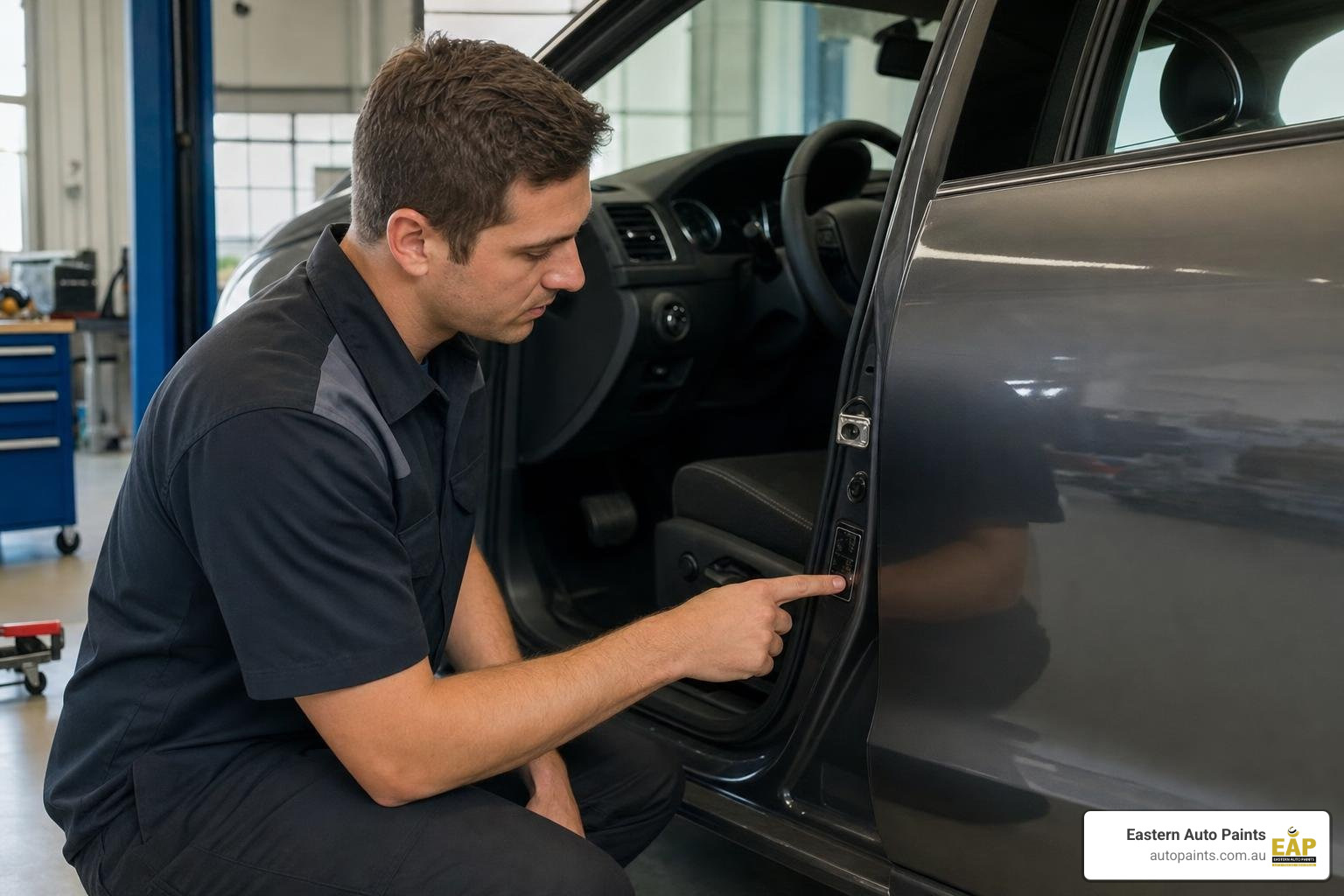
When a colour code from the VIN is retrieved, cross-referencing it with the physical paint identification plate on the vehicle ensures absolute certainty. Automotive manufacturers place these metal plates or durable vinyl labels in specific locations around the vehicle chassis.
The table below outlines common physical locations and sample code formats across major automotive brands found in Australia:
| Manufacturer | Common Physical Tag Locations | Sample OEM Code Format | Label Identifier Clues |
|---|---|---|---|
| Toyota / Lexus | Driver-side B-pillar door jamb, firewall |
070, 1D6, 209
|
Follows C/TR: prefix |
| Honda / Acura | Driver-side door jamb, door shut post |
NH-731P, B-593M
|
Marked COLOR or lower jamb |
| Ford | Driver-side door shut, radiator support, B-pillar |
01, YZ, ST
|
Marked under EXT PNT: or COL
|
| Holden / GM | Glovebox interior, spare tyre well, passenger door jamb |
WA8555, 636R, 79U
|
Marked BC/CC, PNT, or Service Tag |
| BMW / MINI | Suspension strut tower (under bonnet), driver door jamb |
300, 475, A83/7
|
Alphanumeric code with German colour name |
| Audi / VW | Spare wheel well floor, boot lid under-carpet, service book |
LY9B, LC9X, LB9A
|
Paper build sticker with Paint No. / Lack-Nr.
|
| Nissan | Engine bay firewall, driver-side B-pillar |
KH3, QM1, KAD
|
Located on aluminium compliance plate under COLOR
|
| Hyundai / Kia | Driver-side centre pillar post (B-pillar) |
SWP, AA, R3G
|
Marked PAINT: on black vinyl label |
| Subaru | Passenger-side strut tower, driver-side B-pillar |
02C, 37J, K1X
|
Marked Color Code: on aluminium plate |
For additional visual references on locating plates across less common makes, check out our practical guide on how to find the paint code on a vehicle.
European Brands: BMW, Audi, and Volkswagen
European marques typically place their paint identifiers in highly protected areas to prevent environmental wear:
-
BMW and MINI: Frequently stamp the paint code on an aluminium plate or vinyl label mounted directly onto the passenger or driver-side front suspension strut tower under the bonnet. Newer models may also feature this on the driver's door jamb. BMW codes are typically three digits (e.g.,
300for Alpine White) or an alphanumeric string, often accompanied by the German colour name. -
Audi and Volkswagen Group: Rely on a paper vehicle data sticker rather than an exterior metal plate. This sticker is commonly located in the boot floor, fixed to the sheet metal directly inside the spare tyre well or under the luggage compartment carpet. A duplicate is often glued inside the vehicle's original service schedule logbook. The paint code is formatted as a four-character alphanumeric string (e.g.,
LY9Bfor Brilliant Black).
Japanese and Asian Brands: Toyota, Honda, Nissan, and Hyundai
Asian manufacturers prioritise straightforward vehicle identification labels, primarily located on body pillars:
-
Toyota and Lexus: Use a black vinyl compliance label on the driver-side B-pillar door jamb. At the bottom-left of this label, look for the abbreviation
C/TR:(Colour/Trim). The first three characters represent the exterior paint code (e.g.,070for White Crystal Shine Pearl). -
Honda: Mounts a dedicated colour tag on the driver's door sill or B-pillar shut. Honda paint codes generally start with two letters denoting the colour family, followed by a numerical sequence and a finish designation (e.g.,
NH-731Pfor Crystal Black Pearl). -
Nissan and Subaru: Place stamped aluminium plates on the engine bay firewall or passenger strut tower, clearly identifying the code under a dedicated
COLORorPAINTheading.
American and Local Utilities: Ford, GM, and Holden
For work utilities, Australian-built classics, and American light trucks:
-
Ford: Locates paint codes on the driver-side door latch pillar tag under the label
EXT PNT. Ford codes are typically two characters, consisting of letters, numbers, or a combination of both. -
Holden and General Motors (GM): Often store their build data labels inside the glovebox compartment or on the spare tyre well cover. GM codes are identified by an RPO string, a
WAfour-digit prefix (e.g.,WA8555), or aBC/CC(Basecoat/Clearcoat) designation.
Navigating Complex Finishes: Pearls, Metallics, and Tri-Coats
Modern automotive finishes have evolved far beyond basic solid colours. Trade spray painters and automotive refinishers regularly encounter complex optical finishes that require careful identification and dedicated mixing processes. When researching your paint code, it is critical to determine whether your vehicle features a single-stage solid, a standard two-stage metallic, or a complex multi-stage tri-coat.
Solid Versus Metallic and Mica Basecoats
Solid colours consist of concentrated colour pigments suspended in a binder, offering uniform opacity and consistent tone across all viewing angles. Solid colours can be applied as a single-stage topcoat or a two-stage basecoat and clearcoat system.
Metallic and mica finishes, by contrast, incorporate precision-milled aluminium flakes or synthetic mica particles into the pigmented basecoat. These flakes reflect light directly, producing a dynamic sparkle and a pronounced "flip-flop" effect, where the panel changes brightness and tone depending on the viewing angle.
When ordering basecoat materials, such as our trade-grade basecoat mixed colours, application technique directly impacts flake orientation and the final visual match. Always refer to the specific product's technical data sheet (TDS) or product label for exact application guidance, spray gun settings, and flash-off recommendations.
Tri-Coat Pearl Paint Systems
Tri-coat (three-stage) pearl finishes represent the most sophisticated factory coatings. Rather than combining pigment and pearl into a single basecoat, a tri-coat system separates the finish into three distinct layers:
- Ground Coat (Base): A solid, opaque base colour (frequently pure white, deep red, or black) that establishes the underlying tone.
- Mid-Coat (Pearl Layer): A translucent or semi-transparent layer infused with reflective mica pearls and subtle tinting agents that create depth and optical shimmer.
- Clearcoat: A high-durability two-pack (2K) protective layer that encapsulates the system, providing gloss and UV shielding.
Because the final colour tone of a tri-coat finish deepens with every additional pass of the translucent mid-coat, exact colour matching requires test card sprayouts prior to panel refinishing. Whether preparing spot touch-ups or mixing full 2K mixed colours, test sprayouts ensure the mid-coat thickness accurately mirrors the existing factory finish.
Ensuring Long-Term Finish Durability and Resale Value
Applying an accurate colour match does more than restore cosmetic appeal; it actively protects the structural integrity and market valuation of your vehicle. A visibly mismatched panel or poorly blended spot repair stands out immediately during vehicle inspections, often leading prospective buyers and trade-in appraisers to suspect severe, unrecorded collision damage.
Beyond aesthetics, using professional-grade automotive refinishing materials ensures chemical resistance and long-term durability against environmental hazards like industrial fallout, bird droppings, and gravel strikes.
A high-performance refinishing system relies on compatible foundation layers. Sealing bare metal or repaired body filler with a high-build 2K primer establishes an anti-corrosive barrier that prevents moisture ingress and primer mapping.
Topping your colour basecoat with a premium 2K clearcoat delivers vital UV absorption, high gloss retention, and scratch resistance. For exact mixing ratios, drying schedules, and protective equipment guidance, always check the manufacturer's technical data sheet or product label before commencing work.
What to Expect at Eastern Auto Paints
At Eastern Auto Paints, we bridge the gap between digital vehicle data and flawless workshop application. Operating from our trade centres in Bayswater and Dandenong South, our team provides Victorian workshops and DIY enthusiasts with industry-leading coatings expertise and rapid Australia-wide dispatch.
When you contact us with a colour code or VIN reference, we do not simply rely on default formulas. We utilise advanced computerised tinting databases supported by bench-match spectrophotometer scanning technology to verify paint codes against actual production variants.
Whether you need bulk refinishing supplies for an entire commercial fleet or bespoke colour match spray cans for precision touch-ups, our master-tinted formulations are mixed using genuine trade-grade toners from world-class coating manufacturers. We save your bespoke formulations in our system, ensuring identical colour consistency across future repair orders.
When to Get in Touch or Take Action
You should reach out to professional colour-matching specialists whenever you encounter discrepancies in your vehicle's identification data. Take action when:
- Your vehicle's compliance plate or B-pillar paint sticker is missing, damaged, or unreadable.
- Your online VIN decode returns multiple variant formulas for the same production code.
- Your vehicle exhibits noticeable sun fade, chalking, or panel weathering that requires a custom-tinted physical match.
- You suspect a previous aftermarket respray has altered the colour profile of the repair area.
- You are planning a complete panel respray and require technical guidance on primer selection, basecoat coverage, or 2K clearcoat application.
When in doubt, bringing a detachable sample (such as a fuel flap, tow hook cover, or small trim piece) directly to our trade counters guarantees the most accurate formulation possible. You can contact our team for tailored technical advice.
Practical Solutions and Reassurance
Achieving a trade-level finish does not need to be an overwhelming process. By combining a reliable VIN lookup with physical code verification and structured workshop practices, you eliminate the guesswork from automotive refinishing.
For smaller repairs, stone chips, and spot blends, custom-filled aerosol solutions provide exceptional convenience without sacrificing chemical durability. If you are refinishing a solid colour panel, our 2K custom solid colour spray cans deliver a durable, high-gloss, chemical-resistant finish directly from an aerosol can featuring an integrated hardener activation system. For basecoat and clearcoat systems, our aerosol colour-fill services provide atomised application suitable for minor panel work.
To ensure success on every project, follow a structured matching workflow:
- Step 1: Retrieve your vehicle code via VIN lookup or physical plate inspection.
- Step 2: Order your tailored paint system alongside compatible primers, clearcoats, and surface prep degreasers.
- Step 3: Perform a test sprayout on a test card or scrap panel to verify the colour match, pearl opacity, and flake alignment against the vehicle under natural lighting. For practical tips on achieving exact aerosol results, read our guide on perfect match spray paint.
- Step 4: Prepare the substrate thoroughly, cleaning, sanding, and masking according to proper automotive body repair standards.
When applying any automotive coating, always consult the manufacturer's technical data sheet (TDS) and product safety labels for specific application specifications, drying windows, and chemical safety requirements. For comprehensive workplace safety standards and personal protective equipment (PPE) requirements, refer to current guidelines from SafeWork Australia or WorkSafe Victoria.
Closing Statement
Selecting the correct coating system and verifying factory tint specifications gives you total confidence across every automotive refinishing project. As Melbourne's trusted coatings specialist and official distributor for premium global brands, Eastern Auto Paints is dedicated to supporting professional panel shops, commercial refinishers, and vehicle restorers across Australia with trade-grade materials and technical expertise.
Explore our full range of coatings, equipment, and colour-matching services to support your next project:
- Access bespoke formulation and tinting through our colour matching services.
- Browse our extensive catalogue of trade-grade auto paints and refinishing supplies.
- Connect directly with our Melbourne trade specialists via our contact page for expert advice and nationwide delivery.
Frequently Asked Questions About Colour Codes from VIN
Can I find my vehicle's exact paint code directly inside the 17-digit VIN?
The 17-character VIN does not directly spell out the paint code within its alphanumeric sequence. Instead, the VIN serves as an indexing identifier that links to the manufacturer's master build database. Dealerships and trade paint suppliers can input your full VIN into these proprietary systems to retrieve the original factory build sheet, which lists the official exterior paint code and production option (RPO) details.
What should I do if my vehicle's paint code sticker is missing or illegible?
If the physical compliance plate or door jamb label is damaged, missing, or worn away, you have several dependable options. You can contact an authorised dealership parts counter with your 17-digit VIN to request your factory paint specification. Alternatively, you can remove a small, original painted component, such as a fuel filler flap, mirror cover, or tow eye cap, and bring it to Eastern Auto Paints, where our technicians can scan the physical part using a spectrophotometer to formulate a precise custom batch.
Why does my factory paint code show multiple variant formulas?
Automakers often produce the same paint code across multiple assembly plants, countries, and production years. Over time, slight variations in paint supplier batches, environmental regulations, or robotic application equipment can cause subtle shifts in tone, coarseness, or pearl concentration. Paint manufacturers account for these real-world differences by creating official formula variants (such as standard, lighter, darker, yellower, or coarser) under the same primary paint code.
How can I verify the correct colour if my vehicle was previously resprayed?
If a vehicle has undergone previous panel repairs or a complete colour change, a VIN lookup will only reveal the original factory colour, not the aftermarket finish currently on the car. In this scenario, inspect hidden door edges and engine bays to identify whether a full respray took place. To achieve an accurate match on repainted bodywork, the vehicle or a detached panel sample must be optically analysed with a spectrophotometer or visually matched against physical colour swatches.
Can I use my registration plate number to locate my automotive paint code?
Registration plate lookups connect directly to state transport authority databases (such as VicRoads), which record only basic descriptive colour categories like white, silver, red, or blue for vehicle identification purposes. These registration records do not contain the technical OEM alphanumeric paint codes required for automotive paint mixing. You must locate the physical paint code plate on the vehicle or trace the factory specification using the 17-digit VIN.