
How to Prevent Rust Before You Paint Your Car
Why Rust Inhibiting Primer Spray Is the First Line of Defence Against Corrosion

A rust inhibiting primer spray is a specially formulated coating applied directly to metal surfaces to stop corrosion before it starts. It works by creating a chemical and physical barrier that blocks moisture and oxygen from reaching the metal beneath.
Here is a quick summary of what you need to know:
- What it does: Seals bare or lightly rusted metal to prevent further oxidation (the chemical process that causes rust)
- How it works: Uses corrosion-inhibiting compounds such as zinc phosphate to chemically neutralise rust and bond tightly to the metal surface
- Where to use it: Bare steel, lightly rusted metal, and previously painted metal surfaces on cars, trucks, and industrial equipment
- Where not to use it: Galvanised steel or surfaces exposed to temperatures above 200 degrees Fahrenheit (93 degrees Celsius)
- When to apply it: Before any topcoat, as the critical first step in a paint system
- Key conditions: Apply between 20 and 25 degrees Celsius (68 to 77 degrees Fahrenheit) with humidity below 65 percent
Skipping this step is one of the most common and costly mistakes in automotive refinishing. Paint applied directly to unprotected metal will eventually lift, bubble, and peel as rust spreads beneath the surface.
I'm James Maranis, owner of Eastern Auto Paints, and after more than 30 years working with coatings across automotive, truck, and industrial applications, I've seen how the right rust inhibiting primer spray can be the difference between a finish that lasts a decade and one that fails within a season. The advice in this guide comes from real-world experience, not just product labels.
Understanding Rust Inhibiting Primer Spray and How It Works
At its core, a rust inhibiting primer spray is more than just a base for your paint; it is a sophisticated chemical shield. When we talk about Beyond The Rust A Comprehensive Look At Metal Protection Sprays, we are looking at products designed to stop the natural degradation of iron and steel.
These primers function by creating an airtight and watertight seal. Rust requires three things to form: iron, moisture, and oxygen. By removing any one of these from the equation, you stall the corrosion process. High-quality sprays often include active inhibitors like zinc phosphate, which provide a "sacrificial" layer, meaning the chemicals in the primer react with corrosive elements so the metal underneath doesn't have to. For a deeper dive into these mechanics, see our guide on Rust Prevention And Treatment.
The Science of Corrosion Control
The oxidation process is relentless. Once a ferrous metal (metal containing iron) is exposed to the elements, it begins to return to its natural state: iron oxide. In simple terms, the metal is "burning" very slowly. A rust inhibiting primer spray uses non-porous resins to block this microscopic exchange. Unlike standard decorative paints, which can be slightly porous, these primers are engineered to be dense and "tight," ensuring that even at a molecular level, water cannot seep through to the substrate. Choosing the right chemistry is vital, as outlined in A Practical Guide To Choosing Auto Paint Primers.
Benefits of Using a Rust Inhibiting Primer Spray
The most obvious benefit is longevity. A vehicle or piece of machinery treated with a professional-grade primer will maintain its structural integrity and aesthetic value for much longer than one that was simply "touched up" with hardware-store paint.
We often see projects where the owner saved fifty dollars on primer only to spend thousands later on rust repair. High-performance primers offer superior salt spray resistance, often exceeding 2,000 hours in lab testing, which is crucial for vehicles in coastal areas or those exposed to road salts. For more on protecting your investment, check out our Beginners Guide To Rust Repair And Prevention.
Preparing Your Metal Surface for Maximum Adhesion
We’ve found that most adhesion issues come down to poor surface prep. You can buy the most expensive rust inhibiting primer spray in the world, but if you spray it over grease, it will fail. The goal is to create a "surface profile," a microscopic texture that the paint can "bite" into.
Start by removing all surface contaminants. Use a high-quality wax and grease remover to wipe down the entire area. This removes oils from your skin, silicone from old polishes, and road grime. After cleaning, you’ll need to sand the surface. We stock a range of Sanding Sheets and Discs from 80 grit for heavy stripping up to 2000 grit for fine finishing. For most priming tasks, scuffing the metal with 400-grit sandpaper provides the ideal balance of smoothness and mechanical grip.
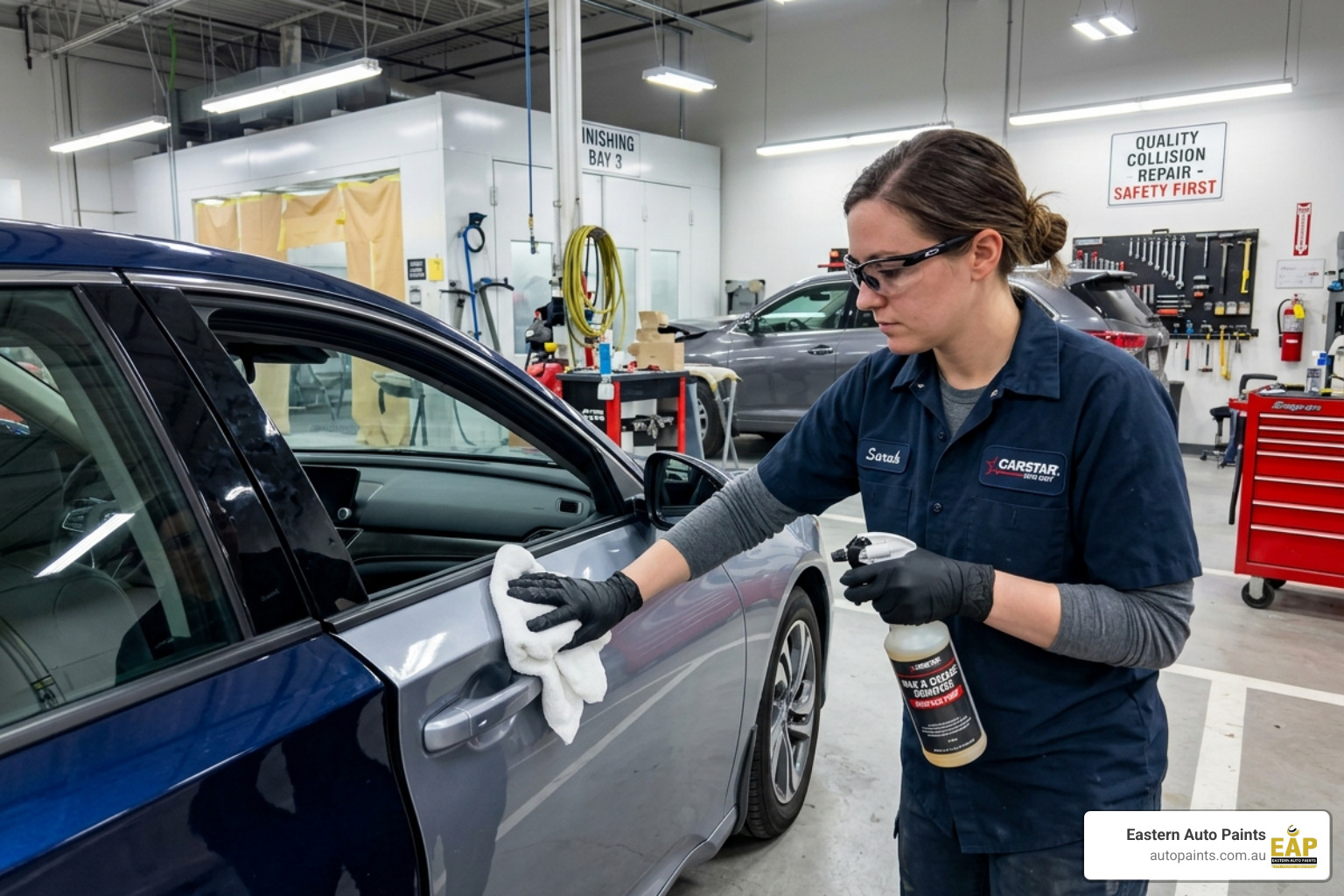
Removing Loose Corrosion Before Using Rust Inhibiting Primer Spray
Never spray over loose, flaky rust. This is like building a house on sand. You must use mechanical means, such as a wire brush, rotary sander, or hand tooling, to get back to "tight" rust or bare metal.
Safety Warning: If you are working on an older vehicle, be aware of lead-based paints. Always wear a NIOSH-approved respirator and appropriate gear from our PPE Masks collection to avoid inhaling toxic dust. Once the loose material is gone, the remaining surface should be firm and clean.
Cleaning and Degreasing Protocols
After mechanical sanding, the surface will be covered in fine dust. Wash the area with a commercial detergent or use mineral spirits for a final wipe-down. This ensures that chemical contaminants like salts or acids (often found in fingerprints) are completely neutralised. A clean surface profile is the only way to ensure your Paint Stripping Products and subsequent primers work as intended.
Choosing the Right Rust Inhibiting Primer Spray for Your Project
Not all primers are created equal. The "right" choice depends entirely on your substrate. Are you spraying over bare, shiny steel? Or are you trying to save a panel that already has deep-seated rust?
| Primer Type | Best For | Key Feature |
|---|---|---|
| Rust Converter | Rusted metal | Chemically changes rust into a stable base |
| Zinc-Rich Primer | Bare steel | Provides sacrificial "Cold Gal" protection |
| Etch Primer | Aluminum & New Steel | Acid-based for maximum "bite" and adhesion |
| Epoxy Primer | Full Restorations | Best moisture barrier and chemical resistance |
For detailed comparisons, read our Self Etching Primer Guide and The Guide To Epoxy Primer Paint For Cars.
Specialised Solutions: Converters and Zinc-Rich Coatings
If you cannot remove every speck of rust, you need a converter. Products like the Concept Rust Converter Primer & Sealer Aerosol actually destroy rust on contact, transforming it into a paintable black coating.
For maximum protection on bare ferrous metal, we recommend "Cold Galvanising." Our Zinc Gal Cold Galvanising Aerosol contains high levels of zinc dust, which protects the steel through a process called galvanic action. If you want a brighter finish for gates or trailers, the Bright Gal Silver Aerosol provides a similar level of protection with a more aesthetic "newly galvanised" look. You can find all these in our Rust Repair & Prevent Collection.
Primers for Non-Ferrous Metals and Aluminum
Aluminium requires a different approach because it doesn't "rust" in the traditional sense, but it does oxidise instantly, creating a film that rejects standard paint. For aluminium ute trays or panels, you must use an etch primer. The Protec PPG Grey/Black Etch Primer or Concept 103 Etch Primer contains a small amount of phosphoric acid that "eats" into the surface to ensure the paint stays stuck.
Step-by-Step Application Guide for Professional Results
The environment you spray in is just as important as the paint itself. Ideally, you want a temperature between 20°C and 25°C (68-77°F). If it’s too cold, the primer won't flow; if it’s too hot, it will dry before it hits the panel, leading to a "sandy" finish. Humidity should be below 65%, high humidity can trap moisture under the primer, which is exactly what we’re trying to prevent!
Mastering the Technique with Rust Inhibiting Primer Spray
Before you start, shake the can vigorously for at least one minute after the mixing ball begins to rattle. Hold the can approximately 25cm (10 inches) from the surface. Use a steady, back-and-forth motion, overlapping each stroke by about 50%.
It is always better to apply two or three light coats rather than one heavy "wet" coat. Heavy coats lead to runs, sags, and solvent entrapment. Our Custom Aerosol Cans often feature high-output tips that cover 50% faster than standard hardware store nozzles. Browse our full Aerosol Spray Collection for professional-grade options.
Drying Times and Recoat Windows
Always consult the Technical Data Sheet (TDS) for your specific product. Generally, a rust inhibiting primer spray will be "touch dry" in 15 to 30 minutes. However, "hard dry" (ready for sanding) usually takes 3 to 4 hours, and a full chemical cure can take up to 48 hours. If you wait more than 24 hours to apply your topcoat, you will likely need to scuff-sand the primer again to ensure the next layer adheres. For more on timing, see Choosing Your Canvas Understanding Automotive Paint Primer Types.
Advanced Curing and Finishing Techniques
In a professional workshop, we don't always have 24 hours to wait for air-drying. This is where Infrared (IR) technology comes in. IR drying uses radiation to heat the coating from the inside out. This means the solvents at the bottom of the paint layer are pushed out first, preventing "solvent pop" or bubbling.
We offer several professional units for this purpose:
- JV1 Velocity Infrared Drying Head 1 (Compact for small repairs)
- JV2 Velocity Infrared Drying Head 2 (Medium coverage)
- JV3 Velocity Infrared Drying Head 3 (Large panels)
Using IR drying drastically reduces turnaround time and enhances the final bond of the primer to the metal.
Moving from Primer to Topcoat
Once your primer is dry and cured, you may need to address minor imperfections with Body Fillers. After filling, sand the area smooth and apply one final "surfacer" coat of primer. This acts as a sealer between the filler and your final paint. The primer's job is to protect the metal; the topcoat's job is to protect the primer from UV light and provide the colour. For help selecting your finishing layers, see our Guide To Choosing Auto Paint Primers.
Final Inspection and Maintenance
Before moving to the final paint, do a "solvent test" or adhesion test on a small area if you are unsure of compatibility. Once the topcoat is applied, your metal is safe from the elements. To keep it that way, maintain the paint finish; any stone chip that reaches the metal should be touched up immediately with a rust inhibiting primer spray to prevent the "cancer" of rust from starting again.
If you have questions about specific industrial applications or complex colour matching, contact our expert team at Eastern Auto Paints. We also provide extensive Auto Paints Information for those tackling larger projects.
Frequently Asked Questions about Rust Prevention
Can I apply rust inhibiting primer spray directly over heavy rust?
No. Loose, scaly rust must be removed. If the rust is "tight" (discoloured but not flaking), you should use a converter like Concept 025 Rust Converter before priming.
How many coats of primer are necessary for full protection?
We recommend two to three light coats. This ensures you reach the recommended "dry film thickness" (usually about 2 mils) without causing runs or trapping solvents. More info can be found in our Acrylic Primer Automotive article.
What is the ideal temperature for spraying automotive primer?
Between 20°C and 25°C is the "sweet spot." Avoid spraying in direct sunlight or in a drafty garage on a freezing Melbourne morning, as this will ruin the adhesion.
Final Thoughts on Rust-Free Paint Prep
At Eastern Auto Paints, we’ve spent over 34 years helping Melbournians achieve professional results on their automotive and industrial projects. Whether you are restoring a classic car in Bayswater or maintaining industrial equipment in Dandenong South, the key to success is never cutting corners on rust prevention.
From our advanced Colour Matching Services to our curated selection of Rust Repair and Prevention products, we provide the tools and the expertise you need. Don't let rust win, start your project with the right foundation. Shop all products today or visit us in-store for expert advice tailored to your specific needs.