
The Ultimate Guide to Comparing Air Compressor Types and Features
Choose an Air Compressor That Supports a Better Finish
At Eastern Auto Paints, we see the difference the right air compressor makes: stable airflow, clean dry air and a spray gun that performs predictably. The wrong setup can lead to pressure drop, excess moisture and inconsistent atomisation, which can affect the finish. For automotive refinishing, compare compressor type, air delivery, operating pressure, tank capacity, noise and filtration as one complete system.
Key Takeaways
- Choose a piston compressor for intermittent workshop use or a rotary screw compressor where sustained air demand is required.
- Prioritise airflow delivery over maximum pressure when matching a compressor to spray equipment.
- Select oil-lubricated or oil-free designs based on maintenance needs and air-cleanliness requirements.
- Include filtration, regulation and moisture control in the plan, not as afterthoughts.
- Read our Compressor Complete Guide for a closer look at sizing and workshop configurations.
We help professional applicators, trade workshops and serious vehicle restorers compare equipment based on how it will actually be used. Our approach starts with the air demand of your spray gun and pneumatic tools, then considers the compressor, receiver tank, air lines, filters and regulators needed to supply clean, dependable air.
At EAP, our core focus is smarter coating solutions backed by practical technical guidance. A well-matched compressed-air system supports more consistent application, helps protect equipment and gives you a stronger foundation for quality refinishing work.
Why This Issue Should Not Be Ignored
Operating with an undersized or improperly configured air supply introduces serious risks to automotive refinishing and panel repair. Pneumatic spray guns, orbital sanders, and blow guns require a consistent flow of dry, clean air. When a compressor cannot keep up with continuous air demand, system pressure drops rapidly. This loss of pressure alters the spray pattern mid-application, leading to inconsistent atomisation, mottling in metallic basecoats, and uneven clearcoat levelling.
Beyond application defects, an overtaxed compressor runs continuously, generating extreme thermal friction. This excess heat prevents airborne water vapour from condensing in the receiver tank, sending hot moisture downstream directly into your air lines. Moisture contamination is a primary cause of micro-blistering, fisheyes, and poor adhesion in two-pack (2K) paint systems.
Investing the time to properly evaluate your air requirements protects your equipment, eliminates costly paint rework, and ensures reliable pneumatic power across your entire workshop.
Common Symptoms, Challenges, or Questions
Trade painters and vehicle restorers regularly experience operational roadblocks tied to their air supply. Common warning signs of an inadequate system include:
- Pressure Drop at the Gun Trigger: The wall regulator reads adequate pressure, but pulling the trigger causes the inline gauge to drop below the manufacturer recommended operating pressure.
- Excessive Pump Cycling and Overheating: The compressor pump runs without shutting off during normal spraying or sanding cycles, causing the crankcase to become excessively hot.
- Moisture and Oil Carryover: Water droplets or oily residues appear in the air line traps, desiccant units, or at the spray gun nozzle.
- Excessive Noise Levels: Loud reciprocating pumps disrupt workshop communication and elevate noise fatigue during long trade shifts.
Understanding how to match compressor displacement, receiver volume, and filtration to your specific tools resolves these production challenges before they compromise a paint finish.
Core Air Compressor Types: Piston vs Rotary Screw
Choosing the right mechanical drive system depends entirely on your daily workload and continuous air demand. The two primary designs used across modern automotive refinishing and mechanical workshops are reciprocating piston compressors and rotary screw compressors.
When to Use a Reciprocating Piston Compressor
Reciprocating piston compressors use a crankshaft-driven piston moving inside a cylinder to draw in and compress ambient air through mechanical valves.
- Intermittent Trade and Restorer Workloads: Piston pumps are engineered for applications with intermittent duty cycles, allowing the pump periods of rest between pumping cycles.
- Budget-Conscious Workshop Setups: These units offer accessible entry costs for small workshops, mobile repairers, and dedicated home garages.
- Straightforward Mechanical Servicing: Routine maintenance involves simple valve inspections, oil sump checks, and standard air filter replacements.
When to Use a Rotary Screw Compressor
Rotary screw compressors use twin interlocking helical rotors to continuously compress air as it moves along the length of the screws.
- Continuous Production Environments: Rotary screw units are engineered for continuous operational duty cycles, providing uninterrupted airflow without thermal degradation.
- Ultra-Quiet Workshop Integration: Due to continuous rotary motion rather than mechanical reciprocating impact, screw compressors operate at significantly lower decibel levels.
- Integrated Air Treatment: Industrial screw models often feature built-in refrigerated dryers and multi-stage oil coalescing filters within a compact acoustic cabinet.
| Feature | Reciprocating Piston Compressor | Rotary Screw Compressor |
|---|---|---|
| Compression Mechanism | Piston stroke in cylinder | Twin interlocking helical screws |
| Operational Duty Cycle | Intermittent demand cycles | Continuous operational demand |
| Noise Level | Higher mechanical sound output | Enclosed cabinet, low-decibel operation |
| Air Delivery Stability | Pulsed output into receiver tank | Continuous, non-pulsing airflow |
| Typical Environment | Garages, light trade, small workshops | High-volume body shops, industrial facilities |
Single-Stage and Two-Stage Piston Compressors
Piston compressors are further classified by the number of compression stages within the pump assembly.
When to Choose a Single-Stage Piston Compressor
In a single-stage pump, ambient air is drawn into one or more cylinders and compressed to final discharge pressure in a single piston stroke. Units like the Anest Iwata NB30 90 3HP 90 Litre Tank 390LPM 145PSI provide reliable air delivery for light trade duties, spot repairs, and general workshop air tools. Single-stage configurations are widely used when setting up a Compressor for Home Garage where tools operate intermittently.
When to Choose a Two-Stage Piston Compressor
Two-stage compressors compress ambient air to an intermediate pressure in a larger low-pressure cylinder, route it through a finned intercooler pipe to dissipate heat, and then compress it to final pressure in a smaller high-pressure cylinder. Two-stage pumps offer improved thermal efficiency, higher maximum pressure thresholds, and reduced moisture vapour generation for demanding trade refinishing environments.
Rotary Screw Compressors for Continuous Industrial Output
For busy commercial body shops running multiple spray booths and sanding bays simultaneously, rotary screw systems deliver continuous volume without the recovery delays of piston pumps. The Anest Iwata Eco Screw Compressor range provides stable airflow while maintaining lower energy consumption during sustained output.
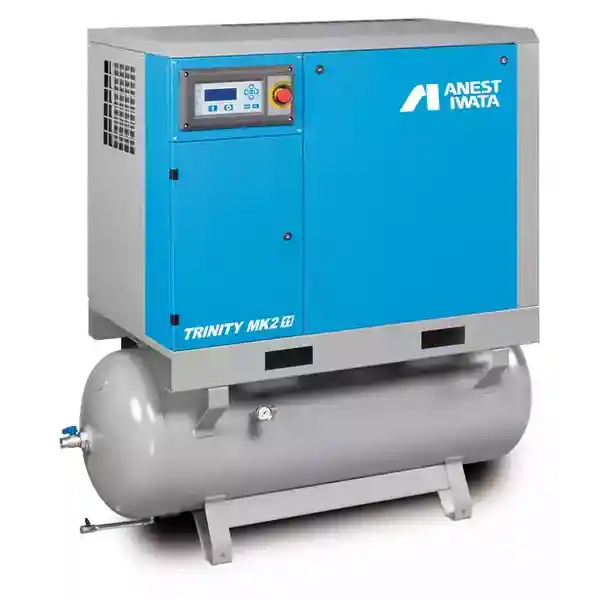
For facilities requiring a complete, turnkey air production centre, the Anest Iwata Trinity11 MK2 11KW 8Bar 270 Litre Screw Tank With Filters and Dryer integrates the screw air-end, a large receiver vessel, precision coalescing filtration, and a refrigerated air dryer into a single footprint. This eliminates the need for external dryer plumbing and protects downstream paint lines from moisture and oil carryover.
Key Performance Specifications: SCFM, PSI, and Power Delivery
Matching a compressor to your tools requires a clear understanding of airflow delivery and pressure ratings.
Understanding SCFM and Operating Pressure Requirements
Airflow volume is measured as Standard Cubic Feet per Minute (SCFM) or Litres Per Minute (LPM). Operating pressure is measured in Pounds per Square Inch (PSI) or Bar.
Pneumatic equipment requires a specific volume of air delivered at a stable dynamic pressure:
- Pneumatic Spray Guns: High Volume Low Pressure (HVLP) and compliant spray guns consume substantial continuous airflow at specific inlet pressures. Sizing your supply to handle these demands is essential; explore our guide on the Best Compressor for HVLP to evaluate airflow compatibility.
- Dynamic Pressure vs Static Pressure: Static pressure is the reading on the regulator gauge when the tool is idle. Dynamic pressure is the actual working pressure when the trigger is fully depressed. A restriction in the supply line or an undersized compressor pump causes significant dynamic pressure drop.
- Application Guidelines: Always consult the paint and spray gun technical data sheet (TDS) or product label for exact operating air pressure and volume requirements before undertaking refinishing work.
For deeper technical insights on calculating system delivery, refer to A Comprehensive Guide to Choosing a Car Painting Compressor.
Choosing an Air Compressor Tank Size for Automotive Refinishing
The receiver tank acts as a pressure buffer and thermal storage vessel. When air enters the tank from the pump, it expands and cools, allowing airborne water vapour to condense against the internal tank walls before reaching the distribution lines.
- Small to Mid Receivers (50–90 Litres): Suitable for intermittent spot repairs, trim painting, and low-consumption air tools. Models like the Anest Iwata NB20C 50 2HP 50 Litre Tank 225LPM 145PSI and the Anest Iwata NBC20C 90 2HP 90 Litre Tank 225LPM 145PSI balance portability with adequate buffer capacity for mobile or small workshop tasks.
- Large Receivers (200+ Litres): Essential for continuous panel resprays, complete vehicle resprays, and multi-operator trade facilities. A large receiver prevents the pump from rapidly short-cycling, stabilises dynamic line pressure, and maximises moisture condensation drop-out.
Lubrication and Configuration: Oil-Free vs Oil-Lubricated Systems
Compressor pump mechanisms are available in oil-lubricated and oil-free configurations, each suited to specific working conditions.
When to Use an Oil-Free Compressor
Oil-free compressors utilise self-lubricating piston coatings (such as PTFE/Teflon) or sealed bearings, eliminating the need for oil in the crankcase.
- Risk-Free Clean Air Requirements: Ideal for specialised cleanroom operations, medical settings, or environments where accidental oil sump migration must be completely avoided.
- Zero Sump Maintenance: Eliminates the need for periodic crankcase oil level checks, top-ups, and fluid changes.
- Cold-Start Reliability: Provides dependable starting performance in low ambient temperatures without oil viscosity drag.
When to Use an Oil-Lubricated Compressor
Oil-lubricated compressors utilise an internal oil bath to lubricate the crankshaft bearings, connecting rods, and cylinder walls.
- Extended Trade Durability: The lubricating oil reduces friction, dissipates internal heat, and seals the piston rings, providing extended operational life under trade workloads.
- Continuous Workshop Demands: Better suited for heavy daily use where long pump runtimes are common.
- Multi-Stage Air Filtration Setup: While oil mist must be removed using downstream coalescing filters before reaching a paint booth, the robust mechanical lifespan makes oil-lubricated units the standard choice for vehicle refinishing facilities.
Explore comprehensive equipment comparisons in our Anest Iwata Compressors Complete Guide.
Portable vs Stationary Workshop Form Factors
The physical layout of your workspace determines whether a mobile or fixed installation is most practical:
- Portable Compressors: Built on heavy-duty wheeled frames with transport handles, portable units allow trade contractors and restorers to move air power directly to the job site or around a shared workshop floor.
- Stationary Vertical and Horizontal Units: Fixed installations save floor space by utilising vertical tank orientations. Stationary units should be secured with vibration isolation dampeners on a level concrete floor to reduce structural resonance and prevent pipe fatigue.
Discover our full range of fixed and portable trade Compressors and professional Workshop Equipment.
Complete Compressed Air Line Setup and Essential Accessories
A high-performance compressor is only as effective as the distribution line and air management system connected to it.
Airline Sizing and Pressure Drop Prevention
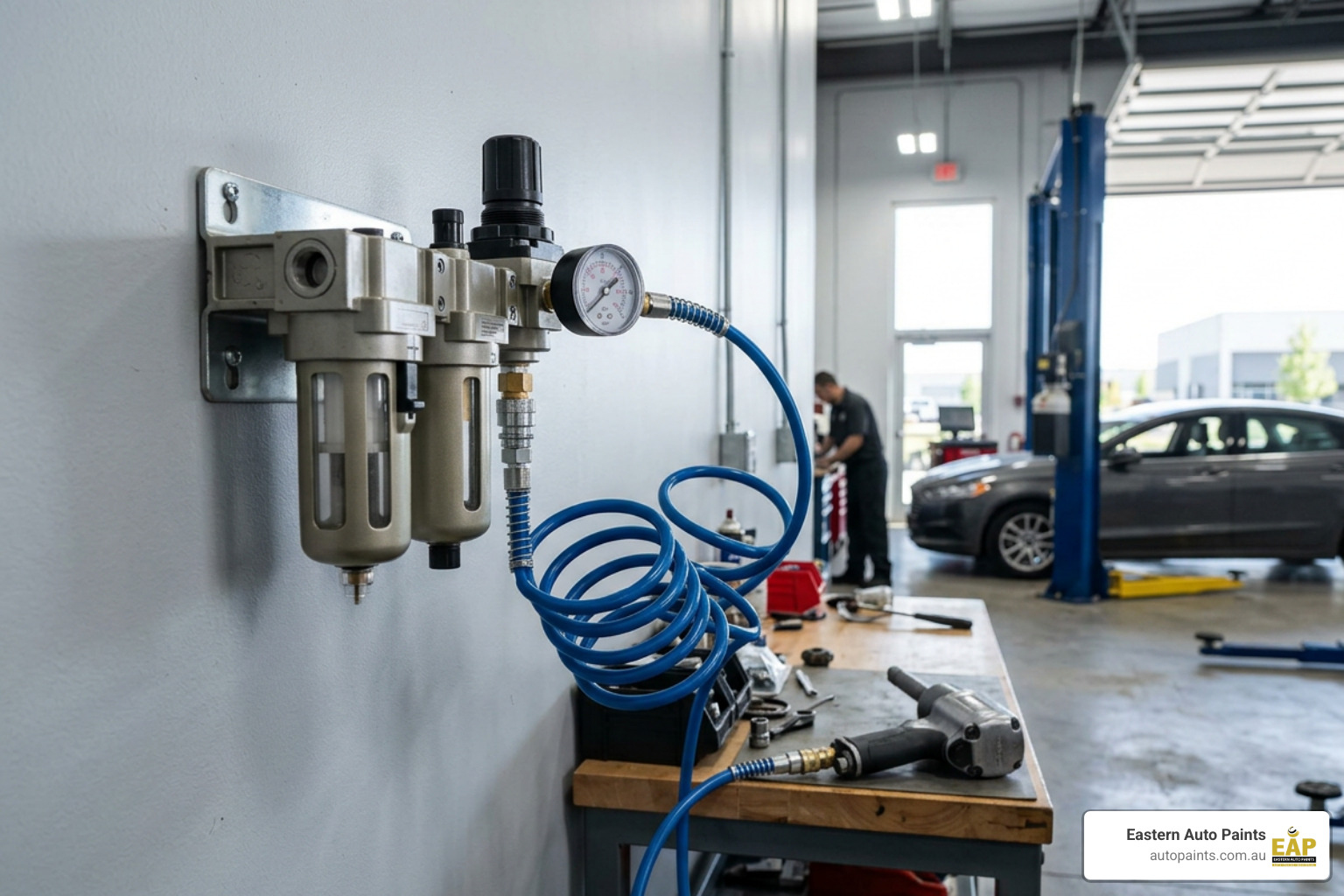
Using undersized air hoses or restrictive fittings chokes airflow, creating substantial pressure drops between the receiver tank and your pneumatic tools.
- Main Airline Piping: Workshop ring mains should utilise smooth-bore aluminium, copper, or dedicated compressed air polymer piping with an internal diameter of at least 12–20 mm (1/2–3/4 in) to minimise friction.
- Flexible Whip Hoses: Connect spray guns using anti-static, flexible rubber air hoses with a minimum 8–10 mm (5/16–3/8 in) internal diameter.
- High-Flow Couplers: Standard restrictive fittings impede air delivery. Fit high-flow couplers and adaptors across all distribution drops, hoses, and tools to maintain full volumetric flow.
- Ensure all workshop distribution lines, whip hoses, and tool connections maintain unrestricted airflow.
Essential Air Compressor Maintenance and Clean Air Filtration
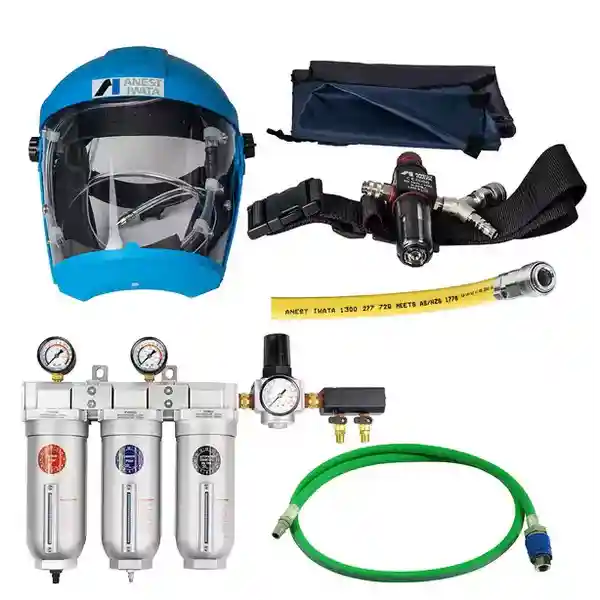
Maintaining high-quality air requires dedicated filtration stages positioned before your tools:
- Water and Particulate Separation: Centrifugal water traps capture bulk condensed liquid and solid scale exiting the main air line.
- Oil Coalescing Filtration: Sub-micron coalescing elements remove atomised oil aerosols and fine particulate down to 0.01 microns.
- Desiccant or Refrigerated Drying: Essential for automotive spray booths to strip remaining gaseous water vapour from the airstream.
- Precision Pressure Regulation: Wall-mounted regulators maintain steady dynamic pressure directly at the spray booth outlet.
Inspect filtration units, regulators, and spray accessories regularly to ensure reliable air delivery. For breathing apparatus compliance, always review supplied air system requirements alongside relevant SafeWork and WorkSafe guidelines.
What a Personalised Experience Actually Looks Like
Selecting compressed air equipment should never rely on generic guesswork. When you consult with Eastern Auto Paints, our technical team evaluates your setup as a complete workflow:
- Audit of Air Demand: We calculate the combined air consumption of your spray guns, DA sanders, and blow guns to establish accurate continuous airflow requirements.
- Site and Electrical Considerations: We verify power availability, assessing single-phase 240V versus three-phase 415V supply to match the correct motor rating to your workshop infrastructure.
- Line Layout and Filtration Planning: We design multi-stage filtration layouts tailored to your workshop layout, preventing moisture traps and pressure drops.
The Value of Consistency and an Ongoing Relationship
Air supply maintenance directly impacts daily workshop productivity. Establishing an ongoing relationship with an expert technical supplier ensures:
- Consistent Refinishing Quality: Clean, dry, properly regulated air eliminates unexpected surface defects, fish-eyes, and spray pattern variations across every job.
- Access to Matched Spares and Service Consumables: Reliable access to replacement intake filters, coalescing elements, desiccant charges, and compressor pump lubricants keeps your system operating within factory tolerances.
- Proactive System Expansion: As your workshop grows, our team helps integrate additional drops, auxiliary tanks, or upgraded screw compressors without disrupting current operations.
What to Expect at Eastern Auto Paints
At Eastern Auto Paints, we combine industry-leading coating systems with trade-credible workshop equipment. With physical locations in Bayswater and Dandenong South, Victoria, our Victorian trade counters provide:
- Expert Technical Advice: Practical guidance from experienced automotive and industrial paint specialists who understand air tool dynamics.
- Advanced Colour Matching: High-precision spectrophotometer colour matching to complement your refinishing setup.
- Comprehensive Stock: Immediate access to leading compressors, spray equipment, pneumatic fittings, and 2K paint systems.
When to Get in Touch or Take Action
If your current compressor struggles to hold dynamic pressure, generates excessive moisture, or disrupts your workshop with unbearable noise, it is time to upgrade your air supply.
You can visit our team in store at Bayswater or Dandenong South, or get in touch through our Contact Us page to discuss your workshop compressed air requirements. Explore our complete range of high-performance Compressors, explore our Spray Equipment, and ensure your setup delivers the clean, reliable air needed for flawless paint application.
Frequently Asked Questions About Compressed Air Systems
How do I calculate the required air delivery for multiple spray guns and pneumatic tools?
To determine the total airflow delivery required for your workshop, calculate the combined volume demand of all tools intended to operate simultaneously. Sum the continuous consumption ratings of your primary spray guns, sanders, and air tools, then add a buffer margin to accommodate pump recovery cycles and prevent continuous motor strain. Always verify individual tool requirements against the manufacturer's technical data sheet.
What is the mechanical difference between single-stage and two-stage piston compressors?
A single-stage piston compressor draws in ambient air and compresses it to final working pressure in a single cylinder stroke. A two-stage compressor compresses air to an intermediate pressure in a larger cylinder, passes it through a finned cooling pipe to reduce thermal buildup, and then compresses it to final pressure in a smaller second cylinder. This two-stage process increases mechanical efficiency, delivers higher maximum pressure thresholds, and reduces moisture generation.
Why is moisture removal critical when using an air compressor for vehicle painting?
Moisture condensing in compressed air lines travels directly to the spray gun nozzle if not captured by multi-stage filtration. When water droplets mix with atomised automotive basecoats or clearcoats, they cause surface defects such as micro-blistering, clouding, pinholing, and adhesion failure. Installing dedicated water separators, coalescing filters, and refrigerated or desiccant dryers ensures clean, dry air reaches the paint booth.
How often should compressor receiver tanks be drained of moisture?
Receiver tanks should be drained of accumulated condensation daily or at the end of each working shift using the manual drain valve located at the base of the vessel. Automatic electronic drain valves can also be installed to purge moisture continuously during operation, preventing internal tank corrosion and stopping liquid water from backing up into downstream air distribution lines.
What personal protective equipment is required when operating pneumatic spray equipment and compressors?
Operators must wear appropriate personal protective equipment matched to the specific coating, solvent, and workshop environment. Always consult the paint manufacturer's technical data sheet, product safety label, and relevant SafeWork or WorkSafe guidance to select the correct respiratory protection, eye protection, protective overalls, and chemical-resistant gloves before commencing spraying or maintenance.