

The Best Air Compressor for Auto Painting in Your Home Garage
Choosing the Right Air Compressor for Auto Painting

At Eastern Auto Paints, we know the difference between a smooth, even finish and a frustrating repaint often starts with air supply. The right air compressor for auto painting delivers clean, regulated air continuously enough for your spray gun, while an undersized setup can cause pressure drops, poor atomisation and inconsistent coverage across a panel. For home-garage vehicle work, match the compressor's free air delivery to the spray gun's stated demand, choose enough receiver capacity for the job, and plan for proper moisture filtration.
Key Takeaways
Before choosing a compressor, use A Comprehensive Guide to Choosing a Car Painting Compressor to compare the essentials:
- Match compressor airflow to the requirements of your HVLP (high-volume, low-pressure) spray gun.
- Choose a larger, sustained-air setup for multi-panel and full-vehicle refinishing.
- Use a compact compressor for touch-ups only when it can maintain the gun's air demand.
- Install filters, water separation and pressure regulation before spraying colour or clearcoat.
We help trade applicators and serious vehicle restorers select practical spray-air systems for panel repairs, restoration projects and complete refinishes. Our approach considers the coating, spray gun, available power supply and the space you have in your garage, rather than treating every compressor as suitable for every job.
Reliable results come from a complete system: suitable airflow, clean dry air, a correctly set spray gun and compatible paint materials. That is why we focus on giving customers clear technical guidance and proven equipment choices before the trigger is pulled.
Why This Issue Should Not Be Ignored
Selecting an inadequate air supply for automotive refinishing introduces hidden variables that undermine surface preparation and paint application. When an air compressor cannot sustain the continuous volume demanded by a spray gun, line pressure collapses mid-pass. This sudden drop in dynamic pressure alters the atomisation pattern, resulting in heavy droplet deposition, mottled metallic orientation, orange peel, and uneven film builds across the panel.
Furthermore, an overworked compressor runs excessively hot. Rapid compression cycles generate intense thermal energy, causing moisture vapour in the intake air to pass through lines without condensing until it reaches the spray gun nozzle. Uncontrolled moisture and oil carryover lead directly to adhesion failure, solvent popping, and severe fisheyes. Ensuring your setup provides stable airflow and effective filtration prevents costly rework and wasted coatings.
Common Symptoms, Challenges, or Questions
Home-garage applicators frequently encounter specific operational hurdles when setting up pneumatic equipment:
- Sudden Pressure Drop Mid-Trigger: The dynamic pressure gauge falls rapidly while spraying, causing the spray fan to narrow and spit coarse paint droplets.
- Compressor Motor Overheating: The pump runs continuously without cycling off, tripping thermal overload switches or drawing excessive current on domestic electrical circuits.
- Moisture Vapour in Paint Lines: Water droplets or milky oil residue appear at the spray gun air cap despite basic drain valves being present.
- Choosing Between CFM and Displacement: Confusion between theoretical pump displacement and actual usable air delivery at operating pressure.
Key Technical Specifications for Home Garage Spray Painting Compressors
Selecting an air compressor requires understanding how workshop power converts into usable pneumatic volume. Spray guns consume air continuously while the trigger is depressed, making continuous air output far more important than headline maximum pressure.
Evaluating Air Delivery and Tank Sizing for an Air Compressor for Auto Painting
When reviewing compressor specifications, distinguish between piston displacement and Free Air Delivery (FAD). Piston displacement measures theoretical cylinder movement, whereas FAD measures usable delivered air at operating pressure. Always compare your spray gun's stated air consumption against the compressor's delivered-air rating, then allow for pressure loss through hose length, fittings, filtration and the gun regulator. You can read our detailed breakdown on Best Compressor for HVLP systems to better understand flow requirements for automotive spray guns.
Receiver tank volume acts as an energy buffer. While the pump generates air, the tank stores compressed volume to smooth out pressure fluctuations. For touch-ups or single panels, a compact receiver can be practical when the spray gun demand is modest. For larger home-garage resprays, a larger receiver gives more reserve between pump cycles and helps the compressor keep pace during longer passes. Explore our guide on selecting a Compressor for Home Garage setups to balance footprint, capacity and home-workshop practicality.
Piston Compressors and Spray Equipment for Home Garage Projects
Eastern Auto Paints' website lists workshop compressor, spray gun, air-line, filter, regulator and personal protective equipment (PPE) categories that support automotive refinishing setups. For this home-garage article, the most relevant compressor options are the listed Anest Iwata piston models, because they are stocked on the site and suit panel repairs, restoration work and occasional larger projects when matched correctly to the spray gun.
Belt-Drive Piston Compressors: When You'd Use This
Belt-drive piston compressors use an electric motor to drive a pump that fills a receiver tank. The stored air can then be filtered, regulated and supplied to a spray gun at the pressure specified by the coating and equipment manufacturer.
- Strengths: A piston compressor can support spray painting plus general garage air tasks when the model has enough delivered air for the connected tool.
- Application: A practical choice for a serious home garage where the compressor can remain stationary and be paired with moisture filtration, a wall-mounted regulator and a gun-mounted regulator.
Spray Gun and Air Management Accessories: When You'd Use This
Instead of unsupported turbine systems, focus the setup around stocked spray guns, high-flow air lines, filters and regulators. These accessories help stabilise air supply and remove moisture before air reaches the gun.
- Strengths: Filters, regulators, suitable hoses and spray gun accessories are listed on the Eastern Auto Paints website and directly support the compressor-based systems discussed in this article.
- Application: Useful for panel repairs, bumper refinishing, primer work, basecoat application and clearcoat application where the exact spray settings must be confirmed from the product label or manufacturer's technical data sheet (TDS).
Decision Guide: Matching System to Home Garage Needs
- Choose a compact piston compressor: If you mainly handle touch-ups, bumpers or single-panel refinishing and your spray gun's stated air demand is within the compressor's delivered-air capacity.
- Choose a larger piston compressor: If your home project includes multiple panels or a full respray and you need more stored air and delivered volume for longer spray passes.
- Add air-management accessories early: If moisture, unstable pressure or hose restriction is affecting finish quality, prioritise proper filtration, regulation and high-flow air lines before spraying colour or clearcoat.
Top Air Compressor Setups for Home Automotive Paint Projects
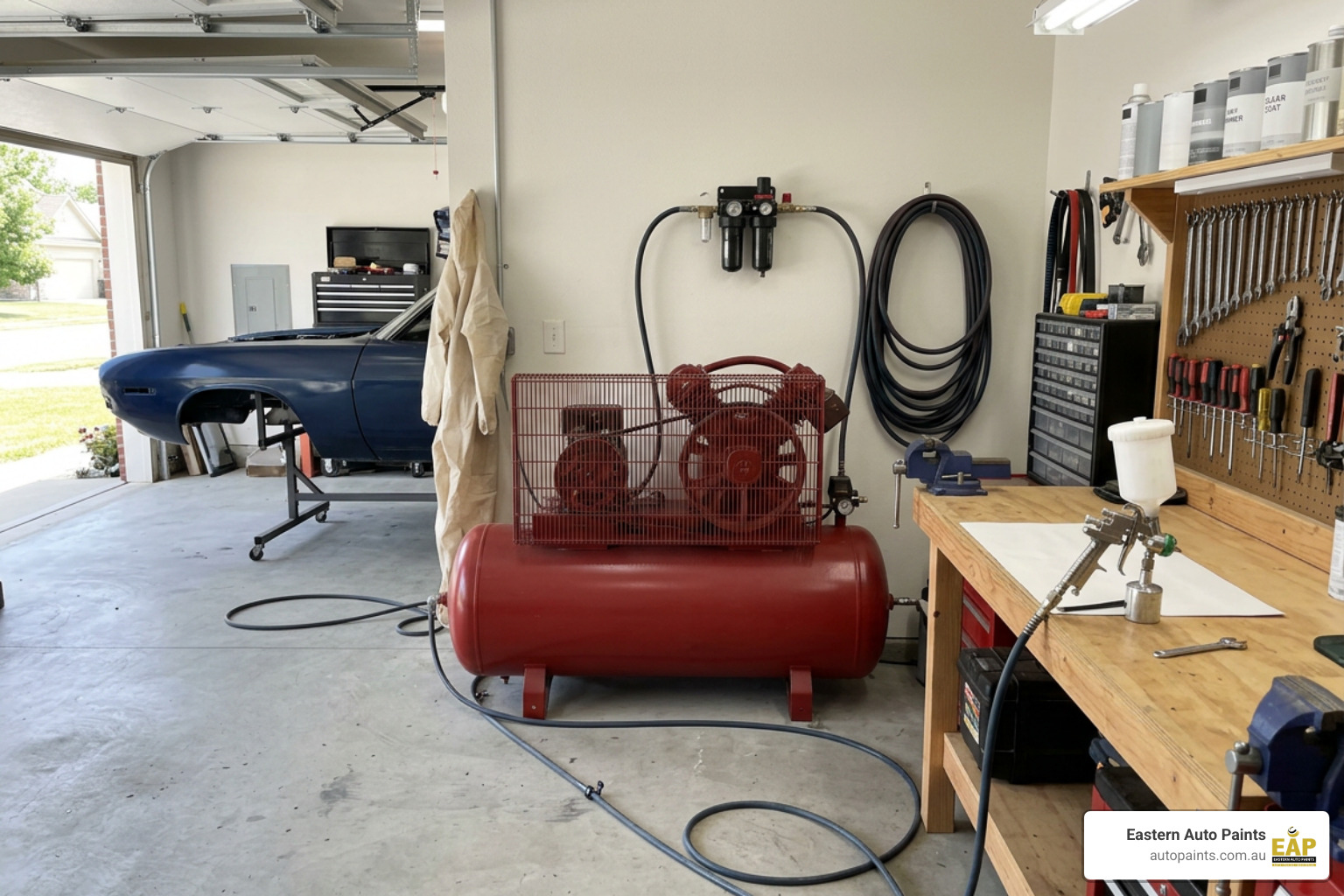
Selecting a listed compressor model helps keep the article aligned with what Eastern Auto Paints actually offers online.
Compressor Specifications Comparison
| Model | Motor Power | Receiver Capacity | Displacement | Working Pressure | Recommended Home-Garage Application |
|---|---|---|---|---|---|
| Anest Iwata NB20C-50 | 2 HP | 50 litres | 225 LPM | 145 PSI | Spot repairs, bumpers and single-panel refinishing |
| Anest Iwata NBC20C-90 | 2 HP | 90 litres | 225 LPM | 145 PSI | Larger single panels and projects needing extra air reserve |
| Anest Iwata NB30-90 | 3 HP | 90 litres | 390 LPM | 145 PSI | Multi-panel resprays and more demanding restoration work |
Anest Iwata NB20C-50 and NBC20C-90 for Panel Repairs and Touch-Ups
For dedicated panel repairs, bumper refinishing and spot blends, compact belt-drive units provide stable pressure output within a manageable home-garage footprint.
- Anest Iwata NB20C-50 2HP 50 Litre Tank 225LPM 145PSI: Features a 50-litre receiver and 225 LPM displacement, making it a practical starting point for smaller automotive refinishing tasks when matched to the spray gun's air requirements.
- Anest Iwata NBC20C-90 2HP 90 Litre Tank 225LPM 145PSI: Uses a 90-litre receiver with the same listed displacement, giving more stored-air buffer for longer trigger time on larger individual panels.
Anest Iwata NB30-90 for Larger Home Restoration Projects
- Anest Iwata NB30-90 3HP 90 Litre Tank 390LPM 145PSI: Suits larger home restoration tasks, multi-panel work and more demanding spray-gun air requirements when the available electrical setup and workspace can support the unit. View the complete Compressors range to compare the stocked options against your garage layout and intended paint work.
Essential Air Management, Filtration, and Spray Equipment Setup
Generating compressed air is only the first stage; managing air quality between the receiver tank and the spray gun nozzle dictates final finish clarity.
Air Filtration, Regulation, and Paint Line Accessories
As air leaves the compressor, cooling inside the lines causes humidity to condense into liquid water. Without adequate separation, this moisture mixes with the paint stream, causing severe defects.
- Multi-Stage Filtration: Install dedicated Air Filter and Regulators on the wall at least 6 metres away from the compressor pump to allow air to cool and condense before entering the water trap and coalescing filter.
- Precise Gun Regulation: Fit a dedicated DR1 Spray Gun Regulator directly at the spray gun base to monitor and adjust dynamic spraying pressure accurately while the trigger is fully depressed.
- High-Flow Air Lines: Avoid restrictive narrow hoses. Use flexible, high-flow air lines such as reinforced twin paint air lines with fittings to minimise internal friction and prevent pressure loss over distance.
Spray Gun Selection and Needle Nozzle Matching
Spray guns atomise paint through precise fluid tip and needle pairings. Selecting the right setup ensures proper material distribution:
- Basecoats and Clearcoats: Typically utilise fine fluid tips to produce ultra-fine atomisation and uniform clear gloss levelling.
- High-Build Primers and Surfacers: Require wider fluid passages to atomise thicker, heavily pigmented primer surfacers without clogging.
- Specialty Flakes and Heavy Coatings: Demand enlarged nozzle assemblies to allow physical metallic flakes or heavy-viscosity textures to pass smoothly.
Always consult our comprehensive Spray Guns and Accessories range to match equipment with your intended paint material. Application and drying times vary by product; always consult the manufacturer's technical data sheet (TDS) or product label before starting for exact spray tip recommendations, dynamic pressures, and reduction ratios.
Best Practices, Maintenance, and Workshop Safety
Maintaining workshop equipment and following rigorous safety procedures ensures consistent performance and personal protection:
- Respiratory Protection: Automotive paints and hardeners contain volatile organic compounds (VOCs) and hazardous resins. Always use compliant personal protective equipment, such as a full-face airfed mask supplied by a dedicated, filtered breathing-air line. Refer to the specific product label/TDS and relevant SafeWork or WorkSafe guidance for product-specific PPE requirements.
- Daily Receiver Draining: Open the tank drain valve after every session to purge condensed water from the bottom of the vessel, preventing internal corrosion and line contamination.
- Pump Maintenance: Regularly inspect pump oil levels and replace compressor lubricant according to the manufacturer's schedule. Keep cooling fins clean and free of overspray.
- Post-Spray Gun Cleaning: Thoroughly flush and clean fluid passages, needle assemblies, and air caps immediately after spraying to prevent dried coating build-up from distorting future spray fan patterns.
What a Personalised Experience Actually Looks Like
When you discuss your home-garage requirements with us, we look closely at your complete system rather than just recommending an isolated pump. We examine your available electrical supply, workspace ventilation, intended paint range and target vehicle scope. Whether you are restoring a single classic panel, refinishing bumpers or preparing for a larger vehicle project at home, our technical team helps ensure your air supply, filtration and spray gun work together properly.
The Value of Consistency and an Ongoing Relationship
Achieving high-grade automotive finishes is a craft that builds over time. Having an established technical partner provides continuous support across project stages, from initial bare metal preparation through priming, colour matching and final clear coating. We provide ongoing access to matching components, filtration service parts and technical advice to keep your home-garage spray setup operating reliably across each vehicle project.
What to Expect at Eastern Auto Paints
At Eastern Auto Paints, we combine industry-leading colour matching with deep technical knowledge of automotive paint systems and application equipment. Based in Victoria across our Bayswater and Dandenong South locations, we support serious vehicle restorers, home-garage applicators and trade customers across Melbourne. Our team helps you select suitable air management equipment, primers, custom-matched topcoats and clearcoats for your specific application environment.
When to Get in Touch or Take Action
If you are planning an automotive paint project, setting up a home garage or struggling with inconsistent finish quality from an undersized air supply, connect with our technical specialists. We will help configure a matched compressor, air filtration line and spray setup designed to deliver clean air and dependable atomisation. Visit our Contact Us page or reach out to our Victorian branch network for expert guidance. Explore our complete guide to Compressor Complete Guide systems and review the listed workshop equipment available through Eastern Auto Paints.
Frequently Asked Questions About Air Compressors for Auto Painting
What size air compressor is required to paint a full car in a home garage?
Painting a complete vehicle requires an air compressor capable of delivering sustained free air delivery without experiencing pressure drop during long, continuous passes across large panels. Look for heavy-duty belt-drive units with a minimum pump output matched to your spray gun requirements and an air receiver of ninety litres or larger to maintain adequate reserve capacity throughout the process.
Can I run a professional HVLP spray gun on standard residential power circuits?
Standard domestic power circuits can support compact and mid-sized compressor motors up to approximately two horsepower. Higher-output compressors with three-horsepower motors or larger continuous-draw pumps often require a dedicated, high-amperage single-phase circuit installed by a licensed electrician to handle start-up current spikes safely without tripping residential circuit breakers.
Why is inline moisture filtration critical when spray painting?
Air compression generates substantial friction and heat, drawing in ambient humidity that condenses into liquid water inside the lines. If this moisture travels into the spray gun, it mixes with the paint stream and causes solvent popping, blistering, clouding in clearcoats, and loss of paint adhesion. Multi-stage filtration removes condensed liquid, fine particulates, and oil aerosols before air reaches the nozzle.
How does Free Air Delivery differ from compressor pump displacement?
Pump displacement is a theoretical mathematical calculation based on the physical cylinder bore and stroke volume running at a specific RPM. Free Air Delivery measures the actual volume of usable air discharged by the compressor at standard operating pressures. Always use the Free Air Delivery rating when comparing compressor capacity against the air demand of your spray gun.
How often should I drain the water from my air compressor tank?
The receiver tank should be drained at the end of every painting session. Condensation naturally collects at the bottom of the steel receiver during operation. Regularly opening the tank drain valve purges accumulated moisture, which helps prevent internal tank corrosion and stops standing water from overwhelming inline filtration traps.