
Bye-Bye Bird Poop: Erasing Car Paint Etching Like a Pro
What is Car Paint Etching and Why Should You Care?
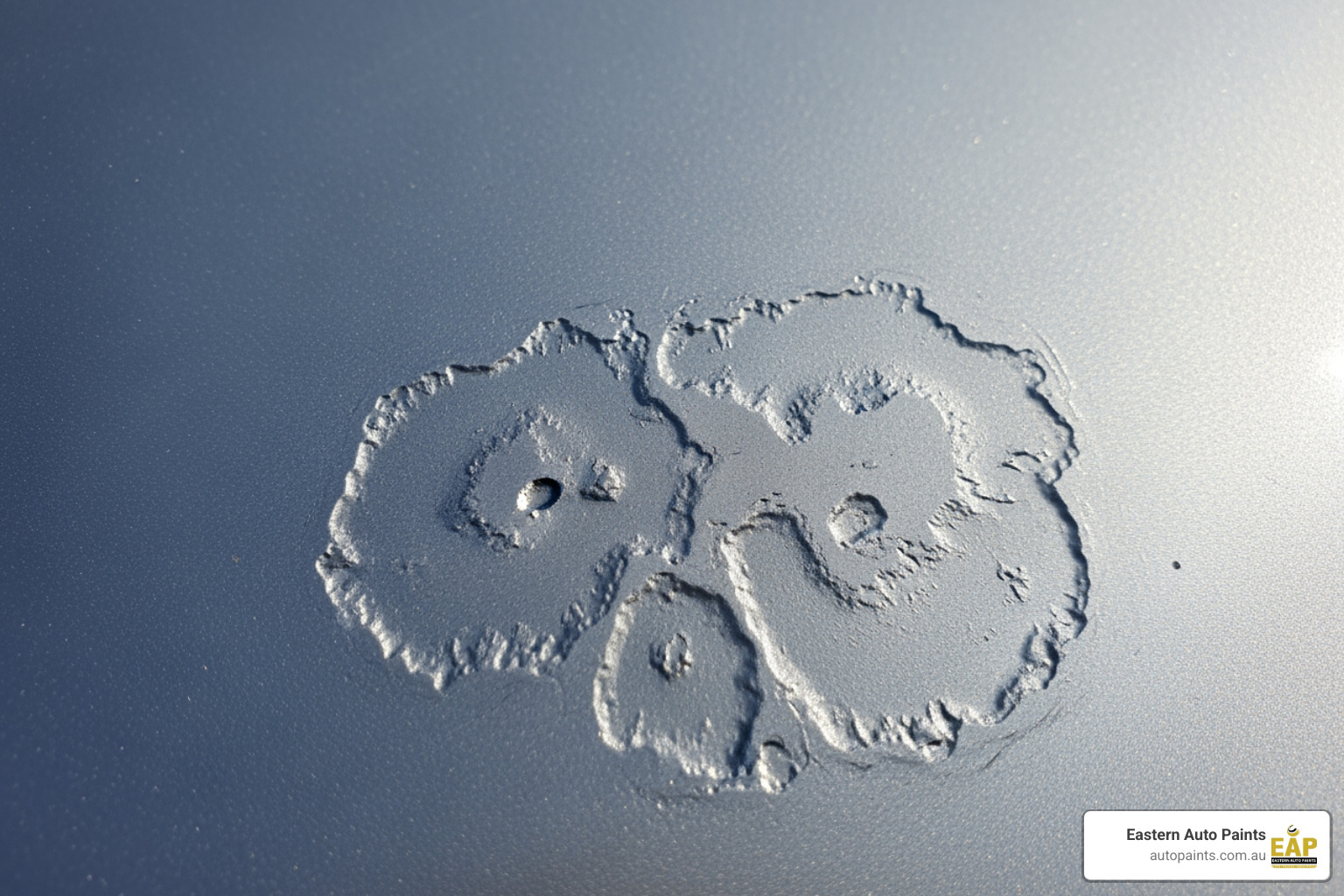
Car paint etching is permanent damage to your vehicle's clear coat caused by acidic or alkaline contaminants that chemically react with the paint surface. If left unchecked, it can worsen over time, reduce your vehicle's resale value, and become difficult to repair.
Quick Answer: Understanding Car Paint Etching
- What it is: Chemical or thermal damage that creates depressions, dull spots, or rough texture in your clear coat.
- Main causes: Bird droppings, water spots, acid rain, bug splatter, and tree sap.
- Two types: Type I (topical staining, removable) and Type II (deep fracturing, often permanent).
- Removal methods: Range from hot water re-flow for fresh marks to wet sanding for severe damage.
- Prevention: Regular washing, protective coatings like ceramic or wax, and prompt contaminant removal.
When you find a dull, rough outline where a bird dropping used to be, that's car paint etching. It's more than a cosmetic annoyance; it's actual damage to your clear coat. The good news is that most etching can be fixed if caught early. Research shows that contaminants like bird droppings contain acids that cause deep etching, especially when heat accelerates the chemical reaction. Understanding the type of damage and the correct repair method can save you hundreds in professional repairs.
With over three decades in the coatings industry, we've seen countless cases of car paint etching and helped customers tackle it effectively, from simple DIY fixes to professional restoration.
Key terms for car paint etching:
Understanding the Damage
Your car's paint consists of several layers. On the metal is a primer for adhesion and corrosion resistance. Above that is the basecoat (colour), and finally, the clear coat. The clear coat is a protective shield, providing gloss and defence against the elements. When acidic or alkaline contaminants land on your car, they chemically react with this clear coat, slowly eating into its structure. This creates microscopic depressions, dull spots, or a rough texture.
If left untreated, these etched areas can lead to permanent hazing, discolouration, or even cracking of the clear coat. This compromises the paint's integrity and reduces your vehicle's resale value, which is why quick action is so important.
Etching vs. Staining: What's the Difference?
Understanding the distinction between etching and staining is key to choosing the right repair method.
Staining is a discolouration on the surface of your clear coat. The contaminant leaves a mark but hasn't physically altered the clear coat's structure. Stains are generally easier to remove.
Etching involves a physical alteration. The contaminant has eaten into the clear coat, creating a depression or rough texture. Severe cases, often from bird droppings, can appear fractured or wrinkled (Type II etching), while shallower marks are known as Type I etching.
How can you tell the difference?
- Visual Inspection: Stains are often just a different colour. Etching usually presents as a dull, hazy spot or a distinct "ring" where the contaminant was.
- The "Baggie Test": Place a thin plastic bag over your hand and gently run your fingertips over the area. If it feels completely smooth, it's likely a stain. If you feel roughness or a depression, you're dealing with etching. The plastic amplifies your sense of touch, making imperfections noticeable.
The Main Culprits: What Causes Car Paint Etching?
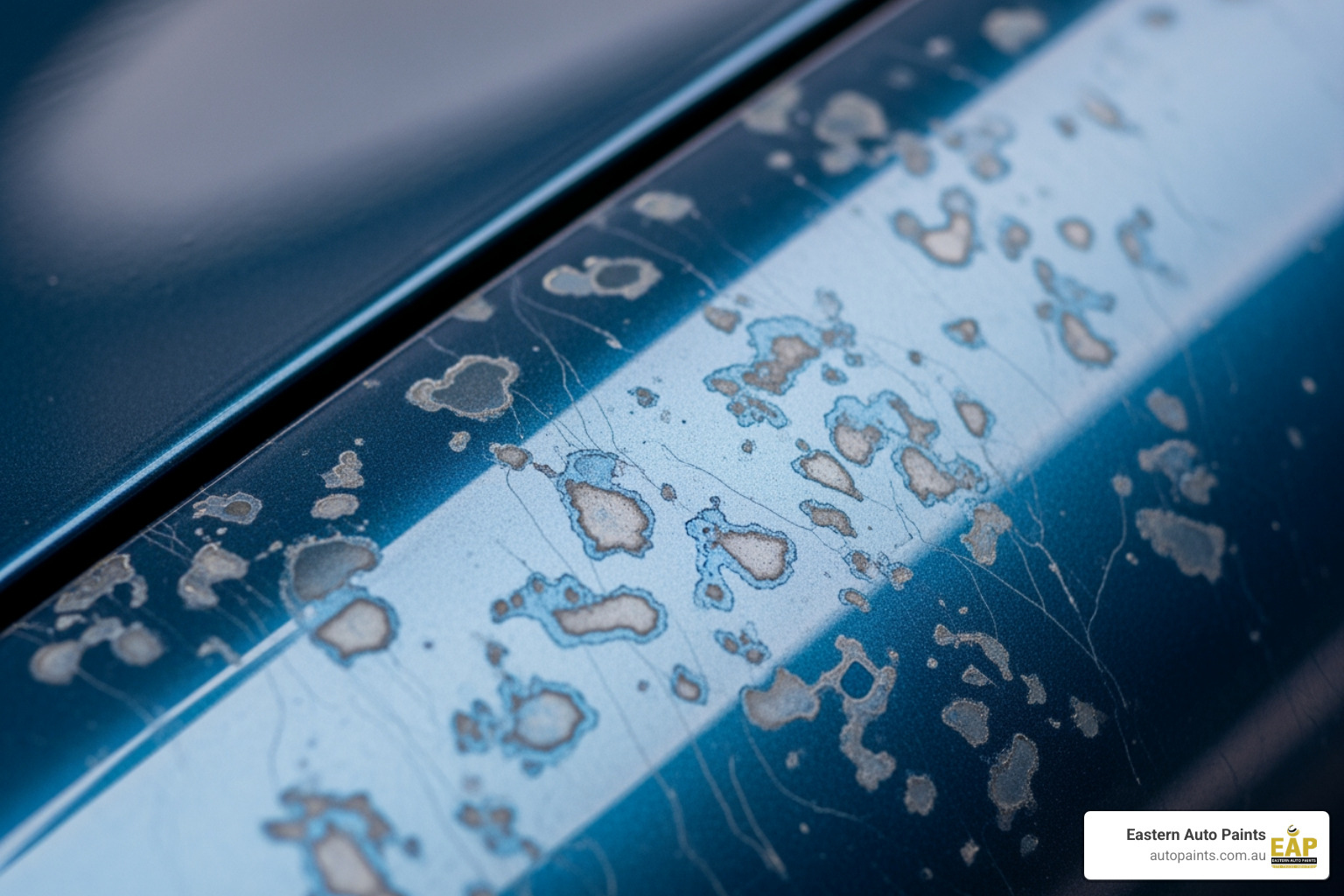
The common thread behind car paint etching is an acidic or alkaline substance left to dwell on your paint, especially when combined with heat.
Bird Droppings: Public Enemy #1
Bird droppings are the most notorious offender because they contain uric acid, a highly corrosive substance that can rapidly eat into your car's clear coat. The damage worsens the longer it sits, especially in direct sunlight.
- Uric Acid: This is the primary component responsible for the damage. Its high acidity quickly degrades the clear coat.
- Thermal Insulation Effect: Your car's paint expands and contracts with temperature. A bird dropping insulates the paint underneath, keeping it cooler than the surrounding, sun-exposed paint. This differential in expansion and contraction can leave a visible etch mark even after the dropping is removed.
-
Types of Etching:
- Type I (Topical Etching): A shallow mark or haze on the top layer of the clear coat, generally repairable with polishing.
- Type II (Fractured/Wrinkled Etching): More severe damage where the clear coat has fractured or collapsed. This is often too deep to fix without repainting.
Water Spots and Acid Rain
Water can also be a significant cause of car paint etching.
- Hard Water Minerals: In Australia, many areas have hard water containing minerals like calcium and magnesium. When this water evaporates on your car, the minerals are left behind. They can bond to and etch the clear coat, leaving dull, circular spots, a process accelerated by the sun.
- Acid Rain: Caused by industrial pollution, acid rain droplets become more concentrated as they evaporate, reacting with and etching the clear coat.
Other Environmental Aggressors
- Bug Splatter: Insect guts are often acidic and can cause significant etching if left to bake in the sun.
- Tree Sap: While sticky, some tree sap contains chemicals that can etch paint if not cleaned promptly.
- Industrial Fallout: Microscopic metallic or chemical particles from industrial areas can land on your car, bond to the paint, and cause etching over time.
- Improper Washing Chemicals: Harsh, non-pH-neutral detergents can strip protective layers and etch the clear coat. Always use clear coat safe products.
For optimal paint health, a strong foundation is crucial. We offer primers like the Protec PPG Grey/Black Etch Primer and the Concept 103 Etch Primer that provide excellent adhesion and corrosion resistance. Learn more in our A Practical Guide to Choosing Auto Paint Primers.
A Step-by-Step Guide to Removing Car Paint Etching
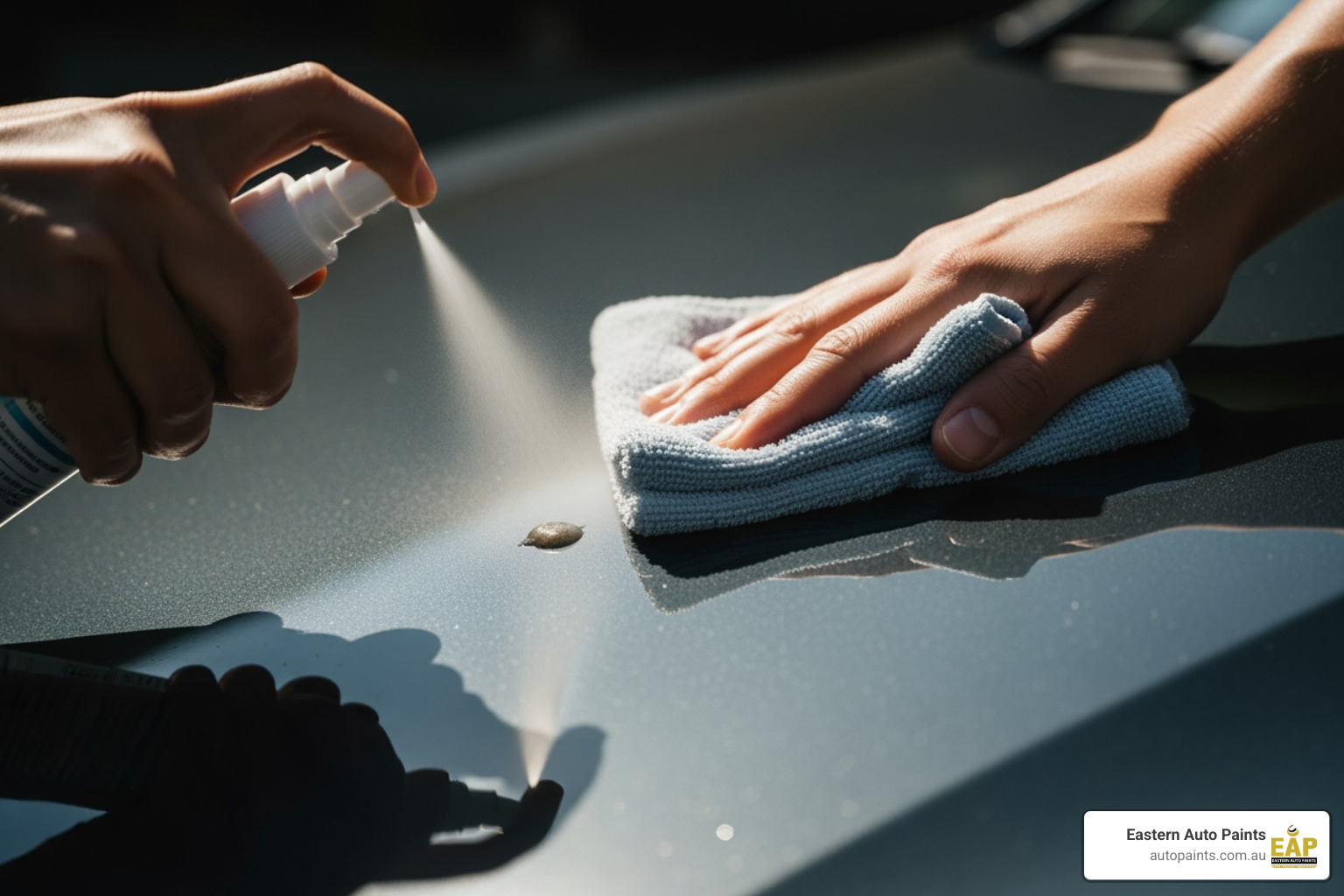
Tackling car paint etching requires starting with the least aggressive method first. Always wear appropriate personal protective equipment (PPE), such as PPE masks, overalls and gloves, while working in a cool, shaded area to prevent products from drying too quickly.
Level 1: Treating Fresh and Minor Etching
For early or shallow etching, these gentle methods may work:
- Hot Water Re-Flow Technique: For fresh bird dropping etches, pouring hot (not boiling) water onto the area can reheat the paint, allowing the clear coat to "relax" and potentially level out. This is often effective on ceramic-coated vehicles.
- Quick Detailer Spray: For minor marks, a quality quick detailer provides lubrication to gently wipe away contaminants without scratching. Use a clean, soft microfiber towel.
- Clay Bar Treatment: A clay bar removes bonded surface contaminants. After washing, lubricate the area and glide the clay bar over the surface to lift embedded particles without abrading the paint.
For related issues like rust, see our Beginners Guide to Rust Repair and Prevention.
Level 2: Hand Polishing for Light Car Paint Etching
For more pronounced Type I etching, hand polishing uses mild abrasives to level the surface.
- Products Needed: A clear coat safe polishing compound, foam applicator pads, and clean microfiber towels.
- Preparation: On a clean, dry surface, apply a small amount of compound to a foam applicator pad.
- Application: Work on a small area (20-25 cm square) with firm, even pressure and a fast, overlapping hand motion to work the product into the paint.
- Buffing: Once the compound has hazed, buff away the residue with a clean microfiber towel. Repeat if necessary.
For more tips, see our A Q\&A for Car Paint Removal.
Level 3: Machine Polishing for Moderate Damage
For moderate etching, a machine polisher offers more power. A Dual Action (DA) polisher is safer for beginners than a rotary buffer.
Essential Polishing Tools:
- Dual Action (DA) Polisher
- Cutting Compounds & Finishing Polishes
- Cutting & Finishing Pads (foam or microfiber)
- Microfiber Towels
Machine Technique:
- Test Spot: Always start with a small, inconspicuous test spot to find the right combination of product, pad, and speed.
- Application: Apply a few dots of compound to your cutting pad. Spread on low speed, then increase to medium.
- Work in Sections: Use overlapping passes on small sections (60x60 cm), keeping the pad flat.
- Compound, then Polish: After compounding, switch to a finishing pad and polish to refine the finish and restore gloss.
Level 4: Advanced Repair for Severe Etching
Deep, Type II (fractured) etching may require wet sanding. This is an aggressive method that carries significant risk and is best left to professionals.
- Wet Sanding: This involves using very fine-grit sandpaper (e.g., 3000 or 5000 grit) with lubrication to carefully level the clear coat. We offer a range of sanding products for such tasks.
- Risks Involved: The main risk is sanding through the clear coat, which exposes the basecoat and requires a full repaint. This is why experience and caution are essential.
- When to Stop: Sand just enough to create a uniform, dull finish over the area. The area must then be machine polished to restore gloss.
If you're unsure, consult a professional. For severe damage, our guide on Understanding Car Paint Strippers: Types, Uses, and Safety may be relevant.
Prevention: Your Best Defence Against Future Damage
While it's good to know how to fix car paint etching, prevention is always the best approach. Proactive protection and regular maintenance are your car's best defence.
The Role of Protective Coatings
Applying a protective layer acts as a sacrificial barrier, taking the brunt of environmental assaults instead of your clear coat.
- Car Wax: An affordable option that provides temporary protection and gloss, repelling water and light contaminants.
- Paint Sealants: Synthetic products offering longer-lasting protection than wax, creating a slick surface that's easier to clean.
- Ceramic Coatings: The top tier of paint protection. These coatings form a durable, semi-permanent, chemical-resistant, and hydrophobic (water-repelling) bond with your clear coat. Research shows they protect paint from the acidity of bird droppings, buying you valuable time to remove contaminants before they etch into the clear coat.
Investing in a quality protective coating is an excellent way to safeguard your vehicle's finish. You can find the right top coat for your vehicle in our extensive range.
The Importance of a Good Wash Routine
A consistent and proper wash routine is paramount in preventing car paint etching.
- Prompt Removal of Contaminants: This is critical. The longer contaminants like bird droppings sit on your paint, especially in the sun, the more likely they are to cause etching. Remove them as soon as safely possible.
- Two-Bucket Wash Method: Use one bucket for soapy water and another for rinsing your wash mitt to prevent re-introducing grit onto your paint.
- pH-Neutral Car Shampoo: Always use a pH-neutral shampoo to avoid stripping protective coatings.
- Safe Drying Techniques: Dry your car with soft microfiber towels or an air blower to prevent water spots.
Learn more about protecting metal in our guide: Beyond the Rust: A Comprehensive Look at Metal Protection Sprays.
Clarifying "Paint Etching": Damage vs. Customisation
It's important to distinguish accidental damage from intentional "paint etching" used for customisation. For example, some manufacturers offer controlled 'paint etching' to create matte-finish graphics on a car's clear coat. This is a permanent, professional alternative to decals. While the term is the same, the context and intent are entirely different. You can learn more about this process in this article on Audi's paint etching technology.
When to Seek Professional Help for Car Paint Etching
While many minor cases of car paint etching can be tackled at home, it's crucial to know when to call a professional.
- Deep Etching (Type II): If you see fractured or wrinkled etching that has clearly compromised the clear coat, it's likely Type II damage. DIY repairs risk burning through the paint, leading to a costly full-panel repaint.
- Widespread Damage: If large sections of your car are affected, a professional has the tools and expertise to address the issue uniformly and efficiently.
- Clear Coat Integrity Concerns: Professionals use tools like paint thickness gauges to assess how much clear coat can be safely removed. If the clear coat is already thin, aggressive DIY methods are extremely risky.
- Cost of Repainting: A mistake with an aggressive method like wet sanding can turn a correctable problem into one that requires a full repaint, significantly increasing the cost. A professional assessment can save you money in the long run.
Eastern Auto Paints has been trusted by professionals for over 34 years in Victoria. Our expert staff can advise on the best course of action and provide colour matching services to ensure a seamless finish if repainting is required.
Frequently Asked Questions about Car Paint Etching
Can all car paint etching be removed at home?
Not all car paint etching can be removed at home. Minor, topical (Type I) etching can often be fixed with polishing compounds or a clay bar. However, deep, fractured (Type II) etching requires professional intervention. Attempting to remove severe etching yourself risks burning through the clear coat, leading to more costly repairs.
Will polishing compound damage my clear coat?
When used correctly, polishing compounds are designed to safely remove microscopic layers of clear coat. However, improper technique—too much pressure, high speed, or the wrong pad—can generate excessive heat and burn through the paint. Always start with the least aggressive product, perform a test spot, and follow the instructions.
How quickly do I need to remove bird droppings?
As quickly as possible. The uric acid in bird droppings can cause etching rapidly, a process accelerated by heat and sunlight. While a ceramic coating provides a sacrificial layer and buys you more time, prompt removal (ideally within 24-48 hours) is the best practice to prevent permanent damage.
Keep Your Finish Flawless
Car paint etching is an unwelcome sight, but with the right knowledge, it's often a fixable problem. From understanding the damage to using the correct repair technique, you are now equipped to tackle these blemishes.
Prevention is your best defence. Regular washing, prompt removal of contaminants, and quality protective coatings like waxes or ceramic coatings will go a long way in keeping your car's finish flawless.
For all your automotive paint and repair needs, from primers to professional-grade compounds, trust the experts at Eastern Auto Paints. We've served the automotive and industrial paint industries in Victoria for over 34 years. Explore our complete range of products online or contact us for custom advice.