

High CFM Air Compressor Sizing: Matching Flow Rates with Heavy Tools
Airflow Dynamics: Calculating True CFM Demand for Heavy Pneumatics
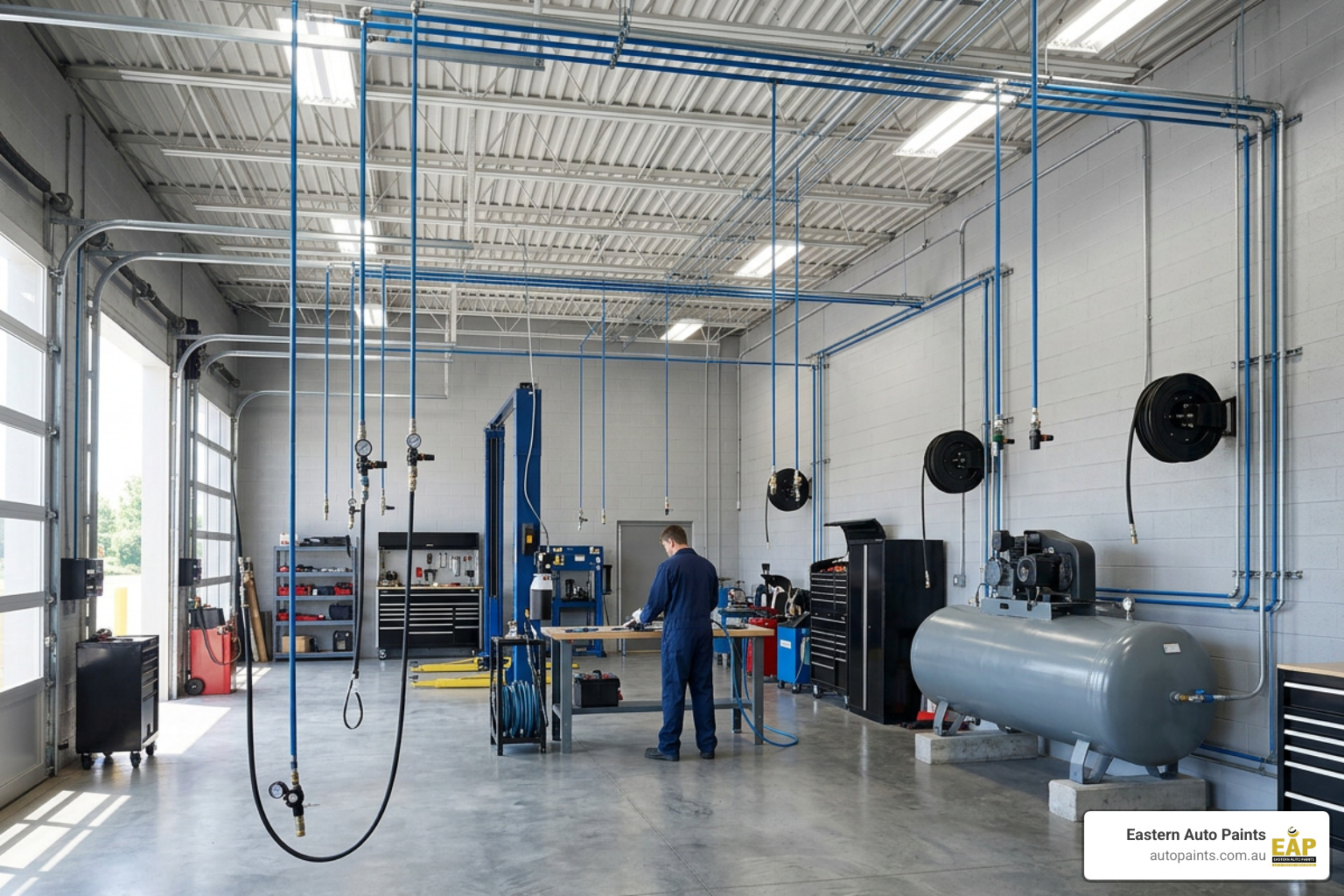
A properly configured high CFM air compressor delivers uninterrupted airflow and flawless coating atomisation, whereas an undersized system creates frustrating pressure drops, inconsistent spray patterns, and premature mechanical wear.
Key Takeaways:
- Continuous pneumatic tools require adequate free air delivery to maintain working pressure.
- Comparing compressor technologies ensures your setup handles your operational duty cycles.
- Proper airline plumbing and filtration protect downstream finishes from moisture and pressure loss.
- Selecting high-performance workshop air tools requires stable air delivery across simultaneous workshop operations.
At Eastern Auto Paints (EAP), we help workshop professionals and automotive restorers design efficient compressed air systems tailored to their specific pneumatic demands.
Combining decades of technical trade experience with advanced colour matching technology and industry expertise, our team ensures every refinisher achieves reliable atomisation and superior workshop productivity.
Selecting the right compressor begins with understanding pneumatic consumption across your entire workshop. Every air tool demands a specific volume of compressed air to operate at peak efficiency. When multiple operators use tools simultaneously, air lines experience flow losses, and pumps work overtime to keep receiver tanks charged. Sum the total consumption of your pneumatic tools and factor in line friction and joint resistance.
Sizing a High CFM Air Compressor for Continuous Demand Tools
Continuous-demand equipment places relentless load on a compressor pump. Tools such as abrasive blasting equipment, continuous rotary orbital sanders, and production spray guns and accessories draw constant air volume throughout an application pass.
If your compressor pump cannot deliver more air than the tool consumes, your system relies entirely on stored tank volume. Once that reserve is exhausted, the line pressure drops below operating thresholds. This leads to erratic spray patterns, atomisation failure, or stalled sanders. Always incorporate a comfortable safety margin above your peak simultaneous demand to protect against pressure dips. For a deeper breakdown of system calculations, our Compressor Complete Guide explores how workshop demand maps to pump capacity.
Pressure Differential: Evaluating Free Air Delivery at Working PSI
Air delivery is not an absolute figure; it changes depending on output pressure. A compressor pump produces more volume at low discharge pressure than it does at elevated operating pressures. This physical relationship between pressure and volume means that a pump rating stated at displacement is very different from its actual Free Air Delivery (FAD) under working load.
When matching equipment, compare delivery ratings at your target operating pressure. While standard workshop air lines often run at elevated pressure through the primary line, atomisation at the gun cap requires stable, regulated delivery. For professional high-volume, low-pressure (HVLP) setups, reviewing our guide on the Best Compressor for HVLP will clarify how dynamic pressure drops affect delivery at the nozzle. Always verify the manufacturer's technical data sheet (TDS) or product label for exact operational pressure ratings and equipment specifications.
Comparing High CFM Air Compressor Technologies: Screw vs Piston
Selecting the right compression technology depends on duty cycles, operating hours, and workshop air quality requirements.
| Feature | Two-Stage Cast Iron Reciprocating | Industrial Rotary Screw |
|---|---|---|
| Primary Duty Cycle | Intermittent operation | Continuous duty operation |
| Noise Emission | Moderate to high mechanical pulse | Low, enclosed operating pitch |
| Air Delivery Profile | Pulsating flow requiring receiver dampening | Smooth, non-pulsating continuous stream |
| Operating Thermal Load | High heat build-up under constant run | Integrated oil-cooling thermal management |
| Best Workshop Setting | Small trade garages, batch refinishing | Multi-bay production booths, blasting |
Explore our full range of workshop Compressors to match these configurations to your layout.
Two-Stage Cast Iron Reciprocating Units
Two-stage reciprocating compressors use heavy-duty cast iron pumps with intermediate cooling between stages to compress air efficiently.
When you would use this: Reciprocating units provide dependable service for automotive restoration shops, custom fabricators, and trade garages that require robust intermittent air delivery. Models such as the Anest Iwata NB30 reciprocating series provide solid air displacement, low-speed cast-iron pump longevity, and simple mechanical servicing for workshops operating intermittent sanding and painting cycles.
Rotary Screw Systems for Continuous Duty Cycles
Rotary screw systems compress air through interlocking helical rotors, delivering continuous, non-pulsating airflow without the mechanical wear associated with reciprocating pistons.
When you would use this: Rotary screw systems suit high-volume commercial panel shops, multi-bay spray booths, and industrial fabrication facilities running continuous shifts. Units like the Anest Iwata Eco Screw Compressor or the integrated Anest Iwata Trinity11 MK2 screw package provide whisper-quiet operation, constant continuous-duty capacity, and built-in refrigerated air treatment to eliminate line moisture before it reaches spray equipment.
Electrical and Infrastructure Requirements for High Flow Workshop Setups
A high-output compressor requires adequate workshop electrical infrastructure and well-designed pneumatic plumbing.
Electrical Requirements for High CFM Air Compressor Installations
Delivering large volumes of compressed air requires substantial electrical power. Smaller trade units typically run on 240-volt single-phase power, but high-output electric motors draw significant startup current. Inadequate workshop wiring can lead to voltage drops, tripped thermal overloads, and premature motor failure.
Industrial high-flow compressors, particularly rotary screw units and large multi-piston pumps, generally require 415-volt three-phase power supplies. These installations demand dedicated sub-boards, appropriately rated circuit breakers, and magnetic starters to handle startup loads smoothly. Always consult a licensed electrician to verify your workshop's electrical capacity before installing heavy machinery.
Tank Sizing, Air Distribution Lines, and Moisture Filtration
Receiver tank capacity acts as a vital buffer, absorbing demand spikes and allowing the compressed air to cool before entering the distribution network. However, tank volume cannot compensate for an undersized pump during continuous operation.
Piping diameter is critical. Narrow air lines restrict volume, causing severe pressure drop over distance. Pair generous line diameters with proper fall angles, water traps, and multi-stage air filter and regulators. Removing oil aerosols, moisture, and particulate matter ensures clean, dry air delivery to your guns. For detailed configuration layouts, explore our Anest Iwata Compressors Complete Guide.
Decision Guide: Selecting the Ideal Workshop Setup
Matching compressor specifications to your workflow prevents premature machinery failure and protects your refinishing quality.
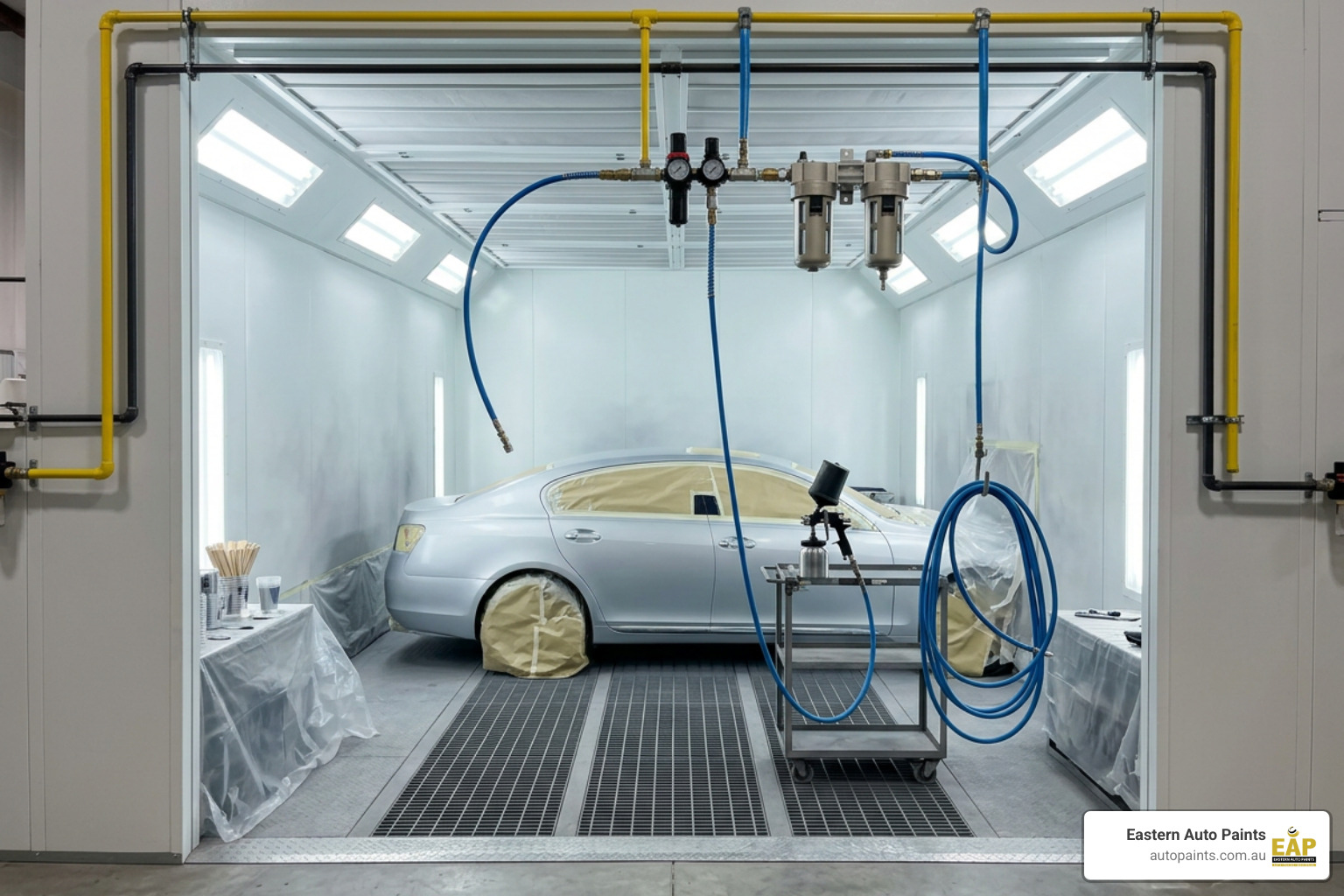
For a broader perspective on selecting automotive equipment, see our Comprehensive Guide to Choosing a Car Painting Compressor.
Low-to-Medium Flow Trade Workshops
When you would use this setup: Single-operator workshops, mobile repairers, and bespoke restoration garages benefit from compact, semi-stationary reciprocating units. The Anest Iwata NBC20C series offers a balanced receiver and dependable motor. It suits panel preparation, individual paint passes, and intermittent tool use without demanding complex electrical upgrades.
High-Volume Commercial Spray Booths and Blasting Stations
When you would use this setup: Production-oriented smash repair centres and industrial coating facilities require unbroken, high-volume airflow across multiple stations. An industrial package such as the Anest Iwata Eco15 MK2 rotary screw system delivers massive air volume, easily powering multiple spray booths, full-time orbital sanders, and media blast cabinets simultaneously while maintaining stable pressure.
Why This Issue Should Not Be Ignored
Airflow restrictions rarely stay hidden; they show up directly in your finish. When a compressor cannot keep pace with continuous demand, atomisation quality falls apart mid-panel. The resulting pressure fluctuations cause inconsistent droplet distribution, leading to mottling, orange peel, dry spray, and uneven clearcoat levelling.
Beyond coating defects, running an undersized compressor forces the pump into an unbroken cycle. Overworking a reciprocating unit causes high thermal buildup, accelerated piston ring wear, oil carryover into distribution lines, and excessive water condensation. Protecting your equipment and finishing quality requires sizing the air source correctly from the outset.
Common Symptoms, Challenges, or Questions
Refinishers and workshop managers often encounter specific operational warning signs when air supply is poorly matched to tooling:
- Pressure Fade at the Gun: The regulator shows correct static pressure, but line pressure drops sharply as soon as the trigger is pulled and held.
- Excessive Moisture in Lines: The compressor runs continuously without cooling cycles, causing hot, moisture-laden air to overwhelm standard inline water traps.
- Motor Overheating and Thermal Trips: Single-phase units operating on long extension leads or overloaded circuits draw high amperage, tripping breakers during sustained sanding.
- Tool Speed Fluctuations: Random orbital sanders or die grinders lose rotational speed mid-cut as receiver tank reserves deplete faster than the pump can recharge them.
What a Personalised Experience Actually Looks Like
Selecting an industrial air setup should never involve guesswork or generic sizing charts. When you talk with our team, we evaluate your workshop's specific operational parameters to design an air supply system tailored to your daily output.
We evaluate your current pneumatic tool inventory, analyse simultaneous operator demand, review available electrical phase supply, and design airline loop layouts that eliminate friction-induced pressure drop. Whether configuring a compact restoration garage or a high-output production booth, we ensure every component from pump to regulator operates harmoniously.
The Value of Consistency and an Ongoing Relationship
Air delivery systems are long-term workshop assets that demand ongoing reliability. Developing a relationship with an expert supplier ensures your air generation, filtration, and downstream spray equipment remain fully supported throughout their operating life.
As your workshop expands, having a dedicated partner allows you to scale capacity smoothly, integrate secondary receivers, upgrade filtration banks, and maintain consistent coating quality across every bay. Application and drying times vary by product, so we always direct applicators to review the manufacturer's technical data sheet (TDS) or product label before starting a project.
What to Expect at Eastern Auto Paints
At Eastern Auto Paints, our team combines decades of practical trade experience with advanced colour matching technology and refinishing expertise. Operating across our Victorian branches in Bayswater and Dandenong South, we supply trade professionals, industrial fabricators, and vehicle restorers across Melbourne with reliable equipment and premium consumables.
We stock industry-leading compressor systems, precision spray equipment, clean-air filtration units, and specialised automotive coatings. Our technical staff take the time to understand your refinishing challenges, offering practical guidance that helps you maintain clean air, consistent atomisation, and reliable workshop productivity.
When to Get in Touch or Take Action
If your workshop is experiencing pressure drop, planning to add extra spray bays, or upgrading to continuous-demand preparation equipment, it is time to audit your air supply system.
Our technical specialists are ready to help you calculate your true air demand, select the right compressor displacement, and configure your filtration network. Get in touch with our team via our Contact Us page or visit our trade counters in Bayswater and Dandenong South to discuss your equipment requirements.
Explore our dedicated range of workshop equipment and automotive supplies:
- Workshop Compressors
- Spray Guns and Accessories
- Air Filtration and Regulators
- Workshop Air Tools
- Refinishing Articles and Guides
Frequently Asked Questions About High CFM Air Compressors
What constitutes a high CFM rating for automotive refinishing?
A high CFM rating in an automotive refinishing environment depends on whether you operate as a single-operator custom shop or a multi-bay production facility. For a single spray booth using modern compliant or HVLP spray guns, a delivery rate that comfortably supports continuous atomisation along with a breathing-air respirator is considered the benchmark. In commercial multi-operator setups, high flow requirements scale upward significantly to supply multiple sprayers, continuous orbital sanders, and preparation stations at the same time without pressure fluctuation.
Can a high CFM compressor run on a single-phase power supply?
Single-phase electrical circuits can power moderately high-output reciprocating compressors, provided the motor is paired with a dedicated, correctly rated circuit and appropriate wiring. However, physical limitations on single-phase amperage mean that high-capacity industrial compressors, including large rotary screw systems, generally require a three-phase power supply to handle the startup load and running current.
Why does operating PSI change delivered CFM output?
Air volume delivery varies with pressure because air is compressible. As the discharge pressure increases, the compressor pump must work harder against backpressure to force air into the receiver tank, which reduces volumetric efficiency. Consequently, a compressor delivers a higher volume of free air at lower pressures than it does at elevated working pressures.
How does tank size influence high CFM air tool performance?
The receiver tank acts as a pressure buffer and storage reservoir rather than an air generator. For intermittent tools, a generous tank provides a reserve of air that prevents the pump from cycling constantly. For continuous-demand tools like sanders and spray guns, tank size provides an initial buffer, but the continuous delivery rate of the pump itself must match or exceed tool consumption to prevent line pressure from falling.
How do I prevent moisture accumulation in high-flow air systems?
High-flow air systems generate significant heat during continuous operation, which holds moisture in suspension until the air cools in distribution lines. Preventing moisture from reaching spray guns requires a complete clean-air strategy, including adequate receiver cooling, looped piping with proper drop legs and drains, and multi-stage filtration with desiccant or refrigerated air dryers. Always check the manufacturer's technical data sheet (TDS) and relevant SafeWork or WorkSafe guidance for product-specific personal protective equipment (PPE) requirements when setting up clean breathing air and spray lines.