
A Comprehensive Guide to Compare Spray Gun Types
Choose Spray Guns and Accessories for a Cleaner Finish

The right spray guns and accessories help produce even colour coverage, controlled atomisation and a finish that needs less correction. The wrong combination can leave a painter fighting dry spray, poor fan patterns, uneven material flow or unnecessary fatigue. For vehicle refinishing, compare HVLP (high volume low pressure) guns for controlled basecoat and clearcoat work, reduced-pressure guns for fast, fine application, and airless equipment for higher-viscosity industrial coatings and larger throughput jobs.
Key Takeaways
- Match the spray gun technology to the coating, panel size and required finish quality.
- Choose fluid tip size according to material viscosity, from finer basecoats to heavier primers.
- Add clean-air filtration, regulators, filters and flexible hose connections to protect spray consistency.
- Start by reviewing our Spray Equipment range before building a complete setup.
At Eastern Auto Paints, we help trade painters, restoration enthusiasts and industrial applicators select equipment as a working system rather than a collection of separate parts. Our approach considers the gun, air supply, fluid tip, cup system and accessories together, because each affects how reliably a coating is applied.
Our core value is practical, expert-led advice based on how coatings behave in real workshop conditions. The sections ahead explain how to compare spray gun types, choose compatible accessories and create a setup suited to professional refinishing work.
Comparing Core Spray Gun Technologies
Pneumatic atomisation relies on compressed air breaking liquid paint into a controlled pattern of fine droplets. The efficiency of this process determines how much material lands on the panel compared to how much disperses as overspray. Selecting the right setup requires balancing transfer efficiency, air supply demands, fluid dynamics, and application speed.
When setting up your workstation, pairing a quality Auto Body Paint Gun with an adequate air delivery system ensures your coatings lay flat and smooth across every pass.
| Spray Gun Technology | Operating Mechanism | Transfer Efficiency | Application Pace | Best Fit Coatings |
|---|---|---|---|---|
| HVLP | High air volume at low air cap pressure | High | Measured, controlled | Basecoats, metallic layers, detail work |
| Reduced Pressure (RP / Compliant) | Optimised air pressure with balanced air volume | High | Fast, continuous sweep | High-solids clearcoats, polyurethane topcoats |
| Airless | Pure hydraulic fluid pressure without air atomisation | Medium | Very fast, heavy build | High-viscosity primers, industrial protective coatings |
High Volume Low Pressure (HVLP) Systems
HVLP systems operate by delivering a substantial volume of air at reduced pressure at the air cap. This approach gently atomises the paint stream, generating a soft spray fan that minimises turbulence and bounce-back.
When you'd use this:
- Basecoat application: The controlled fan pattern allows delicate metallic and pearl flakes to orient evenly without mottling or blotching.
- Detailed panel blending: The softer spray edge gives you exceptional control when feathering colour into adjacent original paintwork.
- Overhead or intricate profiles: Reduced overspray keeps surrounding workshop areas cleaner and helps keep material on tight contours.
Because HVLP guns require higher air volume to atomise properly, ensuring your compressor can deliver sufficient airflow is vital. You can assess your workshop pneumatic demands by checking our guide on the Best Compressor for HVLP. To explore how these units handle general automotive bodywork, see our practical advice on using an air paint gun for cars.
Reduced Pressure and Compliant Spray Guns
Reduced pressure (RP) or compliant spray guns bridge the gap between traditional high-pressure guns and HVLP technology. They operate with slightly higher air cap pressure while remaining compliant with environmental transfer efficiency standards.
When you'd use this:
- High-solids clearcoats: The increased atomisation energy shatters thick clearcoat polymers into ultra-fine droplets, producing exceptional gloss and flow out of the gun.
- Large commercial spray areas: Faster pass speeds allow you to cover broad surfaces such as vehicle sides, bonnets, and commercial roofs quickly.
- Standard air supply setups: Compliant guns generally consume less air volume (litres per minute) than pure HVLP guns, making them adaptable across diverse workshops.
A premium compliant option designed specifically for mirror-like clearcoat finishes is the WS400 Supernova HD clearcoat spray gun series 2. When your refinishing standards require the absolute highest level of mechanical precision and ergonomic balance, exploring a dedicated high-end spray gun provides unmatched fluid control.
Airless and Air-Assisted Airless Systems
Airless equipment uses pure hydraulic pressure rather than compressed air to propel material through a hardened tungsten carbide orifice. The sudden pressure drop shatters the liquid stream into a dense spray pattern.
When you'd use this:
- High-viscosity industrial coatings: Ideal for unreduced primers, structural enamels, and heavy protective barriers that would choke standard pneumatic atomising nozzles.
- High-throughput coating: Allows rapid deposition of high-build films across large vehicle chassis, transport trailers, and machinery panels.
- Production environments: Heavy-duty fluid lines draw directly from bulk containers for uninterrupted application.
Trade workshops looking to expand their industrial coating capabilities can review dedicated airless spray units alongside specialised airless spray gun equipment to handle thick film builds with total reliability.
Selecting Fluid Nozzle Sizes and Modular Atomisation Systems
The fluid nozzle and needle assemble to form the primary metering orifice of your spray gun. Selecting the correct nozzle diameter ensures that the fluid stream enters the air stream at the precise volume needed for uniform droplet distribution.
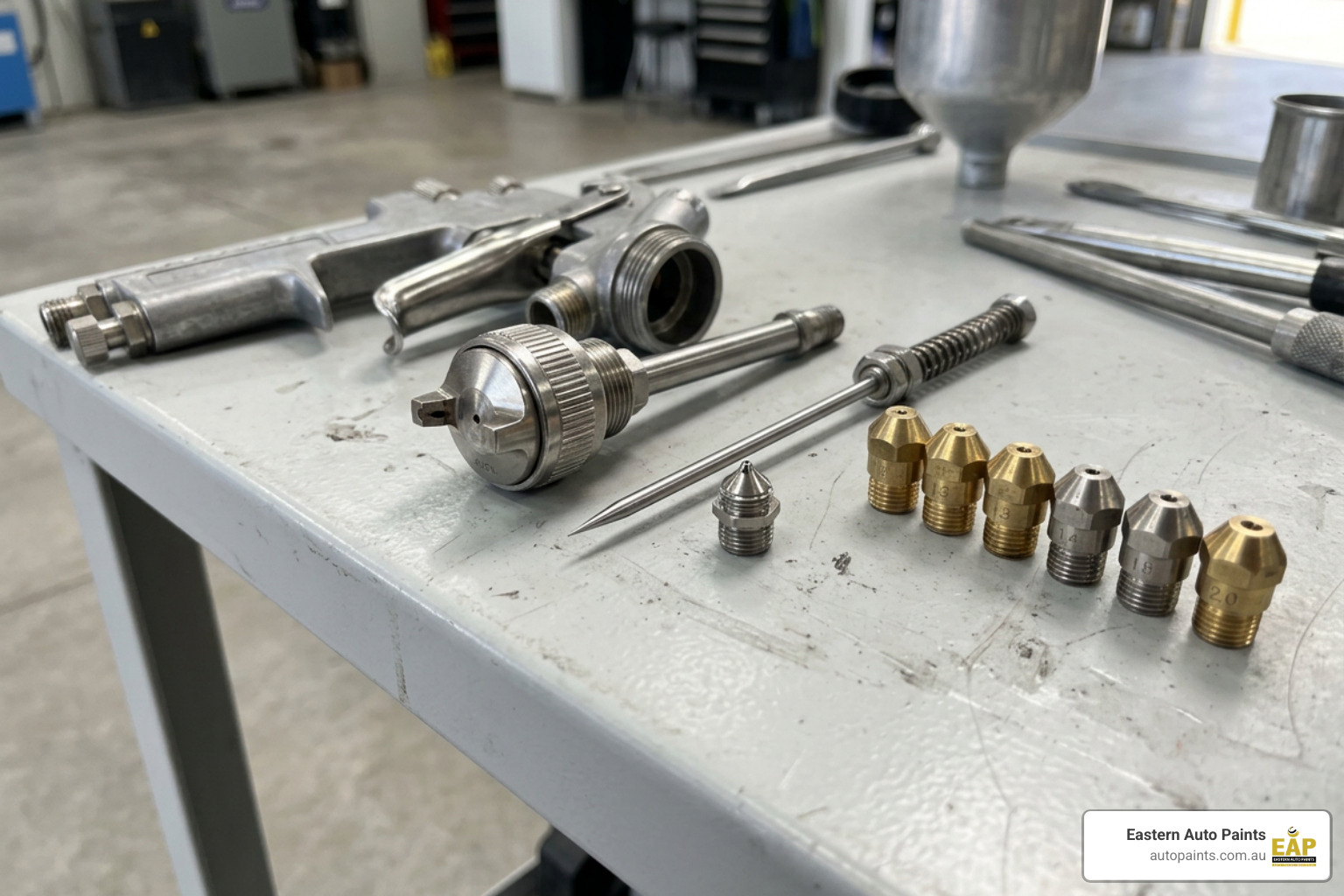
Reviewing our broader guide on Automotive Paint Tools Equipment helps map out how your fluid tips integrate with your workshop mixing and measuring processes.
Fluid Tip Selection Across Automotive Coatings
Different paint chemistries have widely varying flow characteristics and solids content. Choosing the correct nozzle diameter ensures the gun atomises properly rather than producing coarse spatter or dry orange peel.
- Fine Nozzles: Used for low-viscosity materials such as waterborne basecoats, solvent basecoats, and thin direct-gloss colours. The restricted fluid passage prevents excessive material delivery, promoting thin, even colour coats.
- Mid-Range Nozzles: The standard choice for medium-viscosity coatings, including polyurethane topcoats, standard 2K clearcoats, and wet-on-wet non-sanding sealers. They provide a steady balance of fluid delivery and atomisation energy.
- Large-Bore Nozzles: Designed for high-viscosity products, such as high-build spray putties, heavy polyester fillers, and 2K urethane primer surfacers. The wider opening allows thick materials to pass freely without requiring excessive solvent reduction.
Application and drying times vary by product; always consult the manufacturer's technical data sheet (TDS) or product label before starting for recommended fluid tip sizes and air cap operating pressures.
Replaceable Atomising Heads and Disposable Cup Systems
Recent innovations in spray equipment have introduced modular atomisation heads mounted on composite or aluminium bodies. These systems allow painters to swap the entire fluid path, nozzle, and air cap assembly in seconds.
When you'd use this:
- Rapid coating transitions: Swap from a primer head to a clearcoat head on the same gun body without cross-contamination.
- Difficult-to-clean materials: Avoid scrubbing needle packings when spraying fast-curing structural adhesives or epoxy sealers.
- Disposable paint cup integration: Pairing modular heads with disposable liner cup systems allows you to mix, filter, spray, and temporarily store paint in a single vessel.
Using sealed disposable cups also allows painters to spray consistently at any angle, even upside down when coating vehicle sills and inner arches. Integrating these cups significantly reduces the volume of gun wash required in your wash station, simplifying overall clean up and recycling management.
Essential Spray Guns and Accessories for Automotive Refinishing
A spray gun is only as effective as the air and fluid control accessories supporting it. Small pneumatic additions directly prevent hose drag, pressure drop, and contamination.

Maintaining stable delivery requires clean, regulated air. You can explore our selection of air filters and regulators to isolate moisture and dirt, while quality air tool fittings ensure secure, leak-free airline connections across your shop floor.
Choosing Spray Guns and Accessories for Basecoats and Clearcoats
When laying down topcoats, mechanical comfort and fine pressure regulation make a noticeable difference in finish consistency.
- Micro Swivels and Z-Swivels: Mounted between the gun inlet and the air hose, swivels allow full rotational movement without twisting the hose. This prevents the airline from resisting your wrist motion during continuous passes.
- Flexible Hose Whips: A short, lightweight lead-in hose segment (typically around 1 m to 1.5 m (3 ft to 5 ft)) attached directly to the gun isolates the painter's hand from the weight and stiffness of the primary shop airline.
- Digital In-Line Air Regulators: Fastened directly to the spray gun handle, digital gauges provide real-time, dynamic pressure readouts at the moment the trigger is pulled, eliminating guesswork caused by airline pressure drop.
For premium setups, advanced equipment incorporates digital pressure measurement right inside the gun handle. Browse our full range of Spray Guns and Accessories to find compatible fittings, cups, and regulators tailored to your setup.
Maintaining Spray Guns and Accessories for Long-Term Performance
Consistent spray patterns depend on clean fluid passages and undamaged air caps. Dried paint build-up around air horns distorts the spray pattern, leading to heavy centres or split fans.
- In-Gun Fluid Filtration: Always check and clean the miniature push-in mesh filters placed above the fluid tip or inside the cup feed neck to catch unmixed particulate matter.
- Seal Maintenance and Needle Packings: Periodically inspect Teflon needle seals and air valve O-rings. Replace worn seals promptly to avoid air leaks into the fluid chamber, which cause spitting.
- Gentle Air Cap Care: Never use hard steel wire or drill bits to clean blocked air cap holes. Use dedicated soft nylon brushes and wooden picks soaked in gun wash to preserve the precision-machined orifices.
- Responsible Solvent Washing: Implement a closed-loop cleaning routine to protect gun components and support workshop Solvent Waste Management.
Single Premium Units Versus Multi-Gun Starter Kits
Choosing between a single dedicated high-end spray gun and a multi-gun starter kit depends on your workshop's production workflow and finish requirements.
Multi-Gun Starter Kits (When you'd use this):
- Excellent for general restoration workshops needing separate dedicated guns for primers, basecoats, and small spot repairs without large upfront capital expenditure.
- Provides immediate setup flexibility, allowing you to keep a heavy-tip gun reserved exclusively for high-build primer while using a separate gun for colour coats.
Single Premium Units (When you'd use this):
- Built with forged aluminium or specialised composite bodies, featuring ultra-precise fluid needles and hand-matched air caps for flawless droplet uniformity.
- Essential for high-demand spray booths producing continuous commercial and custom automotive topcoats where atomisation repeatability is critical.
To help evaluate your workshop needs and compare different configurations, check out our practical advice for selecting automotive paint guns across every budget and skill level or review recommendations for the best spray guns for cars.
Workshop Safety and Air Supply Integration
High-quality spraying requires clean, dry, oil-free air delivered at constant volume. If an air compressor cannot match the air volume consumption of your chosen spray gun, line pressure will fluctuate mid-panel, causing sudden changes in atomisation and wet film thickness.
To support your spray booth operations, compare stationary and portable workshop Compressors to verify they provide sufficient airflow for both your tools and safety equipment.
When atomising isocyanates, 2K urethanes, or solvent-borne paints, personal protective equipment (PPE) is essential. Respiratory setups with clean air delivery are critical for professional applicators. Explore our protective Masks and Airlines and consult The Complete Guide to Air Fed Face Masks for Automotive and Industrial Work. Do not rely on general assumptions regarding protection; always refer to the specific coating product label/TDS and relevant SafeWork or WorkSafe guidance for appropriate PPE requirements.
Why This Issue Should Not Be Ignored
Using an incorrect spray gun type or neglecting proper accessory setup creates compounding defects across your paint process. Mismatched fluid tips cause over-thinning or severe orange peel, while poor air regulation leads to patchy metallic orientation and cloudy clearcoats.
Addressing your spray setup upfront eliminates unnecessary sanding, re-clearing, and costly material waste, ensuring that your prep work translates into a clean, durable topcoat every time.
Common Symptoms, Challenges, or Questions
Refinishers often face recognisable issues when their spray guns and accessories are out of balance:
- Heavy Centre or Split Spray Fan: Indicates an imbalance between atomising air pressure and fluid flow, or a partially blocked air horn.
- Gun Spitting and Pulsing: Caused by loose fluid tips, damaged needle packing seals, or inadequate venting in the paint cup.
- Excessive Dry Spray and Overspray Fog: Often the result of excessive air cap pressure, holding the gun too far from the panel, or using a standard high-pressure gun where an HVLP unit is appropriate.
- Rapid Painter Fatigue: Caused by stiff, unyielding air hoses and lack of swivel fittings on long commercial spray cycles.
What a Personalised Experience Actually Looks Like
At Eastern Auto Paints, we treat equipment selection as a custom configuration tailored to your workshop layout, compressor capacity, and the specific coatings you spray.
When you speak with our team, we assess your complete air delivery chain from compressor output and filter stages down to nozzle gauge and cup adapters. Whether you need a compliant gun for laying high-solids clearcoats in Melbourne or an industrial airless setup for protective coatings, we provide direct technical guidance to ensure your tools work seamlessly together.
The Value of Consistency and an Ongoing Relationship
Achieving predictable, repeatable refinish quality requires consistent equipment performance and reliable consumable supply. Developing an ongoing relationship with an expert paint supplier ensures you always have access to genuine replacement fluid needles, air caps, and matching seal kits when maintenance is due.
As coating formulations evolve, having trusted support helps you refine spray pressures, adjust reduction techniques, and keep your workshop performing at its best.
What to Expect at Eastern Auto Paints
When partnering with Eastern Auto Paints across our Victorian branches in Bayswater and Dandenong South, or online throughout Australia, you can expect:
- Expert Technical Support: Real-world knowledge on matching gun types, fluid tips, and pressures to specific paint systems.
- Advanced Colour-Matching Technology: State-of-the-art spectral matching for complete refinish accuracy.
- Comprehensive Product Range: Direct access to premium spray guns, airless equipment, filtration systems, and spray accessories.
- Workshop Equipment Integration: Guidance on pairing spray tools with compatible Workshop Equipment for maximum operational efficiency.
When to Get in Touch or Take Action
If you are experiencing inconsistent atomisation, upgrading your shop air lines, or selecting a dedicated spray gun for an upcoming vehicle restoration, our team is ready to assist.
Reach out to our specialists via our Contact Us page or visit our trade counters in Bayswater and Dandenong South to discuss your equipment requirements.
Discover our full collection of professional Spray Equipment, explore our dedicated range of Spray Guns and Accessories, upgrade your workshop with reliable Compressors, and safeguard your team with certified Masks and Airlines and complete Workshop Equipment. We look forward to supporting your next refinishing project with the right tools, coatings, and practical advice.
Frequently Asked Questions About Spray Guns and Accessories
What is the primary operational difference between HVLP and compliant RP spray guns?
HVLP spray guns operate by passing a high volume of air at low air cap pressure, which creates a softer spray pattern that reduces overspray and improves transfer efficiency on basecoats. Compliant or reduced pressure (RP) spray guns operate with slightly higher cap pressure, generating greater atomisation energy to break up high-solids clearcoats with faster pass speeds while remaining compliant with environmental transfer standards.
How do disposable cup systems improve paint booth productivity?
Disposable cup systems allow painters to mix, filter, and spray coatings out of a single lined container, eliminating the need to transfer paint between mixing cups and gun pots. They enable multi-angle spraying without air leaks and significantly cut down the time and solvent volume required to clean the gun fluid passage between colour changes.
When should an airless hose whip or swivel joint be added to a setup?
An airless hose whip or swivel joint should be added whenever you are tackling extensive spraying sessions or intricate parts with complex angles. The swivel allows the gun to rotate freely without fighting hose tension, while the flexible whip hose isolates your wrist from the stiffness of the main fluid line, reducing operator fatigue and preventing uneven spray passes.
How do I know when it is time to replace a spray gun fluid tip or needle?
A fluid tip and needle set should be replaced when you notice fluid leaks from the nozzle when the trigger is released, visible scoring or grooving on the needle taper, or distorted spray patterns that persist after thorough cleaning. Keeping needle packings adjusted and using soft cleaning tools helps prolong nozzle service life.
What is the best way to prevent moisture contamination in spray lines?
Preventing moisture contamination requires a multi-stage air filtration system positioned downstream from your compressor, combined with regular tank draining. Adding a dedicated filter-regulator with coalescing elements near the spray booth entrance removes condensed water, oil vapour, and particulates before the air reaches your spray gun.