
Choosing Your Canvas: Understanding Automotive Paint Primer Types
Why Choosing the Right Primer Makes or Breaks Your Paint Job
Automotive paint primer types are the foundation of every successful paint job. Whether you're doing a small touch-up or a full restoration, the right primer ensures your finish lasts for decades, while the wrong one can lead to peeling, flaking, or rust within months.
A quality primer performs three critical jobs: it ensures paint adhesion, protects the metal from corrosion, and creates a smooth, uniform canvas for your topcoat. Skipping this step or choosing the wrong product can cause bubbling, cracking, and visible imperfections, ultimately costing you more time and money.
Here are the main types of automotive primers and their primary purposes:
| Primer Type | Primary Function | Best Used On |
|---|---|---|
| Epoxy Primer | Maximum corrosion resistance and adhesion | Bare metal, fiberglass, body filler |
| Urethane Primer (High-Build) | Fills imperfections and sands smoothly | Over epoxy or etch primer, body filler repairs |
| Etch Primer | Chemically bonds to bare metal | Bare steel, aluminium, galvanised surfaces |
| Primer Sealer | Creates uniform surface and prevents bleed-through | Over primer/filler before basecoat |
With over 30 years of experience with coatings technology at Eastern Auto Paints, I've seen how the correct automotive paint primer types transform a project from mediocre to exceptional. Understanding what each type does is the key to a professional result.
The Foundation of a Flawless Finish: Why Primer is Non-Negotiable
Think of primer as the foundation of a house; you wouldn't build on bare dirt and expect it to last. Primer is the bedrock of your paint job, handling adhesion, corrosion resistance, and surface preparation all at once. Skipping it is one of the costliest mistakes you can make, as cutting corners on prep always costs more in the long run.
A quality primer creates the ideal conditions for your topcoat to deliver a finish that not only looks stunning but also stands up to Australia's harsh sun and daily wear. Our practical guide to choosing auto paint primers can help you steer the selection process.
The Critical Roles of an Automotive Primer
Here's a breakdown of what primer does for your paint job:
- Adhesion Promotion: Primers are formulated to create a strong chemical bond with the substrate, whether it's bare metal, old paint, or body filler. This bond prevents your topcoat from peeling or flaking off.
- Corrosion Protection: Epoxy and etch primers form a protective barrier that seals metal from moisture and oxygen, preventing rust. This is essential in Australia's varied climates. For existing rust issues, see our beginners guide to rust repair and prevention.
- Surface Filling: High-build primers have the thickness to fill minor sand scratches and surface irregularities. When sanded, they create a perfectly level surface, which is key to a professional-looking finish.
- Colour Uniformity & Chemical Barrier: Primer provides a consistent base colour, preventing the underlying surface from affecting your final shade. It also acts as a chemical barrier, stopping strong solvents in the topcoat from attacking previous layers.
What Happens if You Skip Primer?
Skipping primer leads to predictable and expensive problems:
- Poor Adhesion & Paint Failure: Without primer's bond, paint will eventually bubble, crack, or peel away. A small stone chip can quickly become a peeling disaster.
- Visible Imperfections: Every sand scratch and tiny pit will be highlighted by a glossy topcoat. The prep work, including primer, is what makes a finish look flawless.
- Rust Formation: Bare metal exposed to moisture will rust. Once it starts under your paint, it spreads invisibly, lifting the paint and causing significant damage.
- Increased Costs and Wasted Time: Redoing a failed paint job means stripping everything back and starting over. This doubles the work, materials, and frustration. If you need to strip failed paint, our guide to understanding car paint strippers explains your options.
A Deep Dive into the Main Automotive Paint Primer Types
Automotive primers can be grouped into three main categories: direct-to-metal primers (for bare metal), surfacers (for filling and smoothing), and sealers (for unifying the surface before paint). Understanding which you need is the first step to a professional finish. At Eastern Auto Paints, we stock a comprehensive range of primers and fillers and can offer personalised advice for your project.
Epoxy Primer: The Ultimate Barrier
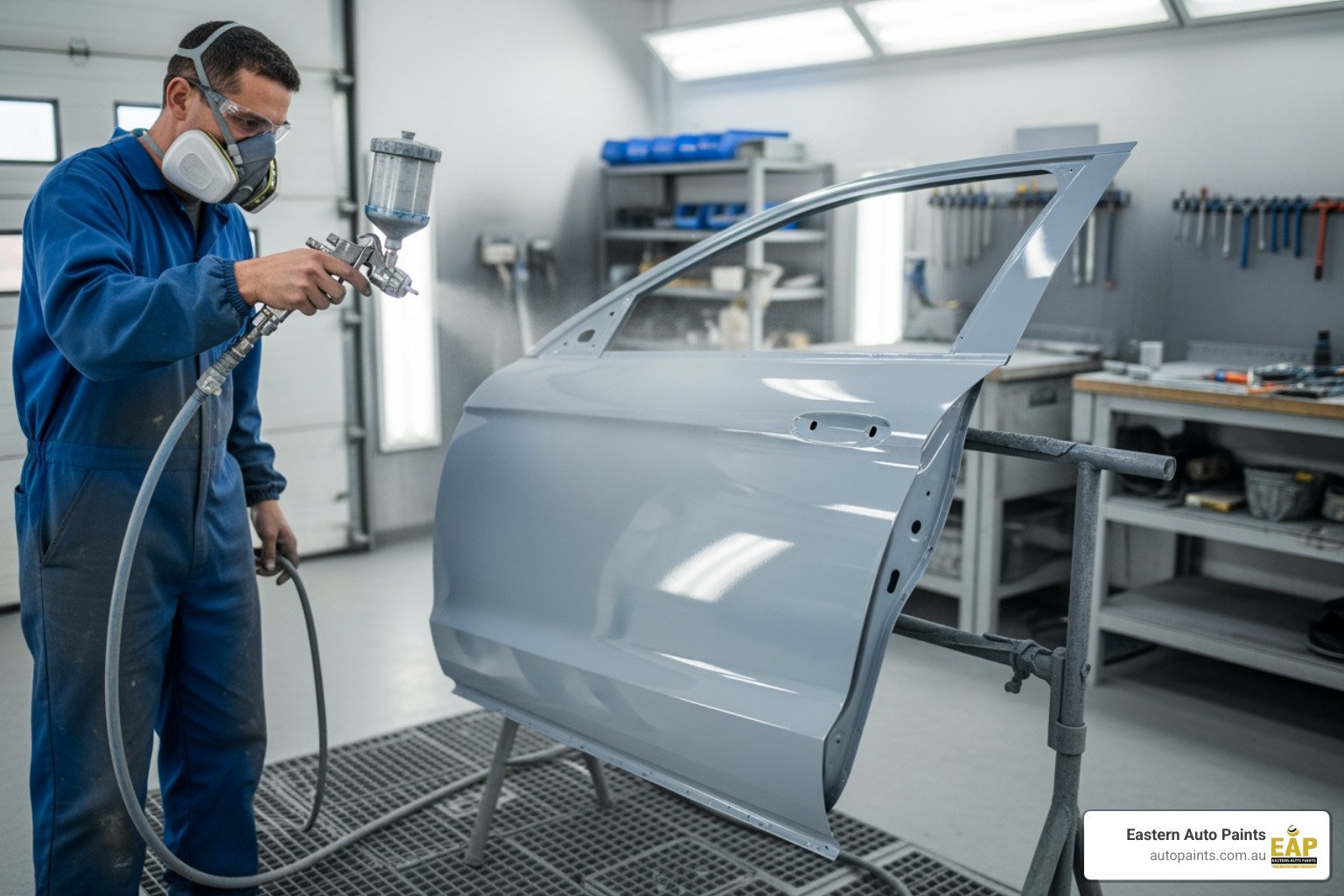
Epoxy primer is the gold standard for corrosion protection and adhesion, making it the top choice for full restorations. As a two-component (2K) product, it cures into a hard, non-porous barrier that moisture and oxygen cannot penetrate, stopping rust before it starts. It forms an incredibly strong bond to bare metal, fiberglass, and body filler.
While it offers superior protection, epoxy primer is not designed for significant filling and can be harder to sand than urethane surfacers. It must also be topcoated or covered with a surfacer, as it can degrade with prolonged UV exposure. If you miss the manufacturer's recoat window, you must scuff the surface before applying the next coat. For a detailed look, see The Guide to Epoxy Primer Paint for Cars.
Urethane Primer (Surfacer/High-Build): The Master of Smoothness
When a glass-smooth surface is the goal, urethane primer surfacer is the answer. These 2K high-build primers are designed to fill minor imperfections like sand scratches and small dings. Their main advantage is their excellent sandability, allowing you to block sand panels to a perfectly flat finish, which is essential after bodywork.
Urethane surfacers are ideal for levelling panels and creating seamless transitions from body filler to metal. However, most do not offer the corrosion resistance of epoxy and are not recommended for direct-to-metal application. The correct process is to apply a urethane surfacer over a direct-to-metal primer like epoxy. After using body fillers, a urethane surfacer like EPO Epotec Primer Surfacer is the next step to refine your repair. Learn more with our guide on how to bodyfiller like a pro.
Etch Primer: The Adhesion Specialist for Bare Metal
For maximum adhesion to bare metal, especially tricky surfaces like aluminium or galvanised steel, etch primer is the specialist tool. It contains phosphoric acid that chemically "bites" into the metal, creating a microscopic profile for an exceptionally strong bond. This makes it perfect for freshly sanded steel panels and spot repairs.
Many etch primers also contain zinc for added corrosion protection and dry quickly, speeding up repair times. However, they are very thin and offer no filling capabilities. Their sole job is adhesion. You should follow an etch primer with a urethane surfacer to smooth the surface. We offer excellent options like Concept 103 Etch Primer and Protec PPG Grey/Black Etch Primer. Check out our etch primers here.
Primer Sealer: The Perfect Unifying Coat
Applied just before your colour coat, a primer sealer creates the perfect canvas for your paint. It's a thin, non-sanding layer that serves two main purposes: it creates a uniform surface colour and prevents bleed-through from underlying layers. This is especially useful when painting light colours over patchwork repairs.
Many sealers are designed for a time-saving wet-on-wet application, where you apply the basecoat directly after the sealer flashes off, without sanding. This isolates previous layers from the topcoat's solvents, ensuring compatibility. Sealers have no filling properties; all smoothing must be done beforehand. Once your surface is sealed, you're ready for one of our top coats.
How to Choose the Right Primer for Your Project
Selecting the correct automotive paint primer types depends on the surface material, the type of repair, and your desired finish. Making the right choice sets you up for a durable, professional result, while the wrong one can lead to failure. If you're ever in doubt, don't hesitate to contact our experts for personalised advice.

Matching Primer to the Surface: A Critical First Step
The substrate you're painting dictates your primer choice:
- Bare Metal: For maximum corrosion protection on full restorations, epoxy primer is the best choice. For spot repairs on steel or aluminium, an etch primer (like Concept 103 Etch Primer or Protec PPG Grey/Black Etch Primer) provides an excellent chemical bond.
- Fiberglass: Epoxy primer offers a strong bond and protective barrier. For significant surface irregularities, a high-build polyester primer may be needed.
- Body Filler: After shaping and sanding body fillers, apply epoxy primer to seal the filler, followed by a urethane surfacer to fill pinholes and sand scratches for a perfectly smooth finish. Our guide on how to bodyfiller like a pro has more details.
- Old Paint: If the existing paint is in good condition, you can scuff it and apply a urethane surfacer to smooth imperfections or a primer sealer to create a uniform base for your new colour.
- Plastic: Standard primers won't stick. You must start with a plastic adhesion promoter before applying a compatible flexible primer.
Understanding 1K vs. 2K Automotive Paint Primer Types
- 1K Primers: These are single-component products that air-dry. They are convenient for small repairs and are often found in aerosol cans. While easy to use, they offer less durability and chemical resistance than 2K products. Shop 1K Primers for your smaller projects.
- 2K Primers: These professional-grade products consist of a primer base and a hardener. The chemical reaction creates a far more robust, durable, and chemical-resistant finish. Epoxy and urethane primers are typically 2K. They require precise mixing and have a limited pot life once activated. Proper safety equipment, like an Air Fed Mask, is essential when spraying 2K products containing isocyanates. Shop 2K Primers for professional results.
How Primer Colour Impacts Your Final Topcoat
The colour of your primer affects the final appearance and coverage of your topcoat:
- White and Light Grey Primers: Use under bright, vivid colours like yellows, reds, and pastels to help them achieve their true hue with fewer coats.
- Dark Grey and Black Primers: Ideal for deep, rich colours like dark blues and metallics. They provide opacity, helping you achieve full coverage faster.
- Neutral Grey Primers: Versatile options that work well under most colours. They can often be tinted to a "value shade" that closely matches your topcoat, ensuring a uniform finish. Our colour matching services can help you select the perfect primer shade.
Environmental Factors: Temperature and Humidity
Temperature and humidity significantly affect how primers dry and cure. Most products work best between 16°C (60°F) and 35°C (95°F). A key guideline is the 15-degree rule: for every 8°C (15°F) change in temperature, a 2K product's pot life and dry time can be halved (if hotter) or doubled (if colder). High humidity can also slow drying and cause issues. Always consult the manufacturer's technical data sheet (TDS) for specific application requirements. To control your workshop environment, consider professional workshop equipment like our range of Anest Iwata compressors.
Frequently Asked Questions about Automotive Paint Primer Types
What is the best all-around primer for a full car restoration?
For a full restoration, epoxy primer is the gold standard. It provides the best foundation due to its exceptional corrosion resistance and strong adhesion to bare metal, fiberglass, and body filler. It creates a sealed, non-porous barrier that locks out moisture and prevents rust. While epoxy provides protection, it's not for filling imperfections. For a perfectly smooth surface, you should apply a high-build urethane surfacer over the cured epoxy primer. This combination gives you the ultimate in protection and finish. Our practical guide to choosing auto paint primers offers more detail.
Can I put a high-build primer directly over bare metal?
Generally, no. Most high-build urethane primers are designed to fill and sand smoothly, but they lack the specific chemical properties needed for strong adhesion and corrosion resistance on bare metal. Applying them directly to metal can lead to future rust and adhesion failure. The correct procedure is to first apply a dedicated direct-to-metal primer, such as an epoxy primer for barrier protection or an etch primer for a chemical bond. Once that layer is cured, you can apply your high-build primer on top to level the surface. If you're unsure, contact our team for guidance.
Do I need to sand primer before painting?
This depends entirely on the primer type and the manufacturer's 'recoat window' specified on the technical data sheet (TDS).
- High-build surfacers are designed to be sanded. Block sanding them creates the perfectly flat surface required for a professional finish.
- Primer sealers are often applied 'wet-on-wet', meaning you apply the basecoat shortly after the sealer flashes off, with no sanding required.
Crucially, if you exceed the recoat window for any primer (epoxy, urethane, or sealer), you must scuff or sand it before applying the next coat. This creates a mechanical key for the next layer to adhere to, preventing delamination. Always read the TDS for your specific product.
Start Your Project with the Right Foundation
Choosing the right automotive paint primer types is the most important step in ensuring your paint job looks great and lasts for years. Each primer, from epoxy and urethane to etch and sealer, plays a specific role in adhesion, corrosion protection, and creating a flawless surface. Getting this foundation right is the difference between a professional result and a costly failure.
At Eastern Auto Paints, we've spent over 34 years helping enthusiasts and professionals select the perfect products. We have the knowledge to guide you through every step, ensuring you get the right foundation for a finish that shines.
Don't leave this critical step to guesswork. Explore our complete range of primers or contact our team today for personalised recommendations for your project.