
Don't Let the Sun Steal Your Shine: Best UV Clear Coats
Why UV Degradation Should Not Be Ignored in Automotive Refinishing

Selecting a high-solids two-pack (2K) acrylic urethane or 2K polyurethane UV resistant top coat protects exterior automotive panels from premature gloss loss, photo-oxidative yellowing, micro-cracking, and delamination caused by severe solar exposure. While an unshielded or poorly protected finish quickly dulls and chalks under ultraviolet radiation, a premium clear coat containing ultraviolet absorbers (UVA) and hindered amine light stabilisers (HALS) preserves the basecoat colour and maintains a durable, high-gloss shine.
Key Takeaways
- Photo-Oxidation Defence: Specialised UVA and HALS additives neutralise destructive free radicals and convert UV radiation into harmless thermal energy.
- Resin Selection: Two-pack acrylic urethanes provide exceptional surface hardness, while 2K industrial polyurethanes deliver high impact flexibility for commercial fleets.
- Application Integrity: Achieving correct film thickness and allowing proper flash-off intervals prevents solvent entrapment, die-back, and clear coat peeling.
- Trade Resources: Refer to our 2K Clear Coat Ultimate Guide 2026 to explore how different resin formulations perform under demanding exterior service conditions.
At Eastern Auto Paints (EAP), we supply professional vehicle refinishers, panel shops, and automotive restorers across Victoria with trade-grade coatings, direct-gloss finishes, and custom spray solutions. Operating from our branches in Bayswater and Dandenong South, our team supports workshops throughout Melbourne with expert product selection and reliable coating systems.
We combine advanced colour-matching technology with hands-on trade advice to ensure every refinish project achieves lasting UV durability and superior aesthetic results.
Common Challenges and Performance Comparison of UV Resistant Top Coat Systems
Choosing the right clear coat requires balancing exterior durability, chemical resistance, working times, and equipment demands.
| Coating Chemistry | Key Mechanical Strengths | Chemical & Solvent Resistance | Weather & Sunlight Durability | Typical Trade Application |
|---|---|---|---|---|
| 2K Acrylic Urethane | High surface hardness, excellent scratch resistance | Exceptional against fuel, solvents, and environmental fallout | Superior long-term gloss retention with minimal yellowing | Commercial vehicle refinishing, panel shops, custom builds |
| 2K Polyurethane | High structural flexibility, strong impact toughness | Outstanding chemical and marine splash resistance | High durability in harsh exterior environments | Fleet transport, heavy equipment, industrial machinery |
| 1K Acrylic Clear | Fast dry-to-touch, simple single-part process | Moderate resistance to mild cleaners and fuels | Moderate durability; best for light exposure | Minor spot repairs, light interior or sheltered metalwork |
Trade applicators often face distinct job requirements. Understanding the operational strengths of each system ensures predictable results on every panel:
Strengths of Two-Pack (2K) Acrylic Urethanes
Two-pack acrylic urethane coatings cure through a chemically induced cross-linking mechanism between acrylic polyols and aliphatic isocyanate hardeners. When fully cured, they form a dense, glassy network with exceptional optical clarity. These coatings provide high resistance to marring, stone chips, chemical exposure, and prolonged solar weathering, making them the standard choice for full automotive resprays and fleet refinishing.
Strengths of Two-Pack (2K) Industrial Polyurethanes
Industrial polyurethanes emphasise elasticity and robust adhesion over various industrial primers. Formulated for heavy equipment, trailers, and commercial utilities, these systems excel at resisting mechanical vibration, stone impacts, and aggressive chemical contact while maintaining high exterior weather stability.
Strengths of Single-Pack (1K) Clears
Single-pack acrylic clears cure purely through solvent evaporation without a chemical cross-linking agent. They require no mixing with hardeners, eliminate pot life concerns, and provide an accessible solution for quick component touch-ups or non-critical repairs where simplified spray setups are needed.
System Decision Guide
- Passenger Car & Custom Automotive Refinishing: Use a high-solids 2K acrylic urethane clear coat for optimal gloss depth and maximum longevity under direct sun exposure.
- Commercial Fleets & Heavy Equipment: Choose a flexible 2K industrial polyurethane top coat to withstand stone deflection, constant chemical washdowns, and exterior site exposure.
- Quick Component Repairs & Light-Duty Metalwork: Choose a 1K acrylic clear when rapid turnaround and single-part convenience outweigh demands for heavy chemical resistance.
For further comparisons across different refinishing formulations, consult our guide to automotive clearcoats.
Chemistry Differences in Every UV Resistant Top Coat System
The protective longevity of a clear coat depends on its additive chemistry and resin backbone:
- UV Absorbers (UVA): These organic molecules absorb destructive UV-A and UV-B wavelengths, converting the radiation into harmless thermal energy before it penetrates deeper layers.
- Hindered Amine Light Stabilisers (HALS): Rather than absorbing light, HALS act as regenerative free-radical scavengers. They bond with radicals generated during photo-oxidation, halting the chain reaction that degrades the polymer backbone.
- Aliphatic vs Aromatic Isocyanates: Premium automotive clears utilise aliphatic isocyanate cross-linkers, which remain stable under UV exposure and resist yellowing. Aromatic curing agents are generally reserved for primers or indoor applications because they rapidly discolour under sunlight.
Formulations such as Concept MS 22 2K Acrylic Urethane Clear Coat and Protec Paraglaze Ultrafinish Clearcoat incorporate balanced HALS and UVA additive packages designed for demanding exterior service conditions.
Applying a UV Resistant Top Coat Over Epoxy Primers and Basecoats
Epoxy primers provide superior anti-corrosion protection and mechanical adhesion over bare metals, but epoxy resins degrade and chalk rapidly when exposed to direct sunlight. Applying an aliphatic UV-stable clear coat or direct gloss topcoat seals the underlying epoxy against solar radiation.
When applying clear coats over solvent-borne basecoats or epoxy substrates, proper intercoat adhesion and flash-off times are critical. Allowing the basecoat or primer to release its solvent tail prevents solvent entrapment, die-back, and micro-blistering. For bare metal fabrications requiring a transparent, corrosion-inhibiting layer, direct-to-metal clears like Concept 701 2K Metal Clear provide strong adhesion and environmental protection. For detailed substrate preparation instructions, see our guide on how to prepare your panel for painting.
Professional Application Protocols and Environmental Controls
Achieving an unblemished, durable finish requires precise environmental management, proper gun configuration, and strict adherence to technical instructions. Application parameters vary between products; always consult the manufacturer's technical data sheet (TDS) or product label before starting any job.
Environmental Parameters
- Temperature: Ambient booth and panel temperatures must be monitored closely. Cooler conditions slow cross-linking and increase solvent pop risks, whereas excessive heat accelerates surface skinning, trapping active thinners.
- Relative Humidity: High humidity can cause isocyanate hardeners to react with airborne moisture rather than the polyol resin, leading to micro-foaming, hazing, or reduced chemical resistance.
- Airflow and Filtration: Controlled downdraft or crossflow air movement ensures uniform solvent extraction across the vehicle body.
For systematic application techniques, read our technical overview on auto paint application and best practices for applying clear coats. Facilities prioritising lower emissions can implement high-solids systems such as HS 2K Eurolak Clear 3-1 Low VOC alongside standard low VOC refinish protocols.
Personal Protective Equipment (PPE)
Two-pack coatings contain active isocyanates and volatile organic compounds (VOCs). Always consult the product label, technical data sheet, and relevant WorkSafe guidelines to select appropriate personal protective equipment (PPE), including suitable respiratory protection, eye protection, and impervious chemical overalls.
Curing Profiles, Film Thickness, and Coverage
Clear coat durability depends on achieving the correct dry film build specified by the manufacturer. Insufficient film thickness reduces UV screening capacity, while excessive film build can lead to solvent entrapment, pinholing, and reduced chip resistance.
Drying and curing schedules depend on ambient conditions, airflow, and hardener selection. Forced curing methods, such as bake cycles or infrared emitters like the JV3 Velocity Infrared Drying Head, accelerate cross-linking to speed up shop turnaround. High-solids formulations like Concept HS Pro Clear 3-1 deliver efficient coverage rates and robust film builds per coat. Refer to the manufacturer's TDS for exact mix ratios, pot life limitations, flash intervals, and recommended film thicknesses.
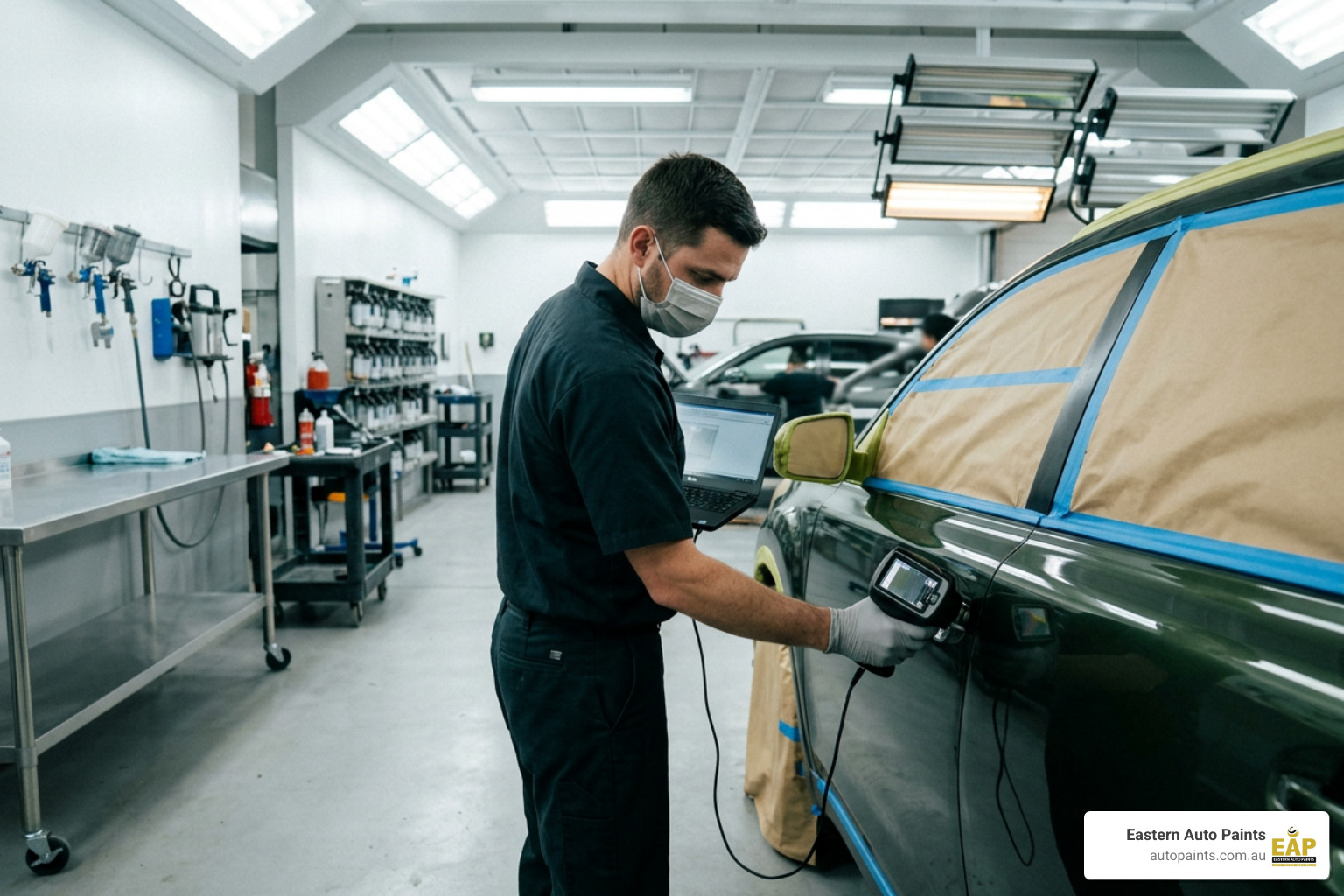
What to Expect at Eastern Auto Paints for Trade Refinish Solutions
At Eastern Auto Paints, we support professional refinishers, fleet managers, and vehicle restorers across Victoria with dedicated technical support and trade-grade supplies.
- Advanced Colour-Matching Technology: Our branches in Bayswater and Dandenong South use precision spectrophotometers to ensure seamless basecoat colour matches for domestic vehicles, imports, commercial fleets, and industrial equipment.
- Extensive Trade Inventories: We stock high-performance 2K clear coats, direct-gloss topcoats, epoxy primers, and spray equipment tailored for workshop use.
- Technical Product Consultation: Our experienced staff assist in selecting compatible primer, basecoat, and topcoat systems suited to your workshop environment and curing capabilities.
- Specialised Aerosol Solutions: For localised repairs, minor panel touch-ups, or prototyping, we pack professional-grade paints and clears into custom aerosols.
Discover our full scope of refinish products through our dedicated paint and industrial supply departments, or visit our Colour Matching page to learn how we reproduce exact fleet and automotive colours.
If you have questions about clear coat compatibility, spray setups, or application techniques, please contact our team for trade advice. We are here to help you achieve a clean, high-gloss, and weather-resistant finish.
Frequently Asked Questions About UV Protective Coatings
How does a UV top coat prevent yellowing and gloss loss on clear finishes?
A UV clear coat relies on a combination of aliphatic resin binders, ultraviolet absorbers, and hindered amine light stabilisers. The aliphatic chemistry resists chemical breakdown under sunlight, while the chemical absorbers convert UV radiation into low-level thermal energy. Simultaneously, the stabilisers intercept and neutralise free radicals formed during photo-oxidation, preserving optical clarity, gloss depth, and flexibility over time. Additional identification methods can be reviewed in our article on 5 practical ways to identify types of clearcoat.
Can 2K UV clear coats be applied directly over bare metals or composite substrates?
Certain specialised two-pack clear coats are formulated with direct-to-metal adhesion promoters to bond directly to clean, profiled steel, aluminium, brass, or carbon fibre. Products such as Concept 760 1K Metal Clear or specialised options in trade factory topcoat ranges seal bare substrates against oxidation while showcasing raw metal grain. Standard automotive clear coats, however, require a compatible basecoat or adhesion-promoting primer; always verify substrate compatibility on the product technical data sheet.
What maintenance routine is recommended for high-exposure clear-coated panels?
Preserving the gloss and UV-blocking integrity of clear-coated panels requires regular cleaning with pH-neutral automotive washes to remove corrosive road grime, bird droppings, and tree sap before they etch the resin. Periodic application of quality waxes or paint sealants provides an extra sacrificial barrier against environmental contamination. If minor micro-scratching or oxidation appears, light machine polishing followed by a protective sealant restores surface gloss without compromising film build.
What is the difference between 1K and 2K UV clear coats?
Single-pack clear coats dry through solvent evaporation, leaving behind a thermoplastic resin film that can soften when exposed to strong automotive thinners or fuels. Two-pack clear coats use a chemical hardener containing isocyanates that chemically cross-links with the acrylic resin. This chemical reaction creates a hard, thermoset matrix that offers significantly greater resistance to fuels, stone abrasion, and long-term solar degradation.
Can an automotive UV clear coat be applied over fully cured epoxy coatings?
Yes, applying an aliphatic 2K clear coat over an epoxy base is standard trade practice to shield the epoxy from sunlight degradation. Because epoxy naturally chalks and discolours when exposed to UV radiation, topcoating it creates a durable weather barrier. The cured epoxy surface must be mechanically scuffed to create an adequate anchor profile, followed by thorough degreasing before clear coat application.
Why do some clear coats crack or peel after prolonged sun exposure?
Delamination and micro-cracking occur when a clear coat reaches the end of its service life or was applied improperly. Insufficient dry film thickness leaves the coating with inadequate UV stabilisers to resist solar radiation, leading to resin embrittlement. Improper surface preparation, incorrect flash-off times between coats, or painting outside recommended temperature parameters can also undermine intercoat adhesion, causing the clear coat to flake away from the basecoat.